 to reduce shipping costs](https://file-host.link/website/bluebonnetmedicalsupplies-l0duvz/assets/blog-images/7b21b8d5-0206-4634-91be-4343d910abce/1774816922711532_a495f2b6ab2c4ee3be178b453cbf40b8/360.webp)
Introduction
Shipping costs are one of the biggest line items for medical product businesses—often accounting for 15-25% of total fulfillment expenses. Distributing inventory across multiple US warehouses is frequently presented as the solution, but whether it actually saves money depends heavily on how it's done.
Many businesses add a second or third warehouse expecting immediate savings, only to discover that storage minimums, inbound freight, and operational complexity exceed the outbound shipping reduction.
This guide walks through the exact steps to split inventory across US warehouses, the key data inputs required, the variables that drive results, and the mistakes that cause costs to rise instead of fall. For medical product businesses, the decision is further complicated by FDA, GMP, and ISO compliance requirements that must be verified at every warehouse location before stock arrives.
TL;DR
- Splitting inventory works best when your customer base is geographically spread and order volume exceeds 500–1,000 monthly shipments
- Start with top-velocity SKUs and highest-cost shipping zones, not your entire catalog
- Every warehouse must meet FDA, GMP, and relevant compliance standards before receiving medical products
- Use 12 months of order data to guide location decisions, not gut instinct
- Low-volume operations often save just as much with a single centrally located, compliant 3PL that has negotiated carrier rates
Step 1: Analyze Your Order Data and Customer Geography
Pull at least 12 months of fulfilled orders and map customer delivery locations by state and zip code. Aim for 12 to 36 months when possible — shorter windows can miss seasonal demand swings and product lifecycle patterns that affect where stock needs to be.
Key metrics to calculate:
- Current average shipping zone per order
- Which lanes (East-to-West cross-country shipments) drive the highest carrier charges
- Which SKUs generate the most orders and from which regions
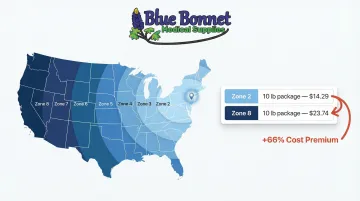
For example, if 40% of your orders ship to California but your warehouse is in New Jersey, you're paying Zone 7-8 rates on nearly half your volume. A 10 lb package costs $14.29 to ship to Zone 2 but jumps to $23.74 for Zone 8 under standard UPS rates—a 66% increase.
Once you've identified where your orders concentrate — whether that's the Southeast, Pacific Coast, or the upper Midwest — you have the foundation to evaluate which warehouse locations would actually reduce your average shipping zone. That analysis drives everything in the steps that follow.
Step 2: Identify Which Products to Distribute and to Which Locations
Apply ABC Velocity Analysis
Not every SKU belongs in every warehouse. Use the Pareto principle to classify inventory:
| Classification | % of Total SKUs | % of Cumulative Value | Distribution Strategy |
|---|---|---|---|
| A-Items | 10-20% | 70-80% | Stock at all warehouse nodes |
| B-Items | 20-30% | 15-25% | Stock at two or more nodes based on regional demand |
| C-Items | 50-70% | 5-10% | Consolidate at a single location to avoid fragmented safety stock |
With your SKUs classified, the next decision is which orders those nodes should prevent from splitting.
Prevent Split Shipments Through SKU Co-location
Identify SKU pairs that are frequently ordered together (at least 20% co-order rate) and ensure they are co-located at the same nodes. When co-ordered products live in different warehouses, every multi-item order generates a split shipment with its own pick, pack, and carrier cost.
Fulfilling a single order from two separate nodes incurs a $6 to $18+ penalty — duplicated base parcel rates, extra pick/pack fees, and redundant packaging add up fast. If 15% of your orders split across warehouses, you're multiplying fulfillment costs on a significant share of your volume.
Verify Compliance Requirements
Distribution decisions don't end with velocity and co-location — for medical products, regulatory fit determines where a SKU can go before you decide where it should go. Confirm which SKUs carry special handling, temperature, or compliance requirements, then verify that each target warehouse is equipped and certified to store them. A non-compliant facility creates regulatory exposure that no shipping cost savings can offset.
Step 3: Select Warehouse Locations Strategically
Evaluate Geographic Coverage Across Core Zones
A standard 2-node configuration places one facility on the East Coast (Pennsylvania or New Jersey) and one on the West Coast (Nevada or California). A 3-node network adds a Central US location (Texas) to push 2-day ground coverage to over 95% of the population.
Start by mapping your customer base to identify which two or three locations would eliminate the most high-zone shipments. The goal is reducing average zone per order — but only warehouses placed where your customers actually are will move that number.
Factor in Inbound Freight Costs
A warehouse near your customers but far from your supply source can raise inbound freight enough to cancel out outbound savings. Splitting inventory means manufacturers must send LTL/TL shipments to multiple facilities, which erodes economies of scale.
In one modeled scenario, adding a second warehouse saved $7,000 in outbound shipping — but added $48,000 across duplicated storage, inbound freight, and labor. Always calculate full landed cost, not just parcel savings.
Verify Compliance at Each Location
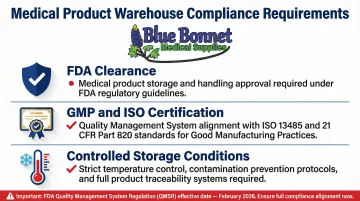
Effective February 2, 2026, the FDA's Quality Management System Regulation (QMSR) harmonizes 21 CFR Part 820 with ISO 13485, strictly enforcing manufacturer responsibility for 3PL storage, handling, and traceability. Every warehouse in your network must clear these requirements before you commit inventory:
- FDA clearance for medical product storage and handling
- GMP compliance and relevant ISO certification
- Appropriate controlled storage conditions for your product type
For medical supply businesses weighing complexity against cost, a single compliant facility can cover a surprising share of the country. Bluebonnet Medical Supplies, based in Cedar Park, Texas, holds FDA clearance, ISO and GMP compliance, and direct carrier relationships for discounted rates — worth modeling against a multi-node setup before committing to additional locations.
Step 4: Set Inventory Allocation Rules and Rebalancing Processes
Establish Minimum Stock Thresholds
Set minimum stock levels at each location for your A and B-velocity SKUs, sized to cover regional demand plus a safety buffer without over-investing in slow-moving stock. The Square Root Law of Inventory shows that as you increase warehouse locations, required safety stock increases by the square root of the number of locations—doubling your nodes increases safety stock by roughly 40%.
Configure Order Routing Logic
Configure your order management system to assign each order to the nearest warehouse that has the item in stock. Skip this step, and distributed inventory sits idle—every order still routes to your primary facility, so you gain none of the speed or cost advantages of splitting stock in the first place.
Schedule Regular Rebalancing Reviews
Plan monthly inventory rebalancing reviews to detect when one node is running low while another is overstocked. Key actions include:
- Schedule inter-warehouse transfers before stockouts force expensive expedited fulfillment
- Act early — inter-warehouse transfers cost money, but far less than emergency air freight
When Does Splitting Inventory Across Warehouses Actually Make Sense?
Inventory splitting is not a universal cost-reduction tool—it only produces net savings when the reduction in outbound shipping costs outweighs increases in storage fees, inbound freight, safety stock, and operational overhead.
Conditions That Justify Splitting
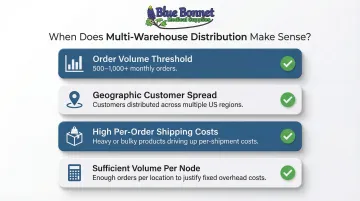
Order volume threshold: A second fulfillment node typically becomes economically viable at 500 to 1,000 monthly orders with significant geographic spread. Below 500 monthly orders, the complexity and fixed costs of managing multiple locations generally exceed shipping savings.
Customer distribution: Your customer base must be spread across multiple US regions. If 80% of orders ship to one region, adding warehouses elsewhere wastes capital.
High per-order shipping costs: Heavy or bulky products benefit most — carriers charge significantly more to ship across multiple zones, so storing heavyweight items closer to end-users yields real per-package savings.
Sufficient order volume per node: If your secondary warehouse handles only 50 orders per month, you're paying full storage and operational overhead for minimal shipping savings.
When Splitting Becomes Inefficient
Low overall order volume: Fixed overhead at each location (storage minimums, inbound freight, management complexity) exceeds outbound shipping reduction.
Unpredictable demand: Variable demand turns regional allocation into guesswork — expect chronic stockouts at busy nodes and dead stock at slow ones.
Many slow-moving SKUs: A catalog heavy with C-velocity items that sit in multiple warehouses multiplies carrying costs without delivering shipping savings.
Strict compliance requirements: For medical products, qualifying and managing multiple FDA or GMP-compliant facilities can be costly relative to shipping savings. In many cases, the compliance overhead of a second regulated location outweighs the cost benefit.
Key Factors That Determine How You Should Distribute Your Inventory
Results from inventory splitting vary widely because outcomes depend on controlling the right variables. Two businesses with identical order volumes can get opposite cost outcomes based on these factors.
Shipping Zone Distribution
Carrier pricing is zone-based — cost per package rises sharply with distance. The goal of splitting inventory is to reduce average zone per order, but this only works if warehouses are placed where your actual customers are.
Under 2024 UPS Ground rates, a 1 lb package costs $10.70 to Zone 2 but $13.38 to Zone 8 — a 25% increase. For a 10 lb package, the gap widens from $14.29 (Zone 2) to $23.74 (Zone 8), a 66% premium. Reducing average shipping zone by 2-3 zones can save $2-5 per package. Beyond a certain number of warehouses, though, incremental zone reduction delivers diminishing returns.
Inventory Carrying Costs Per Node
Every warehouse requires its own safety stock buffer — storage costs that were one unit at a single warehouse multiply by the number of nodes. For slow-moving SKUs, this multiplication can exceed shipping savings entirely.
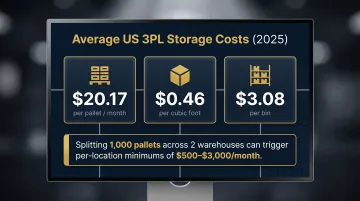
Based on 2025 industry surveys, average US 3PL storage runs $20.17 per pallet per month, $0.46 per cubic foot, or $3.08 per bin. Splitting 1,000 pallets across two warehouses instead of one can eliminate bulk discounts and trigger per-location minimum monthly fees (often $500–$3,000 per facility).
SKU Affinity and Order Co-location
If products frequently ordered together are stored at different warehouses, each multi-item order generates a split shipment with its own pick, pack, and carrier cost — effectively multiplying cost per order.
A split shipment typically costs $6–$18 more than a consolidated one. Those costs add up from several sources:
- Additional base parcel rate: $8–$14
- Residential delivery surcharges: ~$5.15
- Extra packaging materials: $0.75–$2.00
- Second 3PL pick-and-pack fee: $1.50–$4.00
Co-locating high-affinity SKU pairs at the same nodes reduces split shipment rates across your network.
Regulatory Compliance at Each Location (Medical Products)
For medical product businesses, every warehouse in the network must be verified for FDA clearance, GMP compliance, proper storage conditions (temperature, contamination prevention), and HIPAA-safe handling. A warehouse that fails any of these creates product liability and regulatory risk that no shipping savings can offset.
Non-compliant warehouses can result in product holds, rejected shipments, or recall liability. Standard 3PL onboarding takes 30–90 days; medical-grade facilities require extensive audits and WMS validation on top of that. The time and cost of vetting each node is part of the true cost of expanding your network.
Common Mistakes When Splitting Inventory Across US Warehouses
Splitting Inventory Before Reaching Sufficient Order Volume
Businesses add a second or third warehouse expecting immediate savings, but at lower volumes the fixed overhead of each additional location—storage minimums, inbound freight, management complexity—exceeds outbound shipping reduction. The cost-benefit only tips in favor of multi-warehouse distribution at a threshold most small and mid-sized operations haven't reached yet.
Stocking the Wrong Products at Each Location
Distributing inventory evenly across warehouses regardless of regional demand patterns causes chronic stockouts at high-demand nodes and dead stock at low-demand ones. The result is split shipments, expedited inter-warehouse transfers, and customer experience problems that offset any zone-based savings. Allocation must be driven by actual order data, not intuition.
Ignoring Sales Tax Nexus Obligations
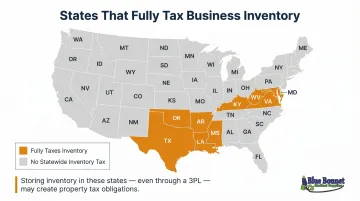
Storing inventory in a state—even through a 3PL—typically establishes sales tax nexus in that state, requiring registration, collection, and remittance. For medical product businesses operating in multiple states, this compliance burden can grow quickly and result in penalties if overlooked.
Fourteen states also levy tangible personal property or inventory taxes on goods stored within their borders. States that fully tax business inventory include:
- Arkansas
- Kentucky
- Louisiana
- Maryland
- Mississippi
- Oklahoma
- Texas
- Virginia
- West Virginia
Factor state tax exposure into warehouse site selection before signing any lease.
Alternatives to Splitting Inventory Across Multiple Warehouses
Multi-warehouse distribution is not the only path to lower shipping costs. For businesses that aren't ready for the operational or compliance complexity it brings, alternatives can deliver comparable results at lower risk.
Single Centrally Located Warehouse with Carrier Optimization
A single warehouse in a central US location—Texas or the Midwest, for example—can reach most of the US population within two to three ground shipping days. For medical product businesses still building order volume, or those where qualifying multiple facilities is time-consuming and costly, this approach avoids the overhead of multiple nodes.
Zone-skipping strategies, where orders heading to distant regions are consolidated and injected into a local carrier hub, can further reduce transit time without adding warehouse locations. By avoiding multi-zone parcel rates, zone skipping can reduce per-package shipping costs by 20-40%. This strategy typically requires a minimum volume of 150-200 packages per week to a specific region to be economically viable.
The trade-offs are real but manageable. Customers in remote regions may face slightly longer delivery windows, and a single-node operation has no geographic redundancy if a disruption occurs. For regulated medical products, though, the ability to manage compliance, handling standards, and inventory visibility at one certified location often outweighs those risks.
Bluebonnet Medical Supplies operates a compliant single-warehouse 3PL in Cedar Park, Texas, with FDA clearance, ISO and GMP compliance, and direct carrier relationships that provide discounted rates.
Their facility handles sensitive medical items with proper storage, sterile packaging solutions, and HIPAA-safe protocols—a practical starting point for medical businesses that want compliance without the complexity of multiple nodes.
Partnering with a Multi-Node 3PL Network
When geographic reach is necessary but contracting with multiple warehouses independently isn't feasible, a 3PL with an established multi-node network handles location management, routing logic, and compliance vetting across sites.
This approach suits businesses that need distributed coverage quickly, without the lead time of building out their own warehouse relationships. That said, it comes with real trade-offs to evaluate before committing:
- Facility control: You have less direct oversight of each location's handling standards.
- Compliance verification: For medical products, every node in the network—not just the primary one—must meet applicable regulatory requirements.
- Due diligence burden: Thorough vetting of each facility is required before onboarding, which takes time and resources most businesses underestimate.
If the 3PL can't provide documentation confirming compliance at each location, that's a meaningful risk for any medical product business.
Frequently Asked Questions
How do I reduce my shipping costs?
The most effective ways include reducing average shipping zone through strategic warehouse placement, negotiating volume-based carrier rates, optimizing package dimensions to avoid dimensional weight penalties, and consolidating shipments rather than splitting orders. The right approach depends on your order volume and customer geography.
Is shipping included in inventory cost?
Shipping is generally not included in inventory cost for accounting purposes. Inbound freight (cost to receive inventory into a warehouse) may be capitalized as part of inventory value under some accounting methods, but outbound shipping to customers is typically recorded as a separate operating expense.
How to split shipping cost?
Common approaches include calculated shipping charges at checkout, flat-rate fees that partially offset carrier costs, or building average shipping expense into product pricing. In inventory distribution, the real goal is reducing total shipping cost—not just deciding who absorbs it.
What packing strategy splits items in two or more parcels?
Split parcel shipping applies when an order exceeds carrier size or weight limits, requires special handling (such as hazmat materials), or ships from multiple warehouse locations. To control costs, co-locate frequently ordered SKUs at the same fulfillment node to minimize unnecessary split shipments.
How many warehouses do I need to reduce shipping costs?
A second warehouse can cut parcel shipping costs by roughly 10%, and a third by 25–30%—but those savings only hold if order volume offsets the added storage and operational overhead. For most small to mid-sized businesses, one well-located warehouse with strong carrier rates is the better starting point.
Does splitting inventory across warehouses create tax obligations?
Yes. Storing inventory in a state—including through a third-party warehouse—typically establishes sales tax nexus in that state, requiring registration and tax remittance on sales to customers there. Some states also impose annual property or inventory taxes on goods stored within their borders, so review your tax exposure in each state before committing to a new fulfillment location.