Introduction
Medical products aren't ordinary consumer goods — and most warehouses aren't built to treat them that way. Proper storage, handling, and shipping require compliance at every step:
- Temperature-sensitive storage conditions
- Lot tracking and expiration date management
- Tamper-evident packaging
- Strict regulatory documentation
Standard warehouses can't meet this bar. Building your own FDA-compliant facility means heavy capital investment in infrastructure, trained staff, and certifications that most growing businesses can't absorb.
This guide is for businesses selling or distributing medical products—whether through Amazon, your own website, or internationally—who need to understand how third-party logistics (3PL) warehousing works. We'll cover what 3PL warehousing is, what services are included, why compliance matters for regulated industries, and how to evaluate whether outsourcing fits your business.
TL;DR
- 3PL stands for third-party logistics—a provider that handles warehousing, fulfillment, and shipping on your behalf
- These warehouses manage the full cycle: receiving inventory, storing it, picking and packing orders, and shipping to customers or retailers
- Medical products require 3PLs that meet FDA, ISO, GMP, and HIPAA-safe handling standards; most general warehouses aren't equipped for this
- Businesses use 3PLs to reduce overhead, gain logistics expertise, and scale without building their own warehouse infrastructure
- The right partner should match your product type, compliance needs, and volume—not force you into a one-size-fits-all model
What Is 3PL Warehousing?
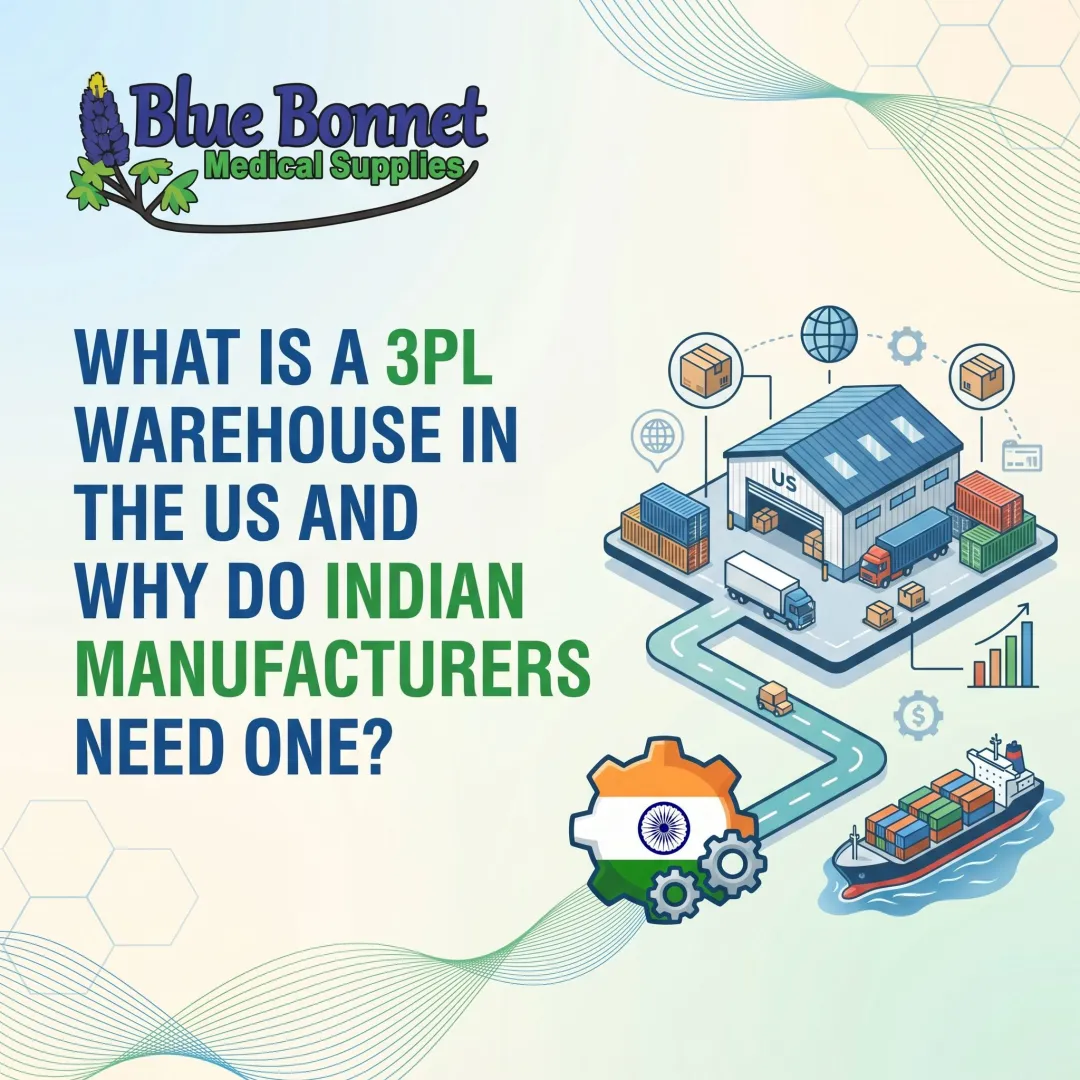
3PL warehousing is a model where businesses outsource inventory storage and order fulfillment to a specialized third-party provider rather than managing their own warehouse. This goes far beyond simply renting warehouse space—3PLs provide labor, warehouse management systems, fulfillment processes, and regulatory compliance infrastructure.
The "third party" refers to the provider's position in the supply chain: sitting between you (the product owner) and your end customer or retailer. When an order comes in, the 3PL picks, packs, and ships on your behalf — managing the entire fulfillment workflow from their facility.
That's worth distinguishing from a related term you'll sometimes encounter:
- 3PL — Executes logistics operations: storing products, packing orders, and coordinating shipments directly
- 4PL — Operates at a strategic level, managing and coordinating multiple supply chain partners across your entire logistics network
Most product-based businesses start with a 3PL and only move to 4PL services when managing complex, multi-provider supply chains.
Why Medical Product Businesses Rely on 3PL Warehousing
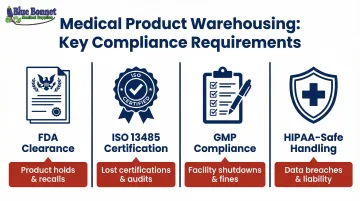
Medical products require specialized handling that standard consumer goods warehouses cannot provide. Temperature-sensitive storage, tamper-evident packaging, lot tracking, expiration date management, and comprehensive regulatory documentation are requirements most general warehouses simply aren't equipped to meet.
The compliance stakes are high. According to FDA Warning Letters issued under 21 CFR 820.150 and 820.160, storing diagnostics in uncontrolled environments or shipping unsterilized medical kits can result in regulatory violations, product holds, and serious patient safety risks. In one 2025 Class I recall, Medline Industries shipped sterile convenience kits that bypassed the sterilization process, creating severe risks of bloodstream infections and sepsis.
What Medical Businesses Can't Afford to Build In-House
Building a compliant warehouse requires substantial fixed capital investment:
- Validated warehouse management systems (WMS) that comply with 21 CFR Part 11
- Quality control inspectors (median annual wage: $47,460) and compliance officers (median annual wage: $78,420)
- ISO 13485 certification audits and continuous environmental monitoring
- Dedicated storage zones for temperature-sensitive products
- Staff training programs for GMP and HIPAA-safe handling
For growing medical product companies, these fixed costs are prohibitive. A specialized 3PL already has this infrastructure in place, converting these capital expenses into manageable operational costs.
The Multichannel Reality
Medical product sellers often ship through multiple channels simultaneously: Amazon FBA, direct-to-consumer websites, wholesale distributors, and international buyers. Managing inventory across these channels from separate facilities creates documentation gaps and increases the risk of lot-tracking failures. A specialized 3PL can manage multichannel inventory from a single compliant facility, maintaining proper lot tracking and documentation across all sales channels.
Bluebonnet Medical Supplies operates as exactly this kind of specialized 3PL: FDA-cleared packaging, ISO and GMP compliance, and HIPAA-safe handling protocols under one roof. Medical product businesses gain the infrastructure they need without building it themselves.
How 3PL Warehousing Works: End-to-End
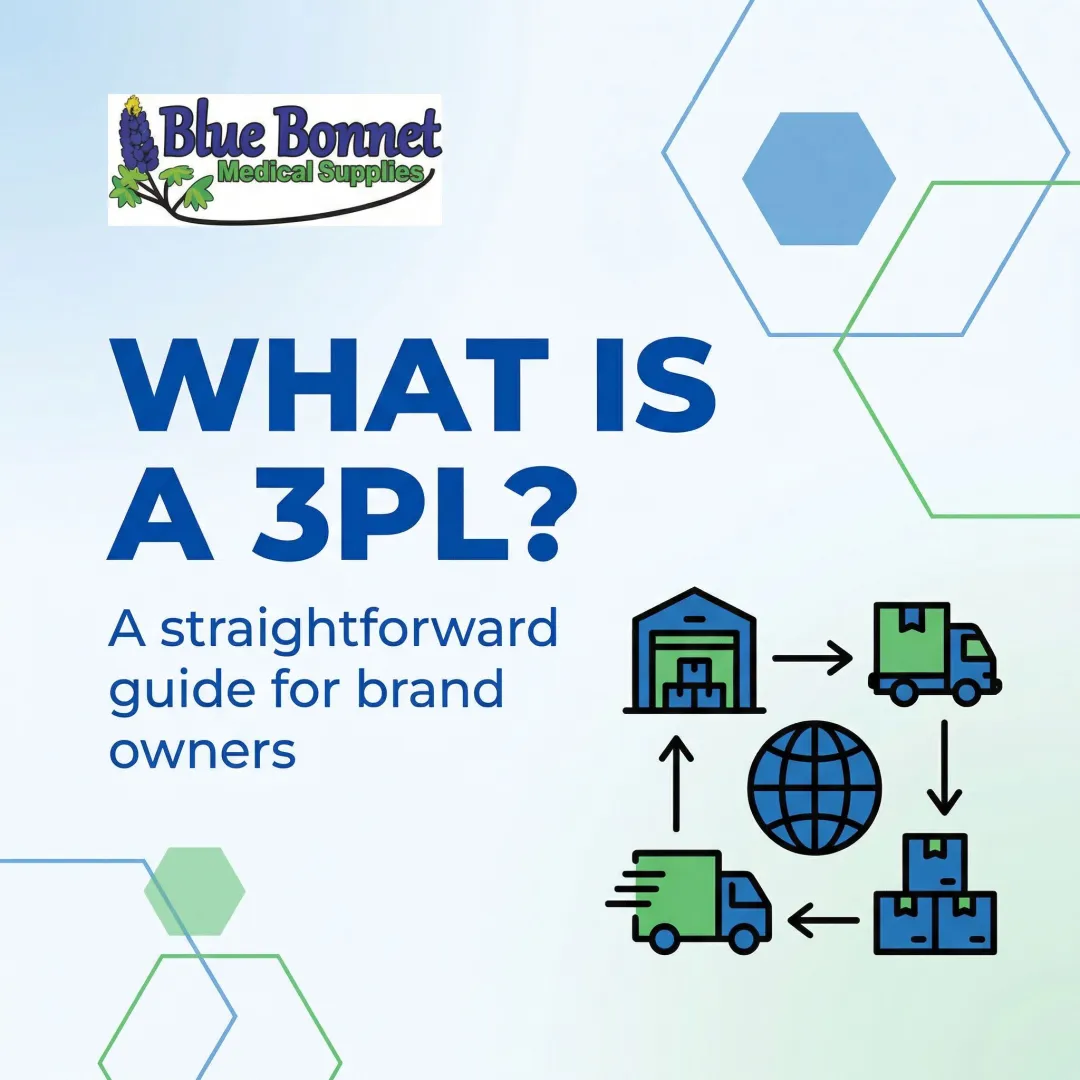
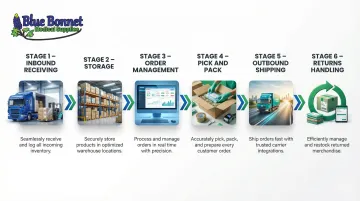
3PL warehousing operates as a closed-loop process, not a one-time transaction. The workflow follows this sequence: inbound receiving → storage → order management → pick and pack → outbound shipping → returns handling. Each stage integrates with the next to create connected fulfillment operations.
Receiving and Inventory Storage
When you send products to a 3PL, the warehouse receives, counts, inspects, and logs inventory into a warehouse management system (WMS). For medical products, this step includes critical compliance tasks:
- Recording lot numbers and serial numbers for traceability
- Documenting expiration dates to prevent distribution of expired products
- Assigning storage locations based on temperature and environmental requirements
- Segregating inventory to prevent cross-contamination
Medical-grade 3PLs maintain dedicated storage zones that meet ISO 13485 Clause 8.3.1 requirements for segregating nonconforming products and preventing unintended use or delivery. Products are assigned bin locations based on SKU, size, and regulatory storage requirements, ensuring every placement decision has a compliance rationale behind it.
Order Fulfillment and Packing
When a customer places an order on Amazon, your website, or a wholesale platform, the order data transmits to the 3PL's WMS, which triggers picking and packing. Warehouse staff retrieve the correct products from their bin locations, verify lot numbers and expiration dates, and prepare them for shipment.
For medical products, packing must meet FDA-cleared packaging standards:
- Tamper-evident seals to ensure product integrity
- Required labeling that complies with 21 CFR 820.120
- Documentation inserts such as instructions for use or certificates of conformance
- Protective packaging that prevents contamination or damage during transit
Value-added services at this stage include kitting (assembling multiple products into bundles), custom labeling, barcoding, and product inserts, all completed before shipment to ensure consistent, compliant presentation. Once the order is packed and verified, it moves to the shipping stage.
Shipping and Returns
The 3PL selects a carrier and shipping method based on destination, delivery window, and cost. 3PLs with direct carrier relationships pass discounted bulk rates to clients, rates that individual businesses typically couldn't negotiate on their own.
For international medical shipments, missing documentation is the most common cause of customs delays. According to FDA import guidance, the following gaps frequently trigger detentions and import refusals:
- Missing Affirmation of Compliance (A of C) codes
- Absent 510(k) or PMA references
- Incomplete registration data
A qualified 3PL prepares and submits this documentation before products leave the warehouse, preventing costly holds at the border.
Returns handling completes the loop. Returned products are received, inspected, and assessed. The 3PL restocks usable items and flags damaged ones for disposal. For medical products, specialized 3PLs conduct functionality testing and restoration to determine whether items can safely re-enter inventory while staying within regulatory compliance.
Core Services in 3PL Warehouse Management
Inventory Management
Real-time tracking of stock levels across all sales channels via WMS, with automated alerts for low stock, expiration dates, and lot traceability. Under 21 CFR 820.160, distribution records must include identification and quantity of devices shipped, dates, and control numbers used—which means robust WMS capabilities aren't optional for regulated medical products; they're a compliance requirement.
Freight and Carrier Management
3PLs negotiate bulk shipping rates with major carriers, giving businesses access to discounted rates they couldn't obtain independently. For international medical shipments, this includes freight forwarding and customs compliance support to keep products moving across borders without costly holds.
Compliance and Documentation Support
For regulated industries, the 3PL handles the documentation trail required by FDA and destination country regulators. This includes:
| Document Type | Purpose |
|---|---|
| Commercial Invoice & Packing List | Required by CBP; must contain accurate device descriptions and quantities |
| FDA Affirmation of Compliance (A of C) | Three-letter codes (such as PM# for 510(k)/PMA) submitted to expedite FDA screening |
| Certificate to Foreign Government | Issued by FDA for devices legally marketed in the U.S., often required by importing countries |
| EU Declaration of Conformity | Required under EU MDR Article 19; states device fulfills MDR requirements |
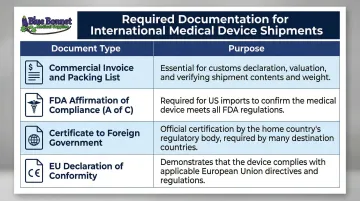
Missing or inaccurate documentation is the primary cause of international customs holds. 3PLs automate the generation of these documents to keep cross-border distribution on schedule.
Outbound compliance is only half the picture. Returned products require the same rigor in reverse.
Returns Processing and Product Restoration
Unlike general 3PLs, specialized medical 3PLs can test returned products, document their condition, and restore them to sellable status where regulations permit—reducing losses from returns. This typically covers:
- Functionality testing to confirm the device performs as intended
- Inspection for physical damage or contamination
- Compliance verification before the item is cleared for restocking
Common Misconceptions About 3PL Warehousing
"A 3PL is just a warehouse that stores your stuff"
A full-service 3PL is an active operations partner—managing orders, compliance, carrier relationships, returns, and real-time inventory visibility. They don't just hold products; they execute your entire fulfillment workflow while maintaining regulatory compliance and documentation trails.
"Any 3PL can handle medical products"
General 3PLs lack FDA clearance, GMP-compliant handling protocols, and the documentation infrastructure that medical product shipments require. Using a non-compliant 3PL for medical goods creates serious liability. FDA Warning Letters confirm that distribution and storage failures carry the same regulatory penalties as manufacturing defects.
"3PL is only for large businesses"
3PLs are especially valuable for growing or mid-sized businesses that have outgrown home or small office shipping but aren't ready to build their own warehouse. The medical device 3PL market hit $28.76 billion in 2024—a figure driven largely by businesses of all sizes using scalable pricing that adjusts to actual order volume.
When 3PL Warehousing May Not Be Necessary
If your order volume is very low—a handful of orders per week—the cost of a 3PL may outweigh the benefit. Self-fulfillment or on-demand fulfillment services are typically more cost-effective at that stage.
Sellers who use a single marketplace—such as Amazon FBA for Amazon-only sales—may also find a 3PL unnecessary. That said, a dedicated 3PL becomes valuable once any of the following apply:
- Selling across multiple sales channels simultaneously
- Shipping internationally and navigating customs compliance
- Managing inventory that spans more than one platform
- Handling regulated products that require documented storage or handling standards
Frequently Asked Questions
What does 3PL mean in warehousing?
3PL stands for third-party logistics. In warehousing, it refers to outsourcing storage, fulfillment, and distribution operations to an external provider who manages those functions on your behalf, handling everything from receiving inventory to shipping finished orders.
How does a 3PL warehouse work?
Businesses send inventory to the 3PL facility, where it's stored and tracked through a warehouse management system. When orders come in, the 3PL picks and packs products, then ships them to customers—all coordinated through integrated software.
What are 3PL warehousing solutions?
3PL warehousing solutions cover the full logistics stack a business needs to operate: inventory storage, order fulfillment, freight management, returns handling, and compliance documentation. Providers typically bundle these into packages tailored to your sales channels and volume.
What is the difference between a 3PL and a 4PL?
A 3PL handles the physical execution of logistics—storing, packing, and shipping products. A 4PL manages and coordinates multiple supply chain partners at a strategic level, overseeing your entire logistics network. Medical product companies almost always start with a 3PL, particularly one with compliance-specific capabilities.
What should medical product businesses look for in a 3PL partner?
Prioritize providers with FDA-cleared packaging, ISO 13485 and GMP compliance, HIPAA-safe handling, and lot tracking with expiration date management. Always verify through certifications and references—not just claims on a website.
How much does 3PL warehousing cost?
3PL pricing covers storage fees (per pallet or bin), pick-and-pack fees (per order or unit), and shipping costs. Standard storage averages $20–$40 per pallet per month, with medical-grade compliance handling carrying additional premiums.