Introduction
You've built a quality medical device or supply product in India and secured US buyers. Getting that product from your facility to a customer's doorstep in Texas or California within 2 days, however, is an entirely different challenge. The bottleneck isn't manufacturing — it's logistics infrastructure.
Ocean freight takes 30-40 days. Air freight adds significant per-unit costs. And direct-to-consumer shipping from India invites customs scrutiny, particularly for FDA-regulated medical products.
The US market moves fast. 90% of US consumers expect 2-3 day delivery if shipping is free, and 23% will abandon their cart entirely if shipping is too slow. Without a US-based fulfillment solution, Indian manufacturers lose sales before they even start.
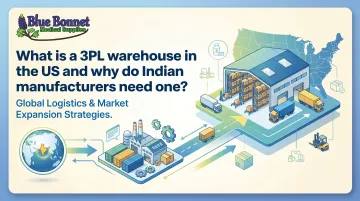
This article explains what a 3PL warehouse in the US is, why it matters for Indian manufacturers entering the US market, and what to look for—especially if you're shipping medical devices or regulated supplies.
TLDR
- A 3PL warehouse stores your inventory in the US and ships orders to customers on your behalf, eliminating the need for you to own warehouse space or hire US staff
- Shipping directly from India means 30–40 day ocean freight delays or costly air freight, both well outside US customer expectations
- Bulk-ship inventory to a US 3PL once, then deliver to customers in 2 days using domestic carriers at discounted rates
- FDA-compliant 3PLs with ISO/GMP certification keep medical products clear of customs holds and maintain chain-of-custody records
- Without US inventory, Indian manufacturers can't qualify for Amazon Prime or compete on delivery speed in US marketplaces
What Is a 3PL Warehouse in the US?
A 3PL (third-party logistics) warehouse is an external facility that stores your products and manages the pick, pack, and ship process whenever a customer places an order. You don't need your own warehouse or fulfillment staff in the US—the 3PL handles it on your behalf.
How it differs from renting warehouse space:
A 3PL is an active operational partner, not passive storage. It integrates with your sales channels (Amazon, Shopify, your website), processes orders in real time, generates shipping labels, and works directly with US carriers. You're outsourcing your entire US logistics operation—not just leasing shelf space.
What a 3PL is not:
- Not a freight forwarder — freight forwarders move goods across borders but don't store or fulfill individual customer orders
- Not a customs broker — though some 3PLs coordinate with brokers to clear shipments
- Not a distributor — the 3PL holds inventory on your behalf; you retain ownership and control
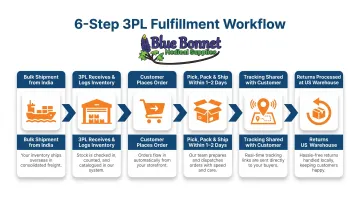
The core workflow:
- Indian manufacturer ships bulk medical product inventory to the US 3PL (via ocean or air freight)
- 3PL receives shipment, verifies against packing lists, and logs into warehouse management system (WMS)
- Customer places an order on Amazon, your website, or another sales channel
- 3PL picks, packs, and ships within 1-2 business days
- Tracking information is shared with the customer
- Returns are processed at the US warehouse—no need to ship defective or unwanted items back to India
For Indian manufacturers entering the US market, this structure dramatically cuts per-unit shipping costs while meeting the delivery speed US customers expect.
The Challenges Indian Manufacturers Face When Entering the US Market
Slow Delivery Times Hurt Sales and Reputation
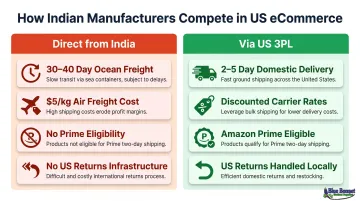
When shipping directly from India to US customers, ocean freight takes 30-40 days. Air freight cuts transit to 8-10 days but costs $5/kg or more—prohibitively expensive for most products. Meanwhile, US customers expect 2-5 day delivery, and anything longer damages conversion rates and triggers negative reviews.
The data is clear: 23% of US consumers abandon orders specifically because shipping is too slow. Even strong product quality can't overcome slow delivery when your competition ships from a warehouse down the road.
Customs and FDA Compliance Create Significant Risk for Medical Products
Medical devices and supplies exported from India to the US must meet strict FDA import requirements:
- Foreign manufacturers must register their establishment annually with the FDA
- Devices must be listed with the FDA before importation
- Premarket authorization is required (510(k) for most Class II devices, PMA for Class III)
- Quality Management System compliance under 21 CFR Part 820 is required
Products shipped direct-to-consumer are more likely to be flagged, detained, or rejected at port compared to bulk shipments entering a licensed US facility. FDA Import Alert 99-34 authorizes detention without physical examination for devices from firms without valid registration or listing, meaning shipments can be held indefinitely.
Working with an FDA-compliant US 3PL dramatically reduces this risk. Bulk shipments to a registered facility with proper documentation face far fewer customs holds.
High Cost and Complexity of Direct International Shipping Per Order
Shipping individual parcels from India to US customers is expensive and unpredictable. Express international parcel rates run approximately $5/kg, adding $25-50+ per shipment, and insurance claims for lost or damaged international parcels are rarely resolved cleanly.
Consolidating into periodic bulk shipments to a US 3PL changes the math entirely:
- Direct international parcel: ~$5/kg, unpredictable transit, difficult claims process
- Bulk to US 3PL + domestic fulfillment: lower per-unit freight cost, 10-40% savings on carrier rates through volume-aggregated contracts
The 3PL ships domestically using discounted US carrier rates, passing those savings to you.
Returns from US Customers Are Nearly Impossible to Manage from India
Without a US return address, customers either can't return products or face such slow and expensive processes that it kills repeat business and triggers chargebacks. Returns accounted for 16.9% of total US retail sales in 2023, valued at $890 billion.
Over 60% of US shoppers review return policies before purchasing, and 65% abandon carts with inflexible return terms.
A US 3PL handles returns locally: receives, inspects, restocks, or disposes appropriately, and updates inventory in real time.
No US Presence Limits Marketplace Access
Selling on Amazon.com with Prime eligibility requires inventory physically located in the US. Amazon captures 37.6% of all US retail eCommerce spending, and Prime members convert at approximately 74% versus 13% for non-members. Without a US 3PL, Indian manufacturers are effectively locked out of the marketplace dynamics that drive the majority of US eCommerce sales.
How a US 3PL Warehouse Solves These Challenges
Single Bulk Shipment Replaces Dozens of Expensive Direct-to-Consumer Dispatches
Instead of shipping each order from India individually at $5/kg air freight rates, the manufacturer ships a consolidated pallet or container to the US 3PL periodically. This cuts per-unit shipping cost by a measurable margin. The 3PL then fulfills individual US orders using domestic carriers at domestic rates—often with carrier discount access the manufacturer couldn't negotiate independently.
Industry benchmarks show 3PL fulfillment costs range from $6-20 per order, including pick, pack, and domestic shipping—far less than individual international parcels.
Domestic Delivery Speeds Match US Customer Expectations
Once inventory is in the US, the 3PL ships domestically, making 2-5 day delivery standard. This directly competes with Amazon Prime expectations and US domestic sellers—a key requirement for conversion on US marketplaces and DTC websites.
Average US parcel delivery speed improved 40% from 6.6 days (Q1 2020) to 4.2 days (Q2 2023). Without a US inventory foothold, Indian manufacturers simply can't hit those numbers—and slow delivery is one of the fastest ways to lose a sale to a domestic competitor.
Regulatory Compliance Is Handled at the Warehouse Level
A US 3PL that is FDA-cleared and operates under GMP/ISO standards stores and handles products in a way that meets import and distribution requirements. This matters most for regulated categories like medical devices and supplies.
Inventory entering through a compliant facility faces fewer customs holds, and chain-of-custody documentation is maintained throughout. ISO 13485 explicitly covers "storage and distribution" in its scope, making an ISO 13485-certified 3PL partner a regulatory asset, not just a logistics choice.
The 3PL Handles US Returns from Day One
The 3PL receives returned goods, inspects them against the manufacturer's criteria, processes refunds or exchanges, and updates inventory—all in the US. The Indian manufacturer never has to manage a transatlantic return. This is essential: over 60% of US shoppers review return policies before completing a purchase.
Scale Without a US Legal Entity or Fixed Overhead
Using a 3PL means the manufacturer pays for storage and fulfillment based on actual usage—no lease, no US employees, no local regulatory filings to start. Typical 3PL costs include:
- Receiving: $4-12 per pallet
- Ambient storage: $12-22 per pallet per month
- Pick and pack: $2-8 per order
- Outbound parcel shipping: $5-25 per shipment
- Returns processing: $3-15 per return
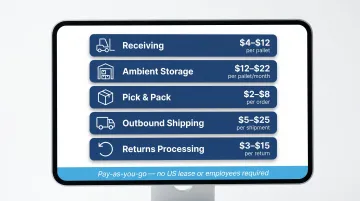
This pay-as-you-go structure lets manufacturers validate US demand at low risk—before committing to warehouses, employees, or a formal US entity.
Key Services a US 3PL Provides to Indian Manufacturers
Receiving and Storage
When your shipment arrives from India, the 3PL unloads the freight, checks it against packing lists, and logs everything into a warehouse management system (WMS). Products are stored under appropriate conditions—including FDA and GMP-compliant storage for sensitive medical items. This single step eliminates the need to find, lease, and staff a US facility yourself.
Order Fulfillment and Shipping
When an order comes in through any connected sales channel—Amazon, Shopify, or your own website—the 3PL handles the rest:
- Picks and packs the product to your specifications or compliance requirements
- Selects the most appropriate carrier for the shipment type
- Ships at discounted carrier rates individual businesses typically can't access directly
Those carrier relationships matter. Established 3PLs routinely save clients 10–40% on shipping costs compared to booking freight independently.
Returns Processing and Inventory Reporting
Returned US orders go directly to the 3PL, which inspects each item and either restocks, restores, or disposes of it based on condition. Separately, real-time inventory reporting lets you monitor stock levels, order status, and low-stock alerts from India—so you can schedule replenishment shipments before a stockout happens.
What to Look for in a US 3PL for Medical Products
Compliance Certifications US Buyers and Customs Require
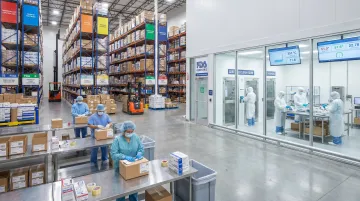
Look for FDA-cleared storage and packaging operations, GMP compliance, ISO alignment, and HIPAA-safe handling practices. Without them, products face customs detention, marketplace rejection, or outright refusal from institutional buyers.
Generic eCommerce 3PLs typically lack this compliance infrastructure. A medical-specific provider like Bluebonnet Medical Supplies — operating out of Cedar Park, TX with FDA-cleared packaging, GMP-compliant handling, and ISO alignment — gives Indian manufacturers the framework needed to move products without interruption.
Custom Workflows for Non-Standard Products and Labeling
Indian manufacturers often have unique product sizes, labeling requirements (dual-language, specific regulatory labels), and packing specifications. A 3PL that forces every client into a standard process will create compliance gaps.
Prioritize providers that customize storage, packing, and shipping workflows to your product's specific requirements. Ask how they handle non-standard dimensions, specialized labeling, and region-specific regulatory needs.
Carrier Rates and Transparent Fee Structures
Before committing, ask the 3PL to walk you through their complete fee structure. A credible provider will give you clear pricing across every touchpoint:
- Receiving and inbound handling
- Storage (per unit or per pallet)
- Pick, pack, and outbound shipping
- Returns processing
- Any minimums or surcharges
Established carrier relationships often translate to discounted shipping rates — a real advantage for manufacturers with variable monthly volumes.
Frequently Asked Questions
What is the difference between a 3PL warehouse and a regular warehouse?
A regular warehouse is passive storage. A 3PL warehouse is an active fulfillment operation that receives orders, picks and packs products, ships to end customers, and handles returns—functioning as a fully outsourced logistics operation, not just shelf space.
Can Indian manufacturers ship directly to US customers without using a 3PL?
Yes, but the tradeoffs are steep. Direct shipping from India means 30-40 day ocean freight times, per-order air costs of $5/kg or more, customs complexity, and no returns infrastructure—none of which supports a competitive, repeat-purchase business in the US.
How does a US 3PL help Indian medical manufacturers with FDA compliance?
A 3PL with FDA-cleared operations and GMP/ISO compliance stores and ships medical products in a manner that satisfies US distribution standards, reduces the risk of customs holds, and maintains proper chain-of-custody documentation required for regulated medical items.
Do Indian manufacturers need a US business entity to work with a US 3PL?
Most 3PLs work with foreign-owned companies shipping inventory into the US. You'll need a Customs Assigned Number (via CBP Form 5106), a customs bond, and a licensed customs broker—but no US LLC or corporation is required to start. Verify your specific import arrangements with a US trade or customs advisor.
How much does it typically cost to use a US 3PL warehouse?
Costs vary by provider but typically cover receiving, storage, pick and pack, outbound shipping, and returns processing. Total landed fulfillment generally runs $6-20 per order—with individual line items ranging from $2-25 depending on service type. Higher volume lowers per-unit cost across the board.
What types of Indian manufacturers benefit most from a US 3PL?
Medical device manufacturers, surgical supply producers, health and wellness product companies, and any Indian exporter targeting US retail or Amazon sales benefit most—particularly where compliance, product handling sensitivity, and delivery speed are business-critical.