Introduction
Many Indian brands shipping direct to US customers face a persistent challenge: 10–20 day delivery windows that tank conversion rates, drive up cart abandonment, and lock them out of platforms like Amazon Prime. According to Statista, 41% of US consumers expect online purchases to arrive within 2 days — a timeline cross-border shipping from India simply cannot meet. That gap costs Indian brands real sales. Setting up a US warehouse solves it by storing inventory on American soil and enabling same-day to 2-day fulfillment that converts browsing into buying.
This guide is for Indian product brands — in textiles, medical devices, wellness, home goods, or manufacturing — who want a practical breakdown of what US warehouse setup actually involves.
We'll cover the legal groundwork (US business entity formation, banking, import documentation), warehouse selection (3PL vs. FBA vs. your own space), and compliance requirements Indian brands frequently overlook, including FDA clearances and sales tax nexus obligations. By the end, you'll understand the full process from registering your LLC to managing your first US shipment.
TL;DR
- You need a US business entity (LLC), an Importer of Record (IOR), and customs clearance before your goods can be stored on US soil
- Choose between three warehouse models: third-party logistics (3PL), Amazon FBA, or leasing your own space — each with different cost, control, and compliance trade-offs
- Medical devices, supplements, and cosmetics require additional FDA compliance steps before warehousing or selling in the US
- Storing inventory in a US warehouse creates sales tax nexus obligations in that state, requiring ongoing tax compliance
- A US warehouse cuts shipping times from weeks to days, improving conversion rates and customer trust on Amazon and direct-to-consumer channels
Why Indian Brands Are Setting Up US Warehouses
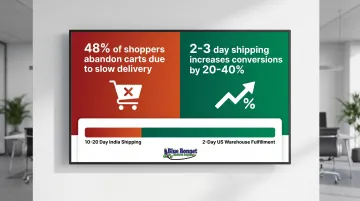
Shipping direct from India means 10–20 day delivery windows, which reduces conversion rates, increases cart abandonment, and limits eligibility for platforms like Amazon Prime. Research shows that up to 48% of shoppers abandon carts due to slow delivery or unexpected shipping costs, and offering 2-3 day shipping can increase conversion rates by 20% to 40%. A US warehouse solves the speed problem by enabling domestic fulfillment that meets customer expectations.
Beyond delivery speed, a US warehouse signals credibility. US customers are more willing to purchase from brands with a domestic return address, faster returns handling, and local customer service. In competitive categories where multiple sellers offer similar products, that trust advantage is often the deciding factor.
A domestic warehouse address on your return policy and shipping confirmation emails tells customers they can resolve issues quickly — without navigating international shipping delays or customs complications.
Taken together, these advantages shift your brand's position in the market:
- Prime eligibility: Domestic fulfillment unlocks Amazon Prime badging, dramatically increasing product visibility
- Higher checkout conversions: Domestic shipping speeds reduce the hesitation that kills sales at checkout
- Simpler returns: US-based return handling removes a major friction point that drives negative reviews
For Indian brands selling in the US, a warehouse isn't just a logistics upgrade — it's a competitive repositioning.
Your Warehouse Options: 3PL, FBA, or Your Own Space
3PL (Third-Party Logistics)
3PL providers store, pack, and ship inventory on behalf of your brand. You ship bulk inventory to the 3PL's facility and pay for storage and per-order fulfillment fees.
If your products fall into regulated categories — medical supplies, wellness, dietary supplements — compliance certifications aren't optional. Not all 3PLs are equipped to handle sensitive products. Look for facilities with FDA compliance, ISO, and GMP certifications built into daily operations, not just marketing materials.
Bluebonnet Medical Supplies, for instance, is a specialized 3PL built specifically for medical product brands. Their Cedar Park, TX warehouse maintains FDA-cleared medical packaging, ISO and GMP compliance, and HIPAA-safe handling — which matters considerably for brands importing medical devices or wellness products into the US.
Typical 3PL pricing:
- Pick and pack per order: $2.50–$5.00
- Storage per pallet per month: $15–$25
- Additional item per order: $0.50–$1.00
Source: 3PL Cost Calculator, WarehousingCosts.com
Amazon FBA
FBA allows brands to ship inventory to Amazon fulfillment centers and leverage Prime shipping. It works well for Amazon-native brands but offers no control over packaging, branding, or multi-channel fulfillment.
What FBA doesn't cover:
- Amazon controls the inventory — you cannot use FBA inventory to fulfill orders from your Shopify store or other channels
- Fees can be unpredictable, especially during Q4 when storage rates increase
- Approximately 82% of active Amazon sellers use FBA, making it the simplest starting point for Indian brands testing US demand
FBA fulfillment fees (2024-2025):
- Small standard (2 oz or less): $3.06/unit
- Small standard (up to 16 oz): $3.65/unit
- Large standard (4 oz or less): $3.68/unit
- Large standard (up to 3 lb): $6.62/unit
- Large standard (3-20 lb): $6.92 + $0.08/4 oz above 3 lb
Monthly storage:
- Jan-Sep: $0.78/cubic foot
- Oct-Dec: $2.40/cubic foot
Source: Amazon Seller Central
Own Warehouse
Leasing or buying your own US warehouse gives you maximum control — over storage conditions, staff, and workflows. That control comes at a cost: you'll need a registered US business entity, upfront capital for rent and utilities, and operational headcount from day one.
This model makes sense only after you've validated consistent US demand and can absorb fixed costs regardless of order volume. For most Indian brands entering the market, it's not the right first move.
Step-by-Step: How to Set Up a US Warehouse for Your Indian Brand
Step 1: Register a US Business Entity
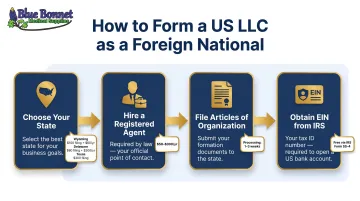
Indian brands cannot legally operate a US warehouse or enter into commercial lease agreements without a US business entity. The most common structure is an LLC (Limited Liability Company), which provides liability protection, tax flexibility, and a formal US presence. Foreign nationals, including Indian citizens, can form a US LLC remotely without traveling to the US.
Practical steps:
Choose a state of formation: Delaware, Wyoming, and Texas are popular choices
- Delaware: $110 filing fee + $300 annual LLC tax
- Wyoming: $100 filing fee + $60 annual report
- Texas: $300 filing fee, no annual franchise tax below threshold
Hire a registered agent with a physical address in the formation state
File Articles of Organization with the Secretary of State
Obtain an EIN (Employer Identification Number) from the IRS — required for banking, taxes, and customs filings
Getting your EIN as a foreign national:
- Call the IRS at 267-941-1099 (6 AM–11 PM ET, Mon-Fri) — EIN assigned during the call
- Fax Form SS-4 to 304-707-9471 — processing takes ~4 business days
- Online application is NOT available for non-US citizens
Source: IRS Instructions for Form SS-4
Step 2: Open a US Business Bank Account
A US bank account is required for paying warehouse fees, customs brokers, domestic carriers, and eventually US taxes. Without it, financial operations become a logistical headache.
Neobanks that accept foreign founders:
- Mercury: No US citizenship required; accepts passport and EIN; requires business formation documents
- Relay: Accepts non-US residents; requires physical US address for beneficial owners (no PO boxes or virtual mailboxes); requires EIN verification letter (CP-575 or 147c)
Sources: Mercury eligibility requirements, Relay account requirements
Having a US bank account also improves customer trust when displaying refund policies and processing payments.
Step 3: Obtain Your Import Documentation
India-side documents:
- IEC (Importer Exporter Code): Issued by DGFT; mandatory for all exports from India
- GST registration: Required for tax compliance
- Letter of Undertaking (LUT): Filed on Form GST RFD-11 via the GST Portal; allows zero-rated export without payment of IGST; valid for the entire financial year
- Commercial invoice: Accurate product descriptions and HS codes required
US-side requirement:
The Importer of Record (IOR) is the entity legally responsible for ensuring imported goods comply with US customs regulations, paying applicable duties, and filing required paperwork. If your US LLC takes on this role, you must appoint a licensed customs broker to manage the process.
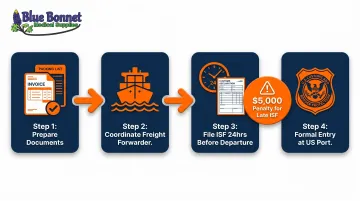
Importer Security Filing (ISF):
- Required for all ocean vessel imports
- Must be filed no later than 24 hours before cargo is loaded onto the vessel at the foreign port
- Penalty: $5,000 per violation for late, missing, or inaccurate filings
Source: CBP Import Security Filing
De minimis threshold: Commercial shipments exceeding $800 aggregate value require formal customs entry with applicable duties and fees.
For regulated products (medical devices, supplements, cosmetics): Additional FDA-specific documentation required before goods can clear US customs.
Step 4: Choose Your Warehouse Location and Partner
Key factors for selecting a US warehouse location:
- Proximity to major ports of entry: Los Angeles, New York/New Jersey, Savannah for inbound shipments
- Proximity to your customer base: East Coast vs. West Coast distribution
- State-level sales tax implications: Storing inventory in a state creates sales tax nexus (see Compliance section below)
Criteria for evaluating a 3PL partner:
- Storage capacity for your product type
- Relevant certifications (FDA, ISO, GMP for regulated products)
- Technology integration with your e-commerce platform (such as Shopify, WooCommerce, or Amazon)
- Per-unit fulfillment pricing transparency
- Returns processing capabilities
For medical product brands, choosing a 3PL like Bluebonnet Medical Supplies that maintains FDA-compliant operations, ISO and GMP standards, and HIPAA-safe handling ensures your products are stored and shipped according to US regulatory requirements without requiring you to independently verify compliance.
Step 5: Ship Your First Inventory Consignment to the US
Preparing a commercial shipment from India:
- Accurate packing lists and commercial invoices with declared values and HS codes
- Coordinate with a freight forwarder for full container loads (FCL) or less-than-container-load (LCL) shipments
- Your customs broker files the ISF at least 24 hours before the vessel departs India
- Formal entry filing upon arrival at the US port
Customs duties: Calculated based on HS codes and declared value. Indian goods are subject to standard MFN (Most Favored Nation) duty rates, not the China-specific Section 301 tariffs. Brands should research their specific duty rate before pricing products for the US market using the USITC Tariff Database.
Step 6: Set Up Order Fulfillment and Inventory Management
With inventory landed and cleared, the next priority is connecting your sales channels to the warehouse's order management system (OMS) or warehouse management system (WMS). This ensures customer orders on Amazon Seller Central, Shopify, or other platforms automatically trigger pick, pack, and ship workflows.
Most 3PLs offer API integrations or middleware tools — such as ShipStation or Linnworks — to make this connection straightforward. If you're working with a specialized 3PL like Bluebonnet Medical Supplies, confirm which platforms they support during onboarding.
Inventory management from India requires real-time visibility:
- Establish reorder thresholds to ensure you replenish stock before sellouts
- Account for the 2–4 week lead time to ship the next consignment from India to the US
- Monitor inventory levels daily to avoid stockouts during peak demand periods
Compliance and Import Requirements Indian Brands Must Know
US Customs and Border Protection (CBP)
All commercial shipments over $800 require a formal customs entry filed by a licensed customs broker. The "de minimis" threshold applies only to individual orders in dropshipping models — not bulk warehouse shipments, which always require formal entry regardless of declared value.
FDA Requirements for Regulated Products
Beyond customs clearance, certain product categories face a second compliance layer: FDA regulation. Medical devices, food products, dietary supplements, and cosmetics all require specific registration or clearance before they can be imported or sold in the US.
Medical devices:
- Must be cleared or registered with the FDA before being imported or sold
- Foreign manufacturers must register their establishment and list devices via the FDA's Unified Registration and Listing System (FURLS)
- Annual registration fee: $9,280 (FY2025) with no small business waiver
- Must designate a US Agent (21 CFR 807.40)
Warning: Warehousing and shipping uncleared medical products can result in goods being detained or destroyed at the port — skip this step, and shipments may be seized before they ever reach your warehouse.
Dietary supplements:
- Facilities must register with FDA under Section 415 of the FD&C Act
- Biennial renewal required (Oct 1–Dec 31 of each even-numbered year)
- Prior notice required for imported supplement shipments: no less than 8 hours before arrival by water; 4 hours by air
Sources: FDA Device Registration, FDA Food Facility Registration
Sales Tax Nexus
FDA registration covers what you can import — but where you store it triggers a separate obligation. Storing inventory in a US warehouse creates "sales tax nexus" in that state, meaning you're legally required to collect and remit sales tax on orders shipped to customers there.
High-impact states for Indian brands:
| State | Physical Nexus from Inventory? | Economic Nexus Threshold | Base Rate |
|---|---|---|---|
| California | Yes | $500,000 in CA sales | 7.25% (up to ~10.25% with local) |
| Texas | Yes | $500,000 in TX revenue | 6.25% (up to 8.25% with local) |
| New York | Yes | $500,000 in sales AND 100+ transactions | 4% (up to ~8.875% in NYC) |
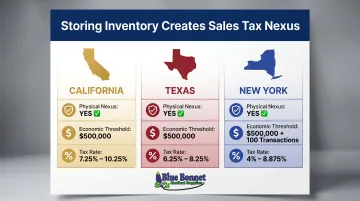
Sources: CDTFA California, Texas Comptroller, NY Department of Taxation
Recommendation: Consult a US tax advisor before choosing a warehouse state to understand your full sales tax obligations.
Product Labeling Requirements
Sales tax is one pre-sale requirement; labeling is another. Products must meet US labeling standards before they can legally be sold — and these rules apply to the physical product packaging, not just your online listings:
Country-of-origin marking (19 CFR Part 134):
- Every article must be legibly marked with the English country name (e.g., "India" or "Made in India")
- Marking must be conspicuous and permanent
- Penalties for improperly marked goods include additional marking duties or criminal penalties
Textile labeling (16 CFR Part 303):
- Country of origin on label
- Fiber content by generic name and percentage by weight
- Manufacturer/importer identification
- Care instructions
Sources: CBP Marking Requirements, FTC Textile Labeling
Common Mistakes Indian Brands Make When Setting Up a US Warehouse
Skipping the IOR Setup
Many brands assume the 3PL or freight forwarder will handle all import responsibilities. In reality, the Importer of Record is legally liable for the shipment. Without your own US LLC and IOR status, you risk customs holds, unexpected fees, or goods turned away at the border entirely.
Common consequences of skipping IOR setup:
- Shipments held at customs with no authorized party to release them
- Fines assessed against the freight forwarder, which get passed back to you
- Forced abandonment of goods when delays become unresolvable
- Delays that miss seasonal demand windows or customer commitments
Choosing a General-Purpose 3PL for a Regulated Product
Brands selling medical devices, supplements, or cosmetics often select a standard warehouse without verifying whether the facility has the certifications required for their product category. A general warehouse may lack temperature control, HIPAA-safe handling, or FDA-compliant processes — creating compliance risk on every shipment.
If your product requires FDA compliance, choose a 3PL like Bluebonnet Medical Supplies that holds FDA-cleared packaging approvals, ISO and GMP compliance, and HIPAA-safe handling procedures built into day-to-day operations — not bolted on as afterthoughts.
Underestimating Sales Tax Obligations
Many Indian brands don't realize that physical inventory storage creates nexus. They then face back-tax liabilities or unexpected costs when they begin scaling.
Critical: Engage a US-based accountant before warehouse operations begin, not after the first year of trading. Sales tax compliance is a recurring operational requirement — registration, collection, and remittance all need to be in place before your first sale, not scrambled together after an audit notice arrives.
Frequently Asked Questions
Do I need a US LLC to set up a warehouse in the United States?
Forming a US LLC is the most practical path — it's required to act as Importer of Record, sign commercial leases, and open a US bank account. Indian citizens can do this remotely without traveling to the US.
Can I dropship to the USA from India?
Yes, dropshipping from India to the US is legal and requires no warehouse, but it results in 10–20 day delivery times and limits access to platforms like Amazon Prime. A US warehouse enables same-day to 2-day fulfillment that dropshipping from India cannot match.
Can I sell on Amazon USA from India?
Indian sellers can list on Amazon.com through Amazon Global Selling. FBA requires shipping bulk inventory to US fulfillment centers; Merchant Fulfilled allows direct shipping from India, though only FBA products qualify for Prime.
What documents does an Indian brand need to import products into the US?
Core documents: IEC from DGFT (India-side), commercial invoice with HS codes, packing list, and formal entry filing via a licensed US customs broker. Regulated products (medical, food, supplements) require additional FDA registration or prior notice.
How much does it cost to set up a US warehouse operation for an Indian brand?
LLC formation runs $100–$500 by state. 3PL storage fees typically run $15–$25 per pallet monthly, plus $2.50–$5.00 per order fulfilled. FDA device registration adds $9,280 annually. First-year operating costs for a small-to-mid-size brand generally fall between $5,000–$15,000, excluding inventory and customs duties.
Does storing inventory in a US warehouse affect my tax obligations?
Yes. Inventory storage creates sales tax nexus in that US state, requiring the brand to register for sales tax collection and remittance in that state. Consult a US tax advisor before selecting a warehouse location to understand your full compliance obligations.