Introduction
Every time a US customer places an order, Indian sellers face the same costly problem: international shipping from India to the US takes 10-20 days, costs $8-12 per kg for express courier service, and creates customs friction that drives cart abandonment. According to Baymard Institute's cart abandonment research, 21% of US shoppers abandon carts specifically because delivery is too slow. This per-order international shipping model is operationally unscalable as order volume grows — both your profit margins and customer satisfaction collapse under the weight of slow delivery and high shipping costs.
There's a better model: "store once, ship locally." Bulk ship your inventory to a US fulfillment center — either Amazon FBA or a third-party warehouse — once. Then fulfill every customer order domestically, eliminating per-order international shipments entirely.
The results are immediate. Orders ship in 2-5 business days instead of 2-3 weeks, shipping costs drop 60-80%, and you compete directly with US-based sellers on delivery speed.
This guide covers:
- Step-by-step setup process for US fulfillment
- Documentation required on both the India and US side
- How to choose the right fulfillment model for your product type
- Common mistakes that cause delays or compliance failures
TL;DR
- Bulk ship inventory to Amazon FBA or a US 3PL warehouse so every customer order ships domestically
- Indian export documents (IEC, LUT) and US requirements (EIN, product compliance) must be in place before your first bulk shipment
- Amazon FBA works for marketplace sellers focused on Amazon; US 3PLs suit multi-channel sellers, DTC brands, and regulated products
- For medical and health products, a US 3PL with FDA, ISO, and GMP compliance is necessary to avoid shipment holds and regulatory violations
- The most common failures are incorrect HS codes, missing compliance certifications, and inventory gaps that trigger stockouts
How to Sell Products in the US from India Without Shipping Every Order
Step 1: Organize Your Indian Export Documentation
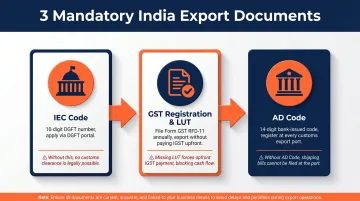
Before you ship a single unit to the US, you need three mandatory India-side export documents in place:
IEC (Import Export Code): This 10-digit number from the Directorate General of Foreign Trade (DGFT) is required for all commercial exports from India. Apply through the DGFT portal — it's your business identification number for cross-border trade.
GST Registration and Letter of Undertaking (LUT): Your GST registration enables you to file a LUT annually using Form GST RFD-11 on the GST Portal. The LUT allows you to export goods without paying IGST upfront, preserving working capital. Without it, you pay IGST on every export and wait for refunds — a cash flow problem for bulk shipments — and it must be renewed each financial year.
Authorized Dealer (AD) Code: Your bank issues this 14-digit code, which must be registered at every customs port from which you ship. Without a registered AD Code at your export port, customs will not clear your shipment. The AD Code also enables you to claim export incentives like GST refunds, Duty Drawback, and RoDTEP.
FSSAI for Food Products: If you're exporting packaged food, spices, or supplements, you need a Central FSSAI license. On the US side, FDA requires Prior Notice for all food imports under the Bioterrorism Act — submit this before your shipment arrives at the US port.
Step 2: Set Up Your US Sales Channel
You have two primary options for selling in the US market:
Amazon Seller Central USA via Amazon Global Selling:
Register using your Indian PAN, GST certificate, and Aadhaar/passport. You need a Professional Seller account at $39.99/month to access FBA and advanced selling tools. Complete the US tax interview using Form W-8BEN (individual) or W-8BEN-E (business entity) — this determines your tax withholding status.
You'll need an EIN (Employer Identification Number) from the IRS. It's free and can be obtained by phone (immediate issuance) or fax (4-day turnaround). Foreign applicants cannot use the online system — enter "foreign" or "N/A" on line 7b of Form SS-4 where it asks for a US SSN.
DTC Website via Shopify or Similar:
Set up a Shopify store, configure a US payment processor, and optionally form a US LLC for easier business banking. Most major US banks require a US entity to open business accounts — fintech alternatives like Mercury or Payoneer may offer accounts to foreign sellers with fewer requirements.
Walmart Marketplace:
Walmart now accepts Indian sellers directly — no US business entity required. You can register using your Company PAN, GST certificate, and Certificate of Incorporation. However, Walmart requires fulfillment through Walmart Fulfillment Services (WFS) or a B2C US warehouse with returns capability. Walmart has a higher approval bar than Amazon and is better suited for sellers with existing US sales traction.
Step 3: Choose and Set Up Your US Fulfillment Partner
Your fulfillment location determines delivery speed, channel eligibility, and compliance exposure. Choose carefully — this is where your US inventory will be stored and from where all customer orders will ship.
Option A: Amazon FBA
You ship inventory to Amazon's fulfillment centers. Amazon handles pick, pack, ship, and customer service. Orders are Prime-eligible, which directly addresses the cart abandonment problem — fast delivery is the single largest controllable abandonment driver after price.
Option B: US-Based 3PL Warehouse
You ship to a third-party logistics provider's facility. The 3PL fulfills orders from any sales channel — Amazon, Shopify, Walmart, or others — giving you channel flexibility.
What Your Product Category Determines:
Amazon FBA restricts several product types and offers no specialized storage environments. Key limitations include:
- Prescription medical devices are prohibited entirely
- OTC Class I/II medical devices require category approval and 510(k) documentation
- Dietary supplements need a Certificate of Analysis from an ISO/IEC 17025 lab and 105+ days remaining shelf life at check-in
A US 3PL can provide purpose-built storage for sensitive, regulated, or temperature-specific products.
For medical device and health product sellers, the 3PL must hold FDA-cleared facility status, ISO compliance, and GMP-compliant processes. Even fully compliant products stored in a non-compliant warehouse create regulatory exposure.
For example, Bluebonnet Medical Supplies (Cedar Park, TX) is a specialized medical 3PL that offers FDA-cleared, ISO/GMP-compliant storage and fulfillment specifically for medical product sellers operating from India.
Amazon FBA integrates natively with Seller Central. 3PLs typically connect via API or order management platforms like ShipStation, Veeqo, or Pipe17. Verify integration capabilities before committing to a 3PL.
Step 4: Bulk Ship Inventory from India to Your US Fulfillment Location
Inventory is sent in bulk — one international shipment covering many units — not a per-order cross-border shipment.
Sea Freight vs. Air Freight:
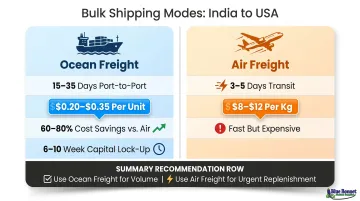
- Ocean FCL (20-ft container): 15-35 days port-to-port, $2,000-$3,500 per container, approximately $0.20-$0.35 per unit for 10,000-unit shipments
- Air freight express: 3-5 days, $8-12 per kg — fast but expensive
- Door-to-door sea freight including customs: 30-40 days
Ocean freight cuts per-unit landed cost by 60-80% compared to air, but locks up capital for 6-10 weeks during each replenishment cycle.
Critical: Use Correct HS Codes
Work with a freight forwarder experienced in India-to-USA commercial shipments. Incorrect HS codes for customs classification can result in shipment detention, additional duties, or seizure. Have a licensed customs broker review your documentation before dispatch.
US Import Requirements:
An Importer of Record (IOR) must file customs paperwork and pay applicable duties on arrival. For commercial shipments over $2,500, formal entry is required. The IOR role can be filled by:
- You directly, if you have a US entity
- A licensed customs broker
- Your fulfillment partner, for certain 3PLs that offer IOR services
Once inventory is received and logged at the US fulfillment location, all subsequent customer orders ship domestically within the US — standard 2-5 business day delivery, Prime-eligible if using FBA, with no per-order customs or international shipping fees.
What You Need Before You Begin
Both India-side and US-side preparation must be fully completed before sending the first bulk shipment. A single missing document can trigger customs holds, inventory rejection, or account suspension — delays that cost far more than the paperwork would have.
Indian Export Requirements
- IEC code from DGFT
- Active GST registration
- Annual LUT filing to export without IGST
- Authorized Dealer code registered at export port
- Commercial invoice and packing list for the bulk shipment
- Correct HS codes for every SKU being exported
- FSSAI registration if exporting food products
US-Side Requirements
- EIN from the IRS (free, processed within days)
- Seller account on Amazon, Walmart, or Shopify
- US return address or fulfillment partner address for customer returns
- Product-specific compliance documentation — research what certifications apply to your product category
Compliance documentation varies by product type. Common examples include:
- FDA 510(k) clearance for Class II medical devices
- CPSC certifications for children's products (third-party lab testing required)
- UL listing for electronics
Compliance and Product Readiness
Verify product compliance and secure all documentation before you dispatch the first bulk shipment. US Customs and Border Protection (CBP) can detain or reject shipments at the point of entry if required certifications are missing.
For regulated products like medical devices or health supplements, confirm that your chosen US fulfillment partner holds the required facility certifications — not just that your product is compliant. A mismatch between product compliance and warehouse certification opens you up to legal liability.
FDA can permanently refuse entry of non-compliant shipments — you then have 90 days to export or destroy goods at your own cost.
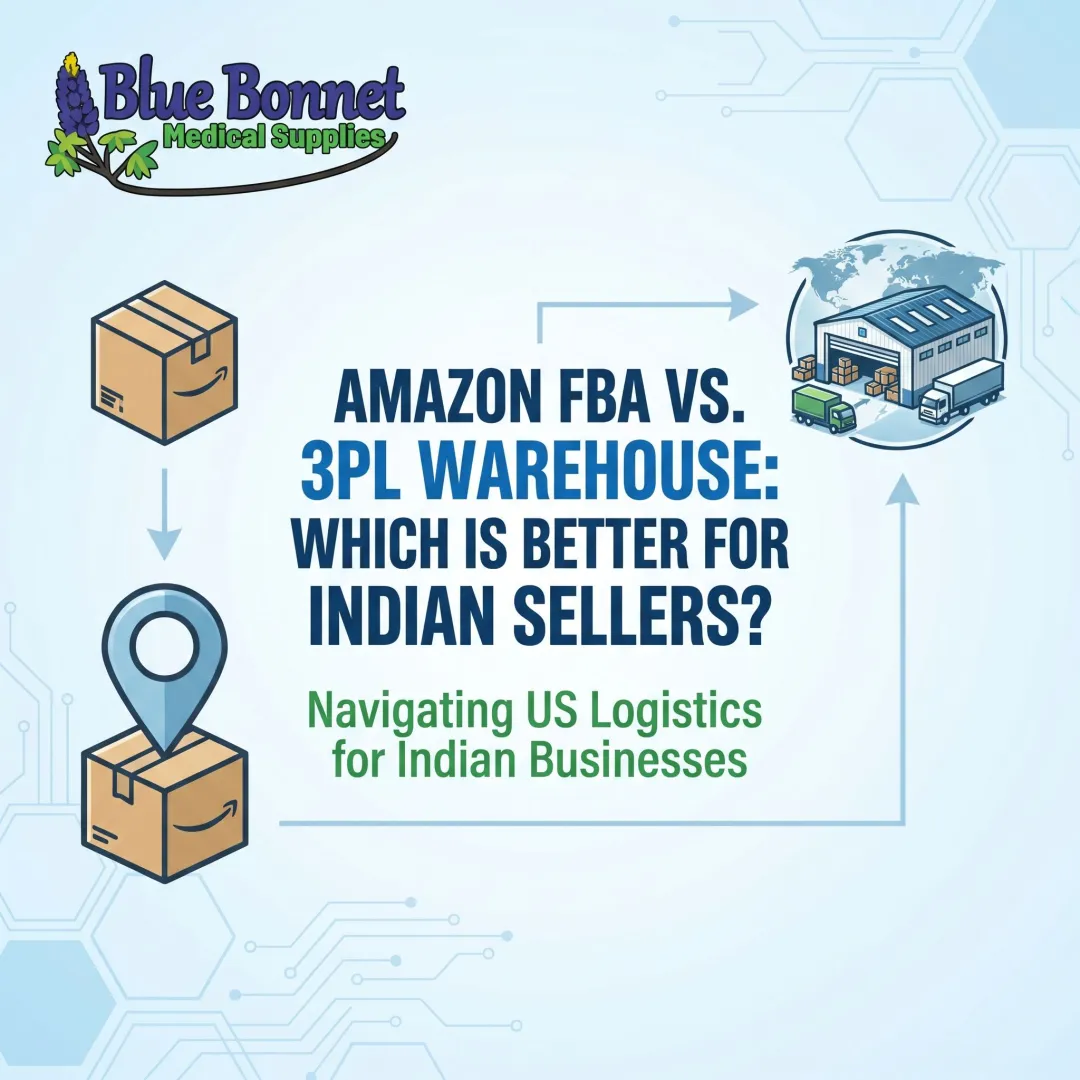
Amazon FBA vs. US 3PL Warehouse: Which Fulfillment Model Fits Your Business?
Choosing between Amazon FBA and a US 3PL warehouse shapes everything downstream: your cost per order, which sales channels you can serve, and whether your product category can even qualify. For medical product sellers, this last point matters more than most — FBA restrictions on health and medical items eliminate it as an option for many businesses before the comparison even starts.
Amazon FBA: Pros and Ideal Use Case
Advantages:
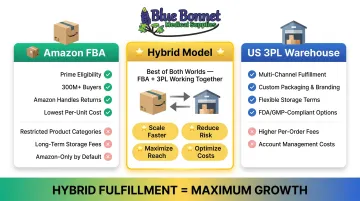
- Prime eligibility drives faster conversion
- Built-in marketplace audience — over 300 million active users
- Amazon handles customer service and returns
- No need for separate warehouse relationships
- Lowest per-unit fulfillment cost — approximately 70% less than comparable premium shipping options
Best for: Sellers whose primary or only sales channel is Amazon and whose product category is approved for FBA without restrictions.
Limitations:
- Strict prep and labeling requirements
- Restricted product categories — many medical devices, supplements, and certain health products require prior approval or are prohibited
- Long-term storage fees for slow-moving inventory (spikes to $2.40/cu ft in Q4)
- Cannot fulfill orders from other sales channels unless using Multi-Channel Fulfillment (MCF)
US 3PL Warehouse: Pros and Ideal Use Case
Advantages:
- Channel-agnostic fulfillment: ship orders from Amazon, Shopify, Walmart, or any channel from one inventory pool
- Custom packaging options
- Flexible storage terms without FBA's aged inventory penalties
- Specialized storage environments for regulated, temperature-sensitive, or compliance-sensitive products
Best for: Multi-channel sellers, DTC brands, or businesses with regulated or specialized products that FBA cannot accommodate.
Considerations:
- Higher per-order fulfillment fees than FBA for lightweight items
- Must manage warehouse relationship and integrations
- Account management fees (typically $100–$500/month)
Hybrid Approach
Many India-based sellers managing both Amazon and DTC channels run a hybrid model: FBA handles Amazon marketplace inventory (preserving Prime eligibility) while a 3PL fulfills website and non-Amazon orders. Inventory splits either at the point of US import or the 3PL holds the full pool and routes non-Amazon orders directly.
Amazon Multi-Channel Fulfillment (MCF): FBA inventory can fulfill orders from Walmart, Shopify, eBay, and other channels in unbranded packaging. A 5% surcharge applies when blocking Amazon Logistics (required for Walmart). That surcharge is waived until January 14, 2027, which makes consolidating all inventory in FBA while selling across multiple channels a workable option for now.
Key Variables That Determine Your Success
Inventory Planning and Reorder Lead Times
The biggest operational risk is a US stockout while the next bulk replenishment is in transit from India.
Replenishment Cycle Timeline:
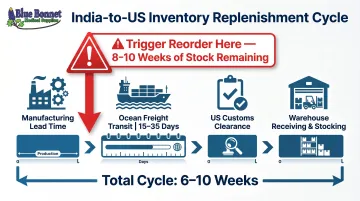
- Sea freight port-to-port: 15-35 days depending on coast
- Door-to-door including customs clearance: 30-40 days
- Adding procurement lead time: 6-10 weeks total replenishment cycle
Maintain 8-12 weeks of safety stock to avoid stockouts. Stockouts on Amazon collapse search rankings and review velocity — recovery can take months.
Unit Economics with US Fulfillment Costs Fully Loaded
Run your numbers fully loaded before committing to large inventory positions. Calculate per-unit cost including:
- COGS
- Bulk outbound freight from India (divided per unit)
- Import duties at applicable tariff rates
- US warehousing fees
- Per-order fulfillment/pick-pack-ship fee
- Returns processing cost
Compare this against your selling price to determine whether the margin is viable before committing to large inventory positions.
Example Tariff Ranges (Subject to Change):
- Textiles/Apparel (Chapters 61-62): 12-32% MFN duty
- Medical devices/instruments (Chapter 90): 0–5% for many categories, though some vary by product classification
Always verify via the USITC HTS database.
Product-to-Channel-to-Fulfillment Fit
Verify that your specific product, chosen sales channel, and fulfillment partner's capabilities are all aligned before the first bulk shipment. Sellers who skip this step face costly consequences: a regulated medical product listed on Amazon FBA in a restricted category, for example, can result in inventory rejection or listing suppression. Confirm channel eligibility and 3PL capabilities before your first container ships — not after.
Common Mistakes to Avoid
Shipping Inventory with Incorrect HS Codes or Missing Compliance Documentation
Bulk shipments held at US customs due to wrong HS codes or absent product certifications can be detained for weeks or permanently rejected. For first-time India-to-US sellers, this is often the most expensive delay they didn't see coming.
Have a licensed customs broker review your documents before dispatch. Ensure all FDA clearances, CPSC certifications, or other required documentation is complete and attached to the shipment.
Choosing a Fulfillment Partner That Does Not Match Product Requirements
Using a general-purpose 3PL for medical devices or health products that require FDA-cleared storage, or selecting Amazon FBA for a product category it restricts, leads to inventory rejection, compliance violations, or forced re-routing of goods.
Before signing with any fulfillment partner, medical device sellers should verify:
- FDA establishment registration (21 CFR Part 807)
- cGMP compliance (21 CFR Part 111 for supplements)
- Appropriate storage conditions for sensitive or regulated products
Underestimating Replenishment Lead Times and Running Out of US Stock
Unlike domestic sellers who can restock in days, Indian sellers face a 6-10 week minimum replenishment cycle (manufacturing + freight + customs clearance).
Plan your inventory strategy around the full cycle, not just shipping time:
- Track sell-through rates weekly, not monthly
- Trigger reorders when you have 8-10 weeks of stock remaining
- Never wait until you're already running low — the replenishment window won't accommodate it
Conclusion
The store-once-ship-locally model — using Amazon FBA or a US 3PL — makes selling from India to US customers practical by cutting out per-order international shipping entirely. Four foundations determine whether it works:
- Indian export documentation: IEC, GST registration, LUT filing, and AD Code
- US compliance: EIN, seller account, and applicable product certifications
- Unit economics: fully-loaded costs including duties, prep fees, and storage before you price
- Fulfillment partner fit: capabilities matched to your product type, not just warehouse proximity
For medical device and regulated goods sellers, the fulfillment partner decision carries as much weight as product compliance. A 3PL without proper FDA-cleared, ISO/GMP-compliant handling puts you at risk of storage violations, Amazon selling suspensions, or recall exposure — all of which are far harder to resolve once inventory is already stateside. Partners like Bluebonnet Medical Supplies, built specifically for medical product logistics, handle these requirements as standard practice rather than add-ons.
Frequently Asked Questions
Can I sell to Amazon USA from India?
Yes, Indian sellers can register through Amazon Global Selling, obtain an EIN, complete the US tax interview using Form W-8BEN or W-8BEN-E (the IRS foreign entity tax forms), and ship inventory to Amazon FBA centers. No US company is required to get started.
Can I sell in Walmart USA from India?
Walmart Marketplace accepts international sellers but requires a US-registered business entity, an application and approval process, and a US fulfillment setup. It's more restricted than Amazon and better suited for sellers with an existing US sales track record.
Can I make $1000 a month selling on Amazon?
This is achievable but depends on product selection, pricing, US fulfillment costs, and advertising spend. Run the numbers on fulfillment fees, shipping costs, and ad spend before scaling to confirm your margins hold up.
Which Indian products are in demand in the US?
Categories with strong India-to-US export demand include:
- Textiles and apparel
- Home goods and handicrafts
- Spices and packaged food
- Medical and health products
- Engineered goods
Check current search volume and competitor listings on Amazon before committing to inventory.
Do I need a US company to store inventory in a US warehouse from India?
A US legal entity is not strictly required for Amazon FBA (an EIN suffices), but a US LLC simplifies business banking, payment collection, and certain 3PL partnerships. A licensed customs broker or IOR service can handle import filing without a US entity.
What is the difference between Amazon FBA and a 3PL warehouse for US fulfillment?
FBA is Amazon's fulfillment network, limited to Amazon marketplace orders with Prime eligibility included. A 3PL is an independent US warehouse that fulfills orders from any sales channel and can offer specialized storage for regulated or sensitive products that FBA cannot accommodate.