
Introduction
Medical product companies manufacturing overseas face a hard reality when selling into the US market: customers expect delivery in 2–5 days, yet cross-border freight takes weeks. Add FDA import scrutiny, cold-chain requirements, and HIPAA-safe handling rules to the mix, and the gap between production and doorstep becomes a serious operational problem.
Ultrahuman's US fulfillment strategy — built around pre-positioned inventory, compliant warehousing, and carrier partnerships — illustrates how medical product businesses can close that gap. For companies navigating the same terrain, the core lesson is straightforward: the right 3PL partner on US soil handles the last mile so overseas manufacturers don't have to.
This case study breaks down how that model works in practice, and what medical product businesses should look for when building a US fulfillment operation from scratch.
TLDR: Key Takeaways from This Case Study
- Ultrahuman uses bulk freight from India to US-based warehouses rather than shipping individual orders internationally
- Smart rings enter the US duty-free under HTS 9031.80.8085, reducing import costs significantly
- Health wearables classified as "general wellness devices" sidestep FDA pre-market clearance — but only with precise, consistent marketing language
- US-based 3PL fulfillment converts an international supply chain into domestic 2-5 day delivery once inventory clears customs
- Returns, inventory replenishment, and carrier negotiations happen on US soil to preserve speed and customer experience
The Cross-Border Challenge: Why Shipping Health-Tech from India to the US Is Uniquely Hard
Indian D2C brands targeting the US market face a delivery expectation gap that directly impacts revenue. Baymard Institute research shows 39% of shoppers abandon carts due to high shipping costs, while 21% walk away because delivery feels too slow. For a $349 smart ring, a 14-day international shipping estimate paired with a $35 fee creates enough friction to push buyers toward competitors with domestic inventory.
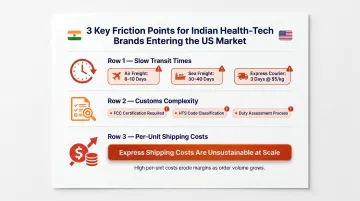
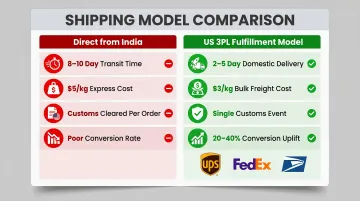
The distance compounds the problem. Standard air freight from India to the US takes 8-10 days door-to-door, while sea freight stretches to 30-40 days. Express courier services like DHL cut transit to three days but cost approximately $5 per kilogram — unsustainable at scale for mid-priced wearables.
Health-monitoring devices add regulatory complexity. Smart rings with PPG sensors, accelerometers, and temperature trackers occupy a gray zone: not quite Class II medical devices, but scrutinized more heavily than standard consumer electronics. Clearing that bar requires:
- FCC certification for wireless functionality
- Correct import classification to avoid customs holds
- Carefully worded marketing to stay clear of FDA medical device triggers
Ultrahuman's early US operations ran directly into all three friction points: slow transit times eroding conversion rates, customs delays on electronics shipments, and per-unit express shipping costs that made direct-from-Bengaluru fulfillment financially unworkable at scale. The path forward was building US-side inventory infrastructure rather than absorbing those costs indefinitely.
How Ultrahuman Structures Its India-to-US Shipping Pipeline
Rather than shipping individual customer orders from India, health-tech brands consolidate inventory into bulk freight shipments to US-based warehouses. This model flips the economics: instead of paying $5/kg for thousands of individual express parcels, brands pay approximately $3/kg for standard air freight on consolidated shipments of 150-500 kg.
For lightweight, high-value products like smart rings (weighing just 3-4 grams each), air freight hits the right balance between speed and cost. A 300 kg shipment can carry tens of thousands of rings, spreading the $900 freight cost across the entire batch rather than paying $15-20 per individual shipment.
Required Import Documentation
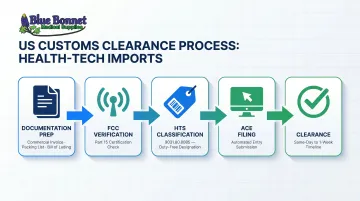
Health-tech products entering the US require specific customs documentation:
Core Documents:
- Commercial invoice with accurate product value and origin
- Packing list identifying package contents
- Bill of lading or air waybill proving right to make entry
- Country of origin certificate
Regulatory Filings:
- Entry manifest (CBP Form 7533 or 3461) filed within 15 days of arrival
- Entry summary (CBP Form 7501) for duty assessment within 10 working days
- FCC Form 740 certifying radio frequency compliance for Bluetooth devices
The Ultrahuman Ring AIR holds FCC ID 2A99X-ULTRAHUMAN01, granted in March 2023 for Part 15C low-power Bluetooth transmission. Without this certification, wireless wearables cannot legally enter the US market.
Customs Brokerage and Classification
Licensed US customs brokers handle entry filing, duty payment, and regulatory representation. A June 2024 CBP ruling classified the Samsung Galaxy Smart Ring under HTS 9031.80.8085 — "measuring or checking instruments" — at a duty rate of Free. This precedent applies to similar smart rings: the device analyzes biometric data rather than simply counting steps, and lacks a display for active notifications, disqualifying it from communication device categories.
Clearance timelines vary. Low-risk entries with clean documentation transmitted through the Automated Commercial Environment (ACE) often clear the same day. Vague product descriptions, classification disputes, or physical inspections trigger delays.
How quickly a shipment clears customs directly shapes how much runway brands have to restock before peak demand hits.
Inventory Timing and Demand Forecasting
Health and wellness ecommerce sees its strongest demand window in January, driven by New Year's resolution purchases. With sea freight requiring 30-40 days and air freight 8-10 days, brands must ship inventory by mid-November (sea) or early December (air) to serve the January surge. Stockouts during peak periods cost the retail industry an estimated $1.77 trillion annually.
Most brands running this model maintain 4-8 weeks of forward inventory cover in US warehouses, using sales velocity data to trigger replenishment orders before stock runs low.
US Fulfillment Infrastructure: Warehousing, Pick-Pack, and Last-Mile Delivery
Once bulk inventory clears US customs, the global supply chain problem becomes a domestic fulfillment operation. Ultrahuman's US operations center on warehousing that receives consolidated shipments from India and fulfills individual customer orders domestically — transforming a 10-day international transit into 2-5 day ground delivery.
What Capable 3PL Partners Provide
Health-tech devices require more than generic warehousing:
Storage Standards:
- Climate-controlled environments protecting batteries and sensors
- ESD-safe handling to prevent static damage to electronics
- Scan-based inventory tracking for real-time stock visibility
Integration Capabilities:
- Direct connections to ecommerce platforms (Shopify, WooCommerce)
- Automated order routing without manual intervention
- Real-time tracking synced back to the brand's website
Compliance Infrastructure:
- Documentation standards meeting regulatory requirements
- Proper labeling verification before shipment
- Returns processing with inspection protocols
VAHDAM India, a Delhi-based D2C tea brand, provides a useful benchmark. By using Amazon Multi-Channel Fulfillment (MCF) integrated with Shopify, VAHDAM achieved 400% year-over-year growth and 15% fulfillment cost savings through single-click order automation. Orders placed on VAHDAM's website route automatically to Amazon's warehouse network, which handles picking, packing, and shipping while syncing tracking data back to Shopify in real time.
That model works well for consumer goods. For health-tech and medical products, where a mislabeled shipment can trigger FDA scrutiny, customs holds, or product recalls, the compliance bar is higher. Specialized 3PLs like Bluebonnet Medical Supplies are built for that standard — offering FDA-cleared medical packaging, ISO and GMP compliance, and direct carrier relationships that reduce shipping costs without cutting regulatory corners.
Last-Mile Delivery Strategy
Once inventory sits in US warehouses, orders ship via domestic carriers (UPS, FedEx, USPS) with typical 2-5 business day delivery. That speed has a direct effect on revenue: offering 2-3 day shipping can increase conversion rates by 20-40%. Key factors that determine last-mile performance include:
- Carrier mix (UPS, FedEx, USPS) selected based on zone and package weight
- Displayed delivery estimates on product pages, which reduce cart abandonment
- Returns routing back to the 3PL for inspection and restocking
When the fulfillment infrastructure is solid, the delivery promise becomes a selling point — not just a logistics footnote.
Regulatory and Compliance Considerations for Health-Tech Devices in the US
FDA General Wellness Device Policy
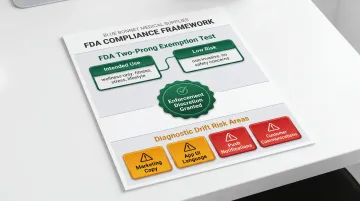
The FDA's General Wellness Policy, reissued January 6, 2026, exempts low-risk, non-invasive devices making wellness-only claims from 510(k) premarket notification, establishment registration, device listing, and Quality System Regulation (QSR) requirements.
Two-Prong Test for Exemption:
- Intended use must relate to general wellness only — maintaining healthy lifestyles, stress management, physical fitness, or chronic disease risk reduction where the lifestyle-disease link is well-established
- Device must pose low risk — non-invasive, no energy modalities raising safety concerns, no biocompatibility issues
Products meeting both criteria operate under FDA enforcement discretion. The agency will not enforce medical device requirements, cutting months off regulatory timelines and removing QSR overhead.
The Enforcement Reality:
In July 2025, the FDA sent a warning letter to WHOOP, Inc. for blood pressure measurement functionality, arguing that blood pressure tracking is "inherently associated" with diagnosing hypertension. This action demonstrates the FDA's "overall impression" enforcement approach : the agency evaluates product listings, app interfaces, push notifications, and social media marketing as a single package.
A single notification referencing clinical thresholds can reclassify an entire product line. Smart ring manufacturers must audit all of the following to avoid "diagnostic drift" that triggers medical device classification:
- Marketing copy and product listings
- App UI language and push notification wording
- Customer communications referencing health thresholds
FCC Certification for Wireless Devices
All Bluetooth-enabled devices sold in the US must comply with FCC Part 15 rules. The Ultrahuman Ring AIR's FCC certification covers Bluetooth Low Energy transmission on 2402–2480 MHz frequencies. Devices too small to accommodate the required compliance statement in 4-point font may place it in user manuals and on packaging instead — a critical exception for smart rings.
Without FCC certification, wireless wearables cannot legally be imported or sold in the US market. For 3PL providers and fulfillment partners handling such devices, verifying FCC certification status before warehousing or shipping is a necessary compliance step.
Managing Scale: Returns, Inventory Replenishment, and Peak Demand
US Returns Processing
The National Retail Federation reports that 19.3% of online sales are returned, with total US returns projected at $849.9 billion in 2025. Consumer electronics see return rates at or above this average due to fit issues and buyer's remorse on premium items.
Successful brands handle US returns domestically rather than shipping items back to India. The US 3PL receives returned products, conducts inspection and testing, and either restocks functional items or disposes of them appropriately. A capable partner like Bluebonnet Medical Supplies can test and restore returned health-tech devices, recovering value that would otherwise be written off.
Keeping the returns loop domestic preserves speed and customer experience while reducing reverse logistics costs.
Replenishment Cycles
Total lead time from Indian manufacturing to US warehouse availability:
| Phase | Air Freight | Sea Freight |
|---|---|---|
| Manufacturing & QC | 2-4 weeks | 2-4 weeks |
| Transit time | 8-10 days | 30-40 days |
| Customs clearance | Same day to 1 week | Same day to 1 week |
| Warehouse inbound | 2-5 days | 2-5 days |
| Total | 4-6 weeks | 7-10 weeks |
Brands use sales data to trigger replenishment orders before inventory hits critical levels. For January's resolution-driven demand spike, inventory must ship by mid-November (sea) or early December (air) to arrive, clear customs, and be available for fulfillment.
Carrier Relationships and Cost Management
US-based 3PLs manage carrier relationships that most brands can't replicate on their own. Working through a fulfillment partner gives brands access to:
- Negotiated discounted rates across multiple carriers
- Carrier selection optimized by zip code or delivery speed requirement
- Built-in protection against carrier service failures

These advantages are managed by the 3PL, not the brand — keeping costs down without adding operational complexity.
Key Takeaways: What Indian Health-Tech Brands Can Learn from Ultrahuman's US Playbook
Ultrahuman's US fulfillment model rests on three operational layers that mid-size Indian D2C brands can replicate:
Layer 1: Bulk Freight with Proper Documentation
Consolidate inventory into air or sea freight shipments with complete customs documentation, accurate HTS classification (9031.80.8085 for smart rings), and licensed customs brokerage. This cuts per-unit shipping costs by 40-60% compared to individual international parcels.
Layer 2: Compliant US-Based 3PL Warehousing
Partner with a fulfillment provider offering ecommerce platform integration, climate-controlled storage, and compliance infrastructure appropriate to your product category. For health and wellness devices, this means FDA-compliant handling, proper documentation standards, and returns processing capabilities.
Layer 3: Domestic Last-Mile via Established Carrier Networks
Once inventory clears customs and enters US warehouses, leverage domestic carrier relationships to deliver 2-5 day shipping that meets customer expectations and drives conversion.
For health and wellness devices, cutting corners on import documentation, device certification, or fulfillment partner compliance creates business-ending risk. The October 2025 ITC ruling that blocked Ultrahuman's US imports due to a patent dispute makes this concrete: intellectual property due diligence must be part of the US market entry strategy, not just logistics planning.
Even a perfectly optimized fulfillment operation cannot overcome regulatory or IP barriers at the border.
Brands that invest in compliance infrastructure early scale without interruption. That means:
- Seeking CBP classification rulings before your first shipment
- Obtaining FCC certification during product development, not after
- Maintaining disciplined marketing language to preserve general wellness positioning
- Partnering with a specialized 3PL that understands your product category's regulatory requirements
The model is replicable. Brands that execute it consistently reach US customers without the border delays, customs holds, or legal disputes that derail less-prepared competitors.
Frequently Asked Questions
How do Indian brands like Ultrahuman handle US customs clearance for health-tech products?
Brands work with licensed US customs brokers who manage HTS classification (9031.80.8085 for smart rings, which enter duty-free) and prepare full documentation — commercial invoices, packing lists, and origin certificates. Clean paperwork submitted through the Automated Commercial Environment typically clears the same day.
Does the Ultrahuman Ring AIR need FDA approval to be sold in the US?
No. The FDA's General Wellness Policy exempts low-risk, non-invasive devices making wellness-only claims from 510(k) clearance requirements. However, FCC certification for Bluetooth functionality is mandatory, and brands must audit all marketing content to avoid diagnostic claims that would reclassify the product as a medical device.
Why do Indian D2C brands use a US-based 3PL instead of shipping orders directly from India?
A US-based 3PL cuts per-shipment international express costs (roughly $5/kg) and enables 2-5 day domestic delivery — which research links to 20-40% higher conversion rates. Customs complexity shifts from individual orders to managed bulk freight, keeping costs low without sacrificing speed.
What should Indian health or medical product brands look for when choosing a US 3PL partner?
Prioritize FDA-compliant handling, ISO/GMP certifications, and ecommerce platform integration for automated order routing. Strong carrier relationships and returns processing with product restoration are also worth vetting. Bluebonnet Medical Supplies, based in Cedar Park, TX, is built specifically for health and wellness brands that need compliance-first fulfillment.
How do Indian brands manage inventory replenishment to avoid US stockouts?
Brands use sales velocity data and lead-time buffers (typically 4-8 weeks of forward inventory cover) to trigger bulk freight shipments from India before stock runs critically low. For January's peak demand window, inventory must ship by mid-November (sea freight) or early December (air freight) to arrive and clear customs in time.
What role does packaging compliance play in shipping health-tech products from India to the US?
Products must carry FCC markings, correct English-language labels, and any applicable regulatory identifiers before leaving India. Non-compliant packaging causes customs delays or product rejection on arrival, disrupting the entire fulfillment pipeline and creating stockouts that cost revenue during peak demand periods.