Introduction
Medical product businesses face mounting operational pressure: FDA scrutiny intensifies, cross-border shipping grows more complex, and fulfillment costs continue to rise. Managing inventory in-house under these conditions isn't just difficult—it's increasingly unsustainable.
For medical product companies, the real value of 3PL inventory management shows up in day-to-day outcomes: fewer compliance failures, fewer shipping delays, and lower carrying costs. This article covers what you need to know:
- The key advantages of outsourcing medical inventory management
- What goes wrong when companies try to handle it in-house
- How to get the most from a 3PL partnership
TL;DR
- Outsourcing to a 3PL means a specialized provider handles your storage, tracking, and fulfillment — freeing you to focus on growth
- Cost savings through carrier partnerships, real-time inventory visibility, and built-in regulatory compliance are the core advantages
- Skipping structured 3PL management leads to stockouts, compliance failures, and logistics costs that compound fast
- Choosing a 3PL with industry-specific experience — not a generalist warehouse — determines whether your operation scales or stalls
- For medical product businesses, partnering with a compliant, specialized 3PL directly affects customs clearance, product safety, and customer trust
What Is 3PL Inventory Management
3PL inventory management means outsourcing the storage, tracking, replenishment, and fulfillment of your inventory to a third-party provider who manages these operations on your behalf. Rather than running your own warehouse, you partner with a logistics specialist who handles the day-to-day details.
This model applies most commonly to product-based businesses that ship moderate to high volumes but don't want to operate their own warehouses. The outcome is control, compliance, and operational consistency—without investing in the infrastructure to get there.
Businesses that typically use 3PL inventory management include:
- Medical device manufacturers managing regulated product lines
- Online retailers and Amazon sellers scaling fulfillment volume
- Companies shipping medical products domestically and overseas
- Small to mid-size brands that need warehouse capacity without the overhead
For medical product businesses specifically, 3PL inventory management addresses a critical need: maintaining regulatory compliance while scaling operations. Products that require FDA-cleared packaging, proper lot tracking, or temperature-controlled storage can't be managed casually. A specialized 3PL builds these requirements into daily operations, reducing compliance risk and keeping operations audit-ready.
Key Advantages of 3PL Inventory Management
These three advantages cover what medical product businesses actually measure: cost per order, inventory accuracy, fulfillment speed, and regulatory compliance. Each one translates to a concrete operational outcome.
Lower Fulfillment Costs Through Carrier Leverage and Shared Infrastructure
3PL providers reduce per-unit fulfillment costs by spreading overhead—warehouse space, staff, equipment—across multiple clients. Businesses pay only for what they use rather than maintaining fixed logistics infrastructure.
How carrier relationships drive savings:
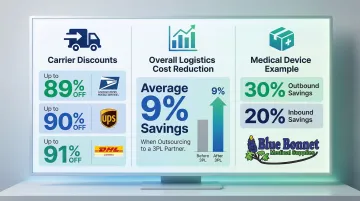
3PLs with established carrier relationships pass negotiated shipping rates to clients, rates that small-to-medium businesses cannot access independently. According to Easyship's rate comparison, 3PL aggregation platforms secure discounts up to 89% off USPS retail prices, 90% off UPS, and 91% off DHL Express.
Where the savings stack up:
Cost savings compound. Businesses eliminate warehouse leases, staffing, and equipment costs while simultaneously reducing per-shipment rates. Shippers participating in the Annual 3PL Study report an average 9% reduction in logistics costs when outsourcing. Medical device manufacturers see even higher returns—one packaging optimization case study documented 30% savings on outbound finished goods and 20% savings on inbound logistics.
That freed capital has a cleaner home in product development or market expansion than in warehouse overhead.
KPIs impacted:
- Fulfillment cost per order
- Shipping cost per unit
- Warehouse overhead as % of revenue
- Inventory carrying costs
When this advantage matters most:
Businesses shipping moderate-to-high volumes across multiple channels (Amazon, DTC, international), or those scaling rapidly where fixed logistics costs would otherwise grow in step with revenue.
Real-Time Inventory Visibility and Accuracy
3PL providers operate warehouse management systems (WMS) that track inventory in real time—from receiving and putaway through pick, pack, and ship. This gives businesses accurate stock data without manual counts.
Barcode scanning, automated replenishment triggers, and live dashboards eliminate the guesswork around stock levels. This reduces the risk of overselling or stockouts and allows more precise demand forecasting.
Why accuracy gaps are costly:
Stockouts lead to an average 4% loss in annual sales, and 43% of consumers will switch to a competitor when faced with an out-of-stock product.
For medical product businesses, the stakes go further. Inventory inaccuracy creates downstream risks: unfulfilled patient orders, compliance gaps in lot traceability, and exposure during regulatory audits.
Automated WMS technology closes that gap significantly. Manual, paper-based picking systems operate at 1-3% error rates with pick rates of 60-80 units per hour. In contrast, robotic-assisted picking systems achieve error rates below 0.5% while increasing pick rates to 300-400 units per hour.
KPIs impacted:
- Order accuracy rate
- Inventory turnover ratio
- Stockout frequency
- Days of inventory on hand
- Returns rate due to fulfillment errors
When this advantage matters most:
High-SKU catalogs, businesses with seasonal demand swings, and any company selling through multiple channels simultaneously where overselling is a constant risk.
Regulatory Compliance and Risk Management for Medical Products
For medical product businesses, inventory management isn't just operational—it's regulatory. Products that aren't stored, labeled, or shipped according to FDA, ISO, GMP, or HIPAA standards can be rejected at customs, flagged by regulators, or recalled.
How compliant 3PLs enforce standards:
A compliant 3PL enforces these standards systematically:
- Temperature-controlled or specialized storage for sensitive items
- Proper documentation for cross-border shipments
- Lot tracking for traceability
- Returns processing that meets restoration or disposal protocols
The cost of getting it wrong:
The direct cost of non-compliance is severe. A single warranty or recall process can cost a manufacturer up to $600 million, with the medical device industry facing up to $5 billion in costs annually due to recalls. U.S. Customs and Border Protection actively seizes misbranded or unapproved medical devices—recent operations in Cincinnati resulted in seizures valued at $3.53 million and $407,784.

Beyond financial penalties, compliance failures damage customer trust. Buyers of medical products—whether B2B or B2C—expect products to arrive intact, properly labeled, and in compliance. A 3PL that enforces these standards reduces liability and builds client confidence.
Bluebonnet Medical Supplies holds FDA-cleared packaging, ISO, and GMP certifications, with warehouse operations built around the handling requirements of regulated medical products—including lot traceability, proper storage conditions, and HIPAA-safe handling practices.
KPIs impacted:
- Customs clearance success rate
- Compliance audit pass rate
- Returns/rejection rate
- Lot traceability accuracy
When this advantage matters most:
Any business shipping regulated medical products domestically or internationally, especially those selling on Amazon (which has strict product compliance requirements) or exporting to markets with customs documentation requirements.
What Happens When 3PL Inventory Management Is Missing or Ignored
Most businesses don't recognize the cost of poor inventory management until it shows up in lost orders, regulatory action, or ballooning overhead. The damage compounds across several fronts.
Stock visibility gaps are the first failure point. Without systematic tracking, businesses operate blind — stockouts hit during demand peaks while slow-moving product ties up working capital. Inventory carrying costs average 15–25% of total inventory value annually, a penalty that falls hardest on medical suppliers holding excess stock.
Fulfillment errors are more expensive than most businesses realize. Manual processes and disorganized warehouse operations drive picking errors, wrong shipments, and returns that cost more to resolve than the original order. A single fulfillment error carries hard costs between $47 and $93 — covering original shipping, return shipping, re-pick labor, re-pack labor, and customer service time. For a warehouse processing 500,000 orders annually at a 3% error rate, that's 15,000 mistakes costing between $705,000 and $1.4 million in hard costs alone.
Beyond the direct costs, three additional problems tend to follow:
- Reactive firefighting replaces growth work — teams spend time resolving problems instead of preventing them, keeping the business in constant crisis mode
- Per-unit costs climb steadily — carrying excess inventory, paying retail shipping rates, and handling returns manually all push costs higher than a well-run 3PL arrangement
- Compliance exposure increases with scale — for medical product companies, informal inventory management carries real risk; a missed lot trace, an improperly packaged device, or a customs documentation gap can halt operations entirely
The customer-side damage is just as lasting. 69% of shoppers are less likely to return to a brand after a poor delivery or fulfillment experience — a permanent loss of customer lifetime value that no discount or apology fully recovers.
How to Get the Most Value from 3PL Inventory Management
3PL inventory management delivers the best results when you treat it as an active partnership. Businesses that get the most value stay engaged with their data, review performance regularly, and communicate clearly with their provider. Three habits make the biggest difference: standardizing processes upfront, tracking the right metrics, and acting on what the data tells you.
Standardize Processes from Day One
Establish standard operating procedures with your 3PL before inventory arrives:
- Agreed-upon receiving protocols
- Labeling requirements
- Order routing rules
- Compliance documentation standards
This eliminates ambiguity during high-volume periods and ensures everyone operates from the same playbook.
Track the KPIs That Signal Problems Early
Review these metrics on a regular cadence:
- Fulfillment accuracy
- Shipping costs
- Inventory turnover
- Compliance flags
Catching a dip in fulfillment accuracy early is far cheaper than dealing with chargebacks or customer churn later. Reliable 3PLs maintain shipping and order accuracy benchmarks of 99% or above.
Turn WMS Data into Decisions
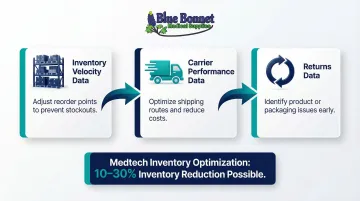
Turn data from your 3PL's WMS into action:
- Use inventory velocity data to adjust reorder points
- Use carrier performance data to optimize shipping routes
- Use returns data to identify product or packaging issues early
For medical product businesses specifically, this kind of active data use carries real financial weight. Medical technology companies typically hold up to three times more inventory than consumer packaged goods companies — and optimizing inventory management can reduce medtech inventory levels by 10% to 30%, freeing up cash and reducing write-offs.
Conclusion
Effective 3PL inventory management doesn't just reduce costs — it changes what's operationally possible. Lower overhead, tighter inventory control, and consistent compliance compound over time in ways that in-house operations rarely match at the same cost or reliability level.
For medical product businesses specifically, the stakes are higher than in general retail. Regulatory exposure, customs requirements, and the sensitivity of the products themselves mean that structured, compliant inventory management is a hard operational requirement, not an optional upgrade.
3PL inventory management should be treated as an ongoing practice with the right partner. Bluebonnet Medical Supplies offers FDA, ISO, and GMP-compliant handling, warehouse infrastructure built for sensitive medical items, and direct carrier relationships — giving medical product businesses the logistics foundation to grow without operational bottlenecks.
Frequently Asked Questions
What is 3PL inventory management?
3PL inventory management is the outsourcing of a business's storage, tracking, and fulfillment operations to a third-party logistics provider. This allows the business to focus on growth while the 3PL handles day-to-day inventory control, order processing, and shipping logistics.
What is 1PL, 2PL, 3PL, 4PL, and 5PL?
Each level describes how much of the logistics function a business controls directly:
| Level | What It Means |
|---|---|
| 1PL | Company manages all logistics in-house |
| 2PL | External carriers or transporters are added |
| 3PL | Warehousing and fulfillment outsourced to an integrated provider |
| 4PL | Full supply chain managed strategically, no physical assets owned |
| 5PL | Network-wide optimization using AI and automation |
Most product businesses operate at the 3PL level.
What are the 4 types of inventory management?
The four main approaches are:
- Just-in-Time (JIT) — matches supply precisely with demand to minimize holding costs
- ABC analysis — prioritizes inventory based on revenue value
- FIFO (First In, First Out) — rotates stock chronologically to prevent spoilage or expiration
- Demand forecasting — uses predictive analytics to anticipate inventory needs
3PLs apply these methods systematically through warehouse management software.
What is the 80/20 rule for inventory?
The 80/20 rule (Pareto Principle) in inventory means roughly 80% of revenue typically comes from 20% of SKUs. Identifying and prioritizing this top-performing 20% helps businesses and their 3PL partners allocate storage, replenishment, and fulfillment resources more efficiently, reducing carrying costs and improving turnover.
How do I know if my 3PL is managing my inventory correctly?
Watch four key metrics: order accuracy rate, inventory turnover, stockout frequency, and fulfillment lead times. A reliable 3PL reports on these regularly and flags issues before they escalate — not after. Order accuracy should be 99% or above, and stockouts should be rare.
Does a 3PL handle regulatory compliance for medical products?
Not all 3PLs are equipped for medical products. Look for providers that hold FDA-cleared packaging capabilities, GMP and ISO compliance, and HIPAA-safe handling protocols — with documented lot traceability and returns processes. These aren't optional for regulated distribution; without them, shipments can fail customs or violate handling requirements. Bluebonnet Medical Supplies maintains all of these certifications specifically for medical product clients.