
Introduction
Most medical product businesses sign a 3PL contract, absorb the fees, and move on—assuming the rates are fixed. They're not.
U.S. business logistics costs reached $2.6 trillion in 2024, representing 8.7% of GDP. For medical product businesses specifically, that spend goes beyond standard storage and shipping. FDA compliance, ISO-grade handling, GMP documentation, and serialized inventory tracking all add layers of cost—and most providers build significant margin into each one.
Every line item, from inbound receiving to pick-and-pack to compliance surcharges, is negotiable. The businesses that cut costs most effectively understand how 3PL pricing is structured, what drives each fee category, and which negotiation tactics apply at each stage of the relationship. This guide covers all three.
TL;DR
- 3PL pricing breaks into three core cost categories: inbound receiving, storage, and fulfillment/shipping—all negotiable
- Medical businesses face added costs from regulatory compliance, special handling, and serialized tracking
- Better rates come from clean operational data, simplified requirements, and volume commitments tied to SLA terms
- Understanding how a 3PL prices its services gives you more negotiating leverage than pushing back on numbers alone
- Choosing a 3PL with your industry's compliance infrastructure already built in often delivers the most durable savings
How 3PL Costs Typically Build Up
3PL costs don't appear as a single invoice line. They accumulate across multiple fee categories—receiving, storage, pick-and-pack, postage markup, special handling, returns—each quoted and billed separately. This fragmentation makes total cost easy to underestimate during initial evaluations.
The gap between quoted and actual costs widens over time. Mismatched volume projections lead to underutilized storage fees. Non-standard packaging requirements add per-order labor costs. Rate escalation clauses buried in contracts can compound annual spend without a clear renegotiation trigger. Many businesses find actual logistics costs running 10–25% above initial quotes once surcharges and untracked fees surface.
For medical product businesses, those baseline costs are just the starting point. Lot tracking, serialized inventory management, temperature requirements, and compliance-related handling each add their own layer—costs that often go unnoticed until they appear as surcharges or contract amendments months into the relationship.
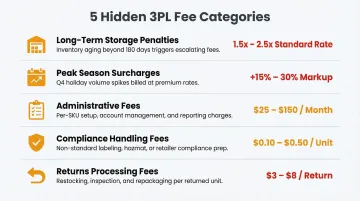
Common hidden fees include:
- Long-term storage penalties — 1.5x to 2.5x standard rates for inventory sitting beyond 30–90 days
- Peak season surcharges — 15–30% markups during Q4 and high-demand periods
- Administrative fees — charged for relabeling, shipment splits, or custom packaging requests
- Compliance handling fees — added for lot tracking, serialization, or temperature-controlled storage in regulated product categories
- Returns processing fees — billed separately from standard fulfillment, often at a higher per-unit rate
Key Cost Drivers Behind Your 3PL Rate
Inbound Receiving Fees
Receiving fees cover labor to unload, count, and verify shipment accuracy. These charges are directly affected by how well-organized and accurately labeled your inbound shipments are. Poor inbound practices raise 3PL labor costs, which eventually pass to the client.
Average inbound receiving costs: $5–$15 per pallet, with industry averages around $10.52 per pallet according to 2025 warehousing surveys.
Storage Pricing
Storage is calculated based on space occupied over time. Industrial warehouse costs rose significantly post-pandemic—despite a 7% decline in U.S. rents during 2024, year-end market rents remained 59% higher than 2019 levels.
Medical businesses with compliance-grade storage requirements face premium rates for controlled environments and restricted access. These premiums are negotiable with sufficient volume commitment.
Typical storage rates:
- Pallet storage: $20–$45 per pallet/month
- Cubic foot storage: ~$0.46 per cubic foot/month
Pick-and-Pack Fees
Pick-and-pack fees are driven by SKU complexity: the number of SKUs per order, variance in product sizes, and custom packaging requirements all increase per-order labor.
Standard pick-and-pack pricing:
- Base fee: $2.00–$5.00 per order
- Additional items: $0.30–$1.50 per unit beyond the first
- Kitting services: $0.25–$0.65 per unit or ~$43/hour
A single-SKU order incurs one pick fee. A five-SKU order incurs a base fee plus four additional item fees—costs multiply quickly with order complexity.
Shipping and Postage Costs
Shipping costs are influenced by dimensional weight, carrier selection, and the 3PL's carrier relationships. 3PLs typically mark up postage 5–20% to cover unattributable carrier charges.
Dimensional weight impact: FedEx and UPS now round up every fractional inch to the next whole number (9.1" becomes 10"), artificially inflating cubic volume and billable weight. Packages exceeding 10,368 cubic inches trigger Additional Handling Surcharges.
Providers with direct carrier relationships can pass volume discounts to clients—making carrier access a key evaluation criterion.
Compliance-Related Cost Drivers
Shipping costs are only part of the picture for medical product businesses. Compliance costs—often the largest variable—appear either as built-in infrastructure or itemized add-ons depending on how a provider is structured.
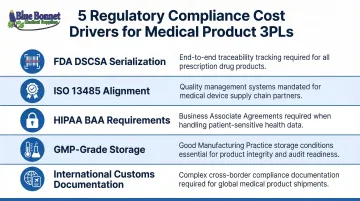
Compliance requirements driving costs:
- FDA DSCSA implementation requiring serialization tracking, SOP development, and physical segregation
- ISO 13485 alignment for medical device storage and distribution
- HIPAA Business Associate Agreements exposing 3PLs to direct financial penalties for breaches
- GMP-grade storage with controlled environments and restricted access
- International customs compliance documentation
How a provider structures these requirements directly shapes your negotiable rate baseline. A 3PL that builds FDA clearance, ISO/GMP compliance, and HIPAA-safe handling into standard operations—as Bluebonnet Medical Supplies does—gives you a single, predictable cost structure rather than a growing list of line-item surcharges.
Strategies to Negotiate Better 3PL Rates
Negotiation strategies work best when matched to the source of the cost. Reducing your rate means changing something: decisions made before the contract, how you manage the relationship during it, or external factors around it.
Strategies That Reduce Costs by Changing Decisions
Share operational data before the quote. Provide your last 60-90 days of order data: monthly volume, average SKUs per order, top-moving SKUs, packaging types, and destination zones. 3PLs price risk into their quotes — better data reduces that risk and the buffer built on top of it.
Simplify before you negotiate. The more complex your operation looks, the higher the 3PL will price it. Before entering talks:
- Drop low-performing SKUs that add handling complexity
- Standardize packaging formats (poly mailers over boxes where appropriate)
- Eliminate pack-out requirements like tissue paper or multi-insert kitting
Set volume commitments at your realistic floor. Committing to a baseline monthly order volume gives the 3PL predictable revenue, which they typically reward with lower per-unit rates. Build in seasonal adjustments so you're not penalized during slower periods.
Cap annual rate increases at contract signing. Propose a hard cap of 3-5% on annual rate increases rather than accepting open-ended "market rate" language. The Bureau of Labor Statistics recommends tying adjustments to a specific Producer Price Index (PPI) or Employment Cost Index (ECI) series — that gives you a defined benchmark to reference at renewal.
Strategies That Reduce Costs by Managing the Relationship
Tie SLAs to measurable KPIs — with penalties. Structure your service level agreements around metrics the Warehousing Education and Research Council identifies as top operational benchmarks:
- On-time shipment rates
- Order picking accuracy
- Dock-to-stock cycle time
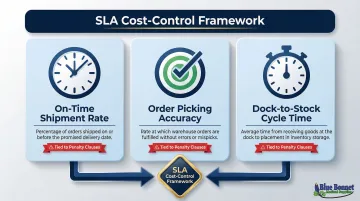
Penalty structures tied to these numbers give quality teeth as a cost-control mechanism.
Give your 3PL advance notice on changes. Alert them to inbound shipments, seasonal volume swings, and new SKU introductions. Providers that can plan labor and space utilization accurately run leaner. Clients who enable that planning consistently have more leverage at renewal.
Build formal review periods into the contract. Quarterly or semi-annual reviews let you assess performance against KPIs and revisit pricing before small cost increases compound into large ones. Without a scheduled review cadence, rate creep often goes unchallenged for years.
Strategies That Reduce Costs by Changing the Context
Get documented quotes from two or three alternatives. Comparable pricing from competing 3PLs establishes a credible floor. Your current or prospective provider needs to meet or beat it if they want the business — and having it in writing makes that conversation direct.
Revisit geographic placement at renewal. A 3PL closer to your highest-order-density region lowers your average shipping zone. If your customer base has shifted since you signed your contract, that's a data-backed reason to renegotiate, not just a preference.
For medical product businesses, verify compliance is included — not itemized. Look for FDA clearance, ISO/GMP compliance, and HIPAA-safe handling as standard capabilities. Bluebonnet Medical Supplies, for example, includes these as part of its baseline service rather than billing them as compliance surcharges — which is worth comparing directly against any generalist 3PL quote you receive.
Conclusion
Better 3PL rates come from understanding where your costs originate, not just pushing for a lower number. Reducing operational complexity and structuring contracts with clear terms gives both you and your provider a foundation that holds long-term.
The most durable cost reductions come from choosing the right partner with the right fit for your product type and compliance needs, then managing the relationship proactively. The businesses that negotiate best aren't the ones who push hardest — they're the ones who show up prepared, with clean data, consistent volume, and a clear picture of what they need.
A few principles worth carrying forward:
- Know your volume patterns before entering any rate conversation
- Choose a partner whose infrastructure matches your product type and compliance requirements
- Build contract terms that reward both consistency and flexibility
- Treat your 3PL as a long-term operational partner, not a cost line to minimize
Frequently Asked Questions
What is the 70/30 rule in negotiation?
The 70/30 rule suggests listening 70% of the time and talking 30% during negotiations. In a 3PL context, this means gathering information about the provider's constraints and cost drivers before presenting your asks, which leads to more targeted and effective requests.
What is the fulfillment fee for a 3PL?
Fulfillment fees typically include a flat per-order pick-and-pack charge ($2–$5) plus a per-unit fee ($0.30–$1.50) for additional items in the same order. Fees vary widely by provider, SKU complexity, and packaging type, and are usually one of the most negotiable components of a 3PL contract.
How to negotiate better freight rates?
Better freight rates come from a few key levers:
- Consolidating volume with fewer carriers
- Providing accurate shipment data upfront
- Leveraging the 3PL's existing carrier relationships and volume discounts
- Negotiating dimensional weight calculation terms when package size is a major cost driver
How to reduce costs with third-party logistics providers?
The most effective approaches include simplifying SKU and packaging complexity, committing to realistic volume minimums in exchange for lower rates, and structuring contracts with rate escalation caps. For medical product businesses specifically, choosing a 3PL with compliance requirements already built in — FDA, ISO, GMP — avoids costly add-on fees later.
What should be included in a 3PL contract to control rate increases?
A well-structured contract should include:
- A cap on annual rate increases tied to a defined index (CPI or ECI)
- Mandatory written notice periods before any rate change takes effect
- Periodic review clauses that let both parties revisit terms based on actual volume and performance
When is the best time to renegotiate a 3PL contract?
The strongest negotiation position is at initial contract signing—before a provider has your inventory. However, meaningful renegotiation is also possible at renewal, especially if you have grown your volume, improved your operational predictability, or gathered competitive quotes from alternative providers.