
Introduction
3PL quotes rarely reflect what businesses actually pay. The real costs hide in fee schedules, billing definitions, and contract terms that most companies don't scrutinize until invoices arrive—often months after onboarding.
That problem gets worse for medical product businesses. Compliance-driven handling steps, lot tracking, and regulatory storage requirements generate billable work at most warehouses—cost exposure that standard 3PL articles rarely address.
This guide breaks down the fee categories, contract clauses, and review methods that help medical product businesses find hidden costs before they show up on an invoice.
TLDR
- Hidden fees cluster into four categories: inbound, storage, outbound fulfillment, and carrier charges—none of which appear in headline quotes
- Contract language matters as much as rates—vague definitions and unilateral change clauses let fees grow after you've signed
- Medical businesses face extra exposure: compliance handling, cold/secure storage premiums, lot tracking, and returns inspection rarely quoted upfront
- Request a complete accessorial schedule, sample invoice, and written definitions before signing anything
The Four Main Fee Categories in a 3PL Contract
3PL contracts typically organize costs across four buckets: inbound/receiving, warehousing/storage, outbound/fulfillment, and carrier/shipping. Storage and receiving are where the billing surprises tend to start — both categories contain unquoted add-ons that are easy to miss on a rate card.
Storage Billing Methods Create Cost Variance
Storage billing method significantly changes what businesses pay for the same inventory footprint. Consider two identical shipments:
Pallet-based billing: 500 small medical devices stored on two half-filled pallets. At $20.17 per pallet monthly, you pay $40.34 — but you're paying for empty vertical space.
Cubic-foot billing: Those same 500 devices occupy 50 cubic feet. At $0.46 per cubic foot, you pay $23.00 — a 43% reduction for identical inventory.
For high-SKU or partially palletized inventory, cubic-foot pricing can slash storage costs by approximately 40% compared to flat pallet charges.
Measurement timing matters just as much. 3PLs calculate storage using:
- End-of-month snapshots
- Daily averages
- Peak-day measurements
Daily average pricing produces higher costs during seasonal inventory buildups than month-end snapshots — a detail that rarely appears in a quoted rate.
Inbound Receiving Lacks Standardization
Inbound receiving is one of the least standardized categories. The same shipment can be billed per pallet, per carton, per SKU, or hourly depending on the 3PL.
2025 average receiving costs:
| Billing Method | 2025 Average Cost |
|---|---|
| Per Pallet | $10.52 |
| Per Carton | $2.25 |
| Per SKU | $2.75 |
| Hourly | $45.67 |
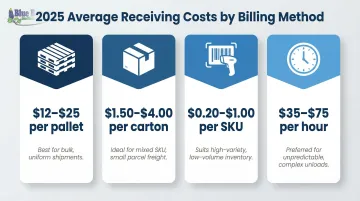
Confirm the billing method before assuming a receiving rate stays predictable. Hourly billing may be cheaper for well-organized palletized shipments but more expensive when loose cartons need sorting.
Common Hidden Fees That Inflate Your Invoice
Most hidden fees are not random—they're triggered by specific, measurable events. Understanding what triggers each fee is more important than the headline rate itself.
Inbound and Receiving Add-Ons
Fees that commonly appear after launch but are not highlighted during sales:
- Missed appointment charges — when carriers arrive outside scheduled windows
- Floor-load unloading surcharges — when containers arrive unpalletized, requiring manual unloading
- Sort-and-segregate charges — for mixed-SKU pallets that need separation
- Recount fees — when carton quantities don't match the ASN
Note that several of these—missed appointments, floor loads—are triggered by carrier behavior outside your direct control. That's worth clarifying in any contract.
Storage Minimums and Long-Term Tiers
Storage minimums mean businesses pay a floor amount even when inventory is low. 47.2% of warehouses enforce a monthly minimum spend requirement, with the average jumping from $337.50 in 2024 to $517 in 2025.
Long-term storage fees have grown aggressively. In 2025, 48.6% of warehouses charged long-term storage fees—up from just 23.33% in 2024.
Inventory sitting past a defined threshold (commonly 90–180 days) moves into a higher-priced long-term storage tier on top of standard rates. The premium can be steep:
- Typical range: 30%–50% above standard fees
- High-end range: 1.5 to 3× the standard rate, depending on provider
Pick, Pack, and Fulfillment Add-Ons
Add-ons that most frequently cause per-order costs to diverge from quoted rates:
- Extra pick fees for multi-line orders — when the quote assumed single-line orders
- Kitting fees — when bundles are assembled at order time instead of pre-kitted
- Insert and marketing collateral fees — billed per unit
- Exception pack surcharges — triggered when an item requires extra dunnage, poly-bagging, or double-boxing
Carrier-Related Surcharges
Dimensional weight adjustments occur when cartons are sized for packing speed rather than billed weight. According to Supply Chain Brain, carrier surcharges and accessorial fees can account for 20%–30% of total shipping costs. Here's what UPS and FedEx charge heading into 2025:
- UPS Residential Surcharge: $5.65 (Ground) to $6.55 (Air)
- UPS Delivery Area Surcharge: $4.20 (Commercial) to $8.85 (Residential Extended)
- UPS Address Correction Fee: $23.50 for Air and Ground
- FedEx Address Correction Fee: $24.00 per correction
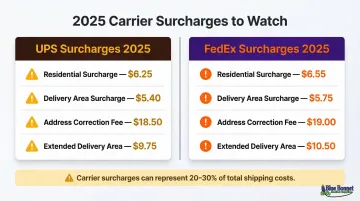
These surcharges are only auditable if your 3PL reports them at the shipment level, tied to individual tracking numbers. If they don't, you have no way to verify what you're being billed.
Account Management and Technology Fees
Monthly account management fees, platform/WMS access fees, and integration setup fees are only justified when tied to measurable deliverables or SLAs. Ask your 3PL to define exactly what each fee covers:
- What specific services does the account management fee include?
- What uptime or performance guarantees come with the WMS/platform fee?
- Is the integration fee one-time or recurring?
A monthly "program fee" with no defined outcomes should be negotiated out or converted to outcome-based pricing.
Hidden Costs Medical Product Businesses Often Miss
Medical product businesses face a category of costs that standard 3PL articles don't cover—compliance-driven handling steps, regulatory storage requirements, and product-specific documentation that generate billable work at most warehouses. The five areas below are where those costs tend to surface.
Compliance Handling and Documentation Fees
Many general 3PLs charge separately for FDA-compliant packaging steps, GMP documentation, or HIPAA-safe handling requirements as "special handling" or "compliance labor" line items. For medical product businesses, these are not optional add-ons—they are baseline requirements.
Working with a 3PL like Bluebonnet Medical Supplies—where FDA clearance, ISO, and GMP compliance are built into standard operations, not billed as exceptions—eliminates this cost exposure entirely.
Special Storage Premiums
Storage surcharges specific to medical inventory:
- Climate-controlled or humidity-regulated storage premiums — typically a percentage above standard pallet rates
- Secure/restricted-access storage fees — for certain device categories
- Re-measurement fees — if packaging changes trigger reclassification of storage type
Lot Number, Expiration, and Serial Number Tracking
Lot tracking, expiration date management, and serial number recording for medical devices are frequently billed as per-unit add-ons at general 3PLs. These fees accumulate quickly on high-SKU medical catalogs.
Under 21 CFR Part 830, a Unique Device Identifier (UDI) must include production identifiers capturing the lot/batch, serial number, and expiration date. 21 CFR 820.60 requires procedures for identifying product during all stages of receipt, storage, and distribution to prevent mixups.
Confirm in writing whether lot tracking, expiration date rotation (FEFO), and serial number recording are included or itemized separately.

Returns Inspection and Product Restoration Charges
Medical product returns involve multiple discrete billable steps that "flat return fee" promises often exclude:
- Intake and order matching
- Grading with documentation
- Restock vs. quarantine decisions
- Relabeling
- Disposal or refurbishment
92% of warehouses charge return fees, with the average cost per return at $4.06 in 2025. General returns processing can cost $10 to $20 per item.
Vague "returns included" language is meaningless without a written step-by-step process and per-step pricing. Bluebonnet's inspection, testing, and restoration services for returned items address this directly—reducing product loss and recovering value that flat-fee promises typically ignore.
International and Customs Compliance Fees
Fees that appear when shipping medical products internationally:
- Export documentation fees — such as FDA Certificate to Foreign Government (CFG) or Certificate of Exportability
- Customs clearance charges — FedEx charges the greater of $15 or 2% of duty/tax charges; UPS charges 3.5% of outlays (minimum $14.00)
- Duties and tariffs — passed through at variable rates
- Compliance documentation — for international regulators
Confirm that your 3PL has direct experience with customs compliance for medical goods. These fees should be defined upfront—not billed as "actual costs" after the shipment clears.
Contract Clauses That Let Fees Change After You Sign
The most expensive 3PL surprises are often "allowed" rather than invented—contract language gives the provider permission to add or raise fees mid-year.
Unilateral Rate Change Clauses
"30-day notice" rate change language allows a 3PL to expand its fee schedule without any formal renegotiation — the rate card simply grows mid-year. Watch your contract for:
- Clauses allowing new fee categories with short notice
- Language that distinguishes "rate changes" from "new service fees" (the latter often falls outside protection)
- No requirement for written acknowledgment from you before changes take effect
In 2025, 77% of warehouses reported increasing their pricing on a regular basis, up from 71.7% in 2024. The annual average price increase was 3.57% in 2025.
Meanwhile, flexible month-to-month contracts dropped from 56.67% in 2024 to 30.23% in 2025, making it harder to exit when rates climb.
Vague "Non-Standard Handling" Definitions
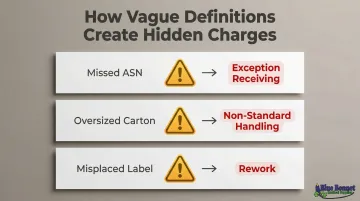
Broad definitions of terms like "non-standard handling," "exception receiving," "special projects," or "rework" transform routine warehouse tasks into billable events.
Examples of how vague definitions trigger charges:
- A missed ASN becomes "exception receiving"
- A slightly oversized carton becomes "non-standard handling"
- A label placed incorrectly becomes "rework"
When definitions are left open-ended in the contract, routine tasks generate unexpected fees.
Billing Dispute Windows and Minimum Commitments
Short dispute windows (often 15–30 days) can expire before accounting teams have time to validate invoice details. Manual billing in 3PL environments is highly prone to error—10-15% of 3PL invoices contain errors, which can cost providers and shippers tens of thousands of dollars annually.
Monthly minimums that exclude postage effectively create an unavoidable cost floor higher than the stated amount.
What to negotiate:
- Dispute windows that match accounting close cycles (30-60 days)
- The right to withhold disputed amounts pending resolution
- Clear documentation of how minimums are calculated and what they exclude
How to Review a 3PL Quote and Catch Hidden Costs
Comparing 3PL quotes requires normalizing all proposals to a true all-in cost per order using a consistent formula:
(Receiving fees + Storage + Pick/Pack + Materials + Shipping + Monthly Fixed Fees) ÷ Orders per Month
Run this calculation at 50%, 100%, and 150% of projected monthly volume. This reveals how costs scale under different scenarios and exposes providers whose minimums or per-unit rates become punishing at lower volumes.
Once you have those numbers, you need documentation to back them up. Request the following before signing anything:
Required Documents to Request Before Signing
- Complete accessorial schedule covering inbound, storage, outbound add-ons, returns, and admin fees
- Sample invoice showing shipment-level line items and at least one real surcharge example
- Written definitions for terms like oversize, special handling, exception receiving, and rework
- Billing cadence details with a documented dispute workflow
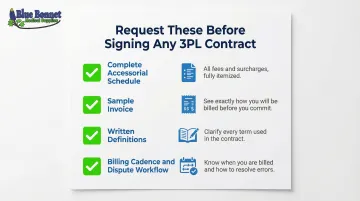
A provider who won't supply these in writing is not ready to be audited and will produce invoice surprises.
Questions That Force Pricing Clarity
Ask during 3PL evaluation calls:
- How do you measure storage (daily average, end-of-month snapshot, or peak daily)?
- Do you pass through carrier invoices at cost or add a markup?
- What triggers peak season surcharges and by how much?
- What is your return processing fee per step?
- Can I see a sample invoice from an existing client with a product profile similar to mine?
Any provider who deflects these with "it depends" without backing it up with specific numbers is a disqualifier — move on to one who can.
Frequently Asked Questions
What are some examples of hidden fees?
Common hidden fees include minimum monthly charges, long-term storage surcharges (48.6% of warehouses now charge these), dimensional weight adjustments, missed appointment fees, extra pick charges for multi-line orders, and peak season surcharges. For medical product businesses, compliance-related handling steps often appear as unexpected line items rather than standard inclusions.
What are the four categories of warehouse costs?
The four main cost buckets are inbound/receiving, warehousing/storage, outbound fulfillment (pick, pack, materials), and carrier/shipping charges. Each category contains both standard quoted fees and variable add-ons that may not appear in a headline rate.
What contract terms most often lead to surprise charges?
Unilateral rate change clauses with short notice periods (30 days), vague "non-standard handling" definitions, short billing dispute windows (15-30 days), and monthly minimums that exclude postage create the most surprise charges. 77% of warehouses now increase pricing annually.
Are compliance and regulatory fees typically included in medical 3PL pricing?
At general 3PLs, FDA/GMP/ISO compliance steps are often billed as special handling add-ons. Medical-specific 3PLs may include these as standard. Businesses should confirm in writing whether compliance documentation, secure storage, and lot tracking are included or itemized separately before signing.
How do minimum monthly fees work in 3PL contracts?
A minimum monthly fee is charged regardless of order volume, and minimums often exclude postage — making the effective floor higher than the stated amount. The average minimum jumped from $337.50 in 2024 to $517 in 2025. If your volume is seasonal, model your cost during slow months, not just peak months.
What questions should I ask a 3PL before signing?
Start with three: How is storage measured (daily average, end-of-month snapshot, or peak daily)? Do you pass through carrier rates at cost or add a markup? Can I see a sample invoice from a similar client? Any provider who answers with "it depends" and no specific numbers is telling you something important about how they bill.