Introduction
Most medical product businesses that outsource fulfillment get hit with unexpected fees months after signing a contract. The quoted rate looks reasonable upfront, but hidden charges for receiving, storage minimums, special handling, and compliance services quietly stack up — and by the time the invoices arrive, the math no longer works.
Costs vary significantly based on order volume, product type, and compliance requirements — particularly for regulated medical supplies. This guide breaks down every major cost component, what drives pricing up or down, and how to build a fulfillment budget that accounts for what most quotes leave out.
TL;DR
- Typical outsourced fulfillment costs range from $3–$15+ per order depending on the 3PL, product type, and service level
- The biggest cost drivers are order volume, product size and weight, storage needs, and compliance requirements
- Basic 3PLs cost less upfront but often generate hidden costs through compliance gaps
- Specialized medical 3PLs charge more per order but eliminate regulatory risks that dwarf the price gap
- Monthly minimums averaging $517 inflate effective per-order costs for low-volume shippers
How Much Does Outsourced Fulfillment Cost in 2025?
There is no single flat rate for outsourced fulfillment. Pricing combines per-order fees, storage fees, and add-on service charges that vary significantly by provider and business type—and underestimating any of them leads to mispriced products and surprise charges after contracts are signed.
Here's how the three main pricing tiers break down:
Entry-Level / Basic Fulfillment (Generic 3PLs)
Basic fulfillment typically includes standard pick-and-pack, basic storage, and carrier-rate shipping for simple consumer goods. Per-order costs average $3.20, though the range spans from $0.20 to $8.00 depending on order complexity and volume.
This tier works best for high-volume, lightweight consumer goods with no special handling requirements — straightforward pick-pack-ship, nothing more.
Mid-Range Fulfillment (Full-Service 3PLs)
Mid-range providers offer receiving, multi-channel fulfillment, returns processing, basic kitting, software integrations, and modest customization. B2B orders average $4.80 per order, with domestic all-in landed costs ranging from $8 to $15.
A good fit for growing eCommerce businesses with moderate SKU counts selling across multiple channels — their own website, Amazon, and retail simultaneously.
Premium / Specialized Fulfillment (Compliance-Required 3PLs)
Premium providers include all standard 3PL services plus regulated handling, compliance documentation, temperature or sensitivity-controlled storage, customs compliance for international shipping, and product-specific protocols such as FDA-compliant packaging for medical items. Pricing is typically quote-based or value-based, with milestone fees like $3,000 for regulatory document verification.
This tier is designed for medical product companies, device manufacturers, and businesses shipping regulated products domestically or internationally — where a compliance failure isn't just costly, it can halt operations entirely.
Key Factors That Affect the Cost of Outsourced Fulfillment
Pricing isn't just about what the 3PL charges—it reflects the technical, operational, and compliance complexity of the business they're serving.
Order Volume and Frequency
Most 3PLs use volume-based pricing—the more orders you ship, the lower the per-order cost. However, the average 3PL minimum monthly spend jumped to $517 in 2025. A business shipping only 100 orders effectively pays $5.17 per order just to meet the floor.
Volume tier benchmarks:
- 50-500 orders/month: $3.00–$8.00 per order (subject to $500–$1,000 minimums)
- 500-5,000 orders/month: $2.00–$5.00 per order (sweet spot for 3PL economics)
- 5,000+ orders/month: $1.50–$3.50 per order (lowest rates with dedicated account management)
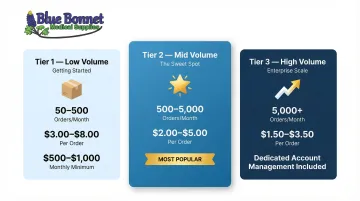
Low-volume businesses often face minimum monthly fees even when they don't ship enough to trigger them, which inflates effective per-order cost significantly.
Product Size, Weight, and Fragility
Dimensional weight and physical handling complexity directly impact pick-pack labor, packaging material costs, and shipping rates. Heavier, bulkier, or fragile items cost more to fulfill per unit.
New 2025/2026 carrier rules mandate rounding up fractional inches—for example, 9.1" becomes 10"—inflating cubic volume and triggering Additional Handling Surcharges more frequently. UPS Additional Handling fees now range from $43.50 to $52.75 for packages over 50 lbs, while FedEx charges $29.50 to $40.75 when the longest side exceeds 48 inches.
Sensitive medical items—sterile packaging, devices with components—may require additional handling steps not reflected in a standard rate card, adding labor costs that aren't immediately visible.
Storage Requirements and Inventory Turnover
Storage fees are typically charged per cubic foot or per pallet per month. Standard pallet storage averages $20.17/month, but slow-moving inventory compounds storage costs significantly.
Nearly half (48.6%) of 3PLs now charge long-term storage fees for aged inventory, adding $5 to $10 per pallet per month for items sitting beyond 180 days. Medical products often require climate-controlled, secure, or segregated storage that carries a 20-50% premium over standard warehousing.
Compliance and Regulatory Requirements
For medical product businesses, a 3PL's compliance infrastructure—FDA clearance, ISO and GMP compliance, HIPAA-safe handling—is both a cost driver and a cost-saver. When compliance is handled correctly, shipments don't get held at customs, rejected by retailers, or flagged for regulatory violations.
Medical device recalls reached a 15-year high in 2024, with financial impacts ranging from $10 million to $600 million per event. The FDA recorded 1,059 recalls affecting 440.41 million units. Those numbers put standard 3PL fulfillment fees in perspective.
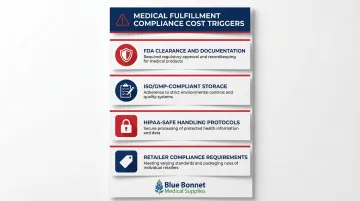
Key compliance cost triggers to factor into your budget:
- FDA clearance and documentation for medical packaging and device handling
- ISO/GMP-compliant storage and processes required by many healthcare buyers and retailers
- HIPAA-safe handling protocols for any products tied to patient data or healthcare providers
- Retailer compliance requirements (labeling, packaging standards) that vary by channel
Geographic Reach and Shipping Complexity
Domestic shipping costs depend on carrier rates, zone splits, and whether the 3PL has negotiated volume discounts. International shipping layers on customs documentation, duties management, and carrier surcharges—each adding to the per-shipment cost.
For medical products crossing borders, the penalties for errors are steep. U.S. Customs and Border Protection levies $5,000 per violation for late or inaccurate Importer Security Filing (ISF) submissions. FDA export certificates run $175 each. A 3PL with established international compliance workflows absorbs this complexity—one without it passes the risk directly to you.
Full Cost Breakdown: What You're Actually Paying For
The total cost of outsourced fulfillment goes well beyond the per-order fee—here's a breakdown of every fee category businesses should expect to see on a 3PL invoice.
Receiving and Inbound Processing
Billed per shipment or per unit received, receiving covers unloading, inspecting, counting, and logging inventory into the warehouse management system. 2025 market data puts current rates at:
- Per pallet: $10.52 average
- Per carton (loose shipments): $2.25 average
- Floor-loaded containers (complex breakdown): $45.67/hour
- Per container: ~$500 in 2025, up from $350 in 2024
Pick, Pack, and Ship Fee
Billed per order, this is the core fulfillment fee covering labor for picking, packing materials (boxes, poly mailers, dunnage), and carrier handoff.
- First item per order: $2.00–$3.00
- Each additional item: $0.30–$0.75
- B2B orders: $4.80 average
Medical devices often require specialized kitting, serial/lot tracking, and custom packaging—each adding hourly or per-unit fees on top of the base rate.
Storage Fee
Billed monthly, storage rates vary by how your inventory is measured:
- Cubic foot: $0.46/month average
- Bin: $3.08/month average
- Pallet: $20.17/month average
- Long-term storage (180+ days): adds $5–$10 per pallet/month
- Climate-controlled or compliant conditions: 20–50% premium
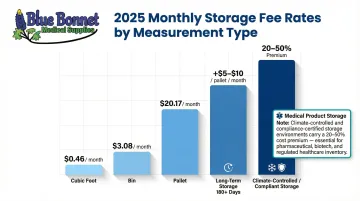
Medical product storage typically lands at the higher end of this range due to secure, compliant handling requirements.
Add-On Services and Compliance Fees
Fees here vary by service and volume. Common line items include kitting, labeling, product inspection, returns processing and restoration, compliance documentation, and international shipping support.
For medical businesses, most of these aren't optional—they should be built into the baseline cost estimate from the start.
What Sets Budget 3PLs Apart from Premium Fulfillment Partners
Price alone is a misleading way to evaluate a fulfillment partner—what you save on the rate card, you may pay in errors, compliance gaps, or customer experience failures.
Service Quality and Error Rates
General-purpose, high-volume 3PLs move orders fast, but speed without specialization causes problems. Mispacks, wrong labels, and damaged goods are more common when a warehouse isn't built for sensitive medical items.
The financial consequences add up quickly:
- A single mispick costs between $22 and $75+, with annual losses at a typical distribution center running $390,000–$600,000
- 73% of consumers who receive an incorrect item are less likely to buy again
- Returns processing, re-shipping, and write-offs compound the original error cost
Specialized providers invest in trained staff, quality checkpoints, and product-specific handling protocols. Advanced warehouse technology at that tier achieves accuracy rates above 99.9%—which matters far more than a lower line-item rate.
Compliance Infrastructure
General-purpose warehouses aren't designed to meet FDA, ISO, GMP, or HIPAA requirements. A medical product business using one absorbs the compliance risk entirely—and that risk is rarely reflected in the 3PL's rate card.
A compliant partner has those certifications built into daily operations. Bluebonnet Medical Supplies, for example, integrates FDA, ISO, GMP, and HIPAA-safe handling directly into warehouse workflows, so clients ship with confidence and skip the compliance audit headaches.
Long-Term Cost and Scalability
Compliance gaps and error rates feed directly into total cost of ownership—often turning the "cheapest" 3PL into the most expensive one. The hidden costs rarely appear on the original quote:
- Re-shipping and replacement for mispicked or damaged orders
- Product write-offs for items damaged in non-medical storage
- Compliance fines or customs holds from missing certifications
- Internal staff time spent auditing and managing a non-specialized partner
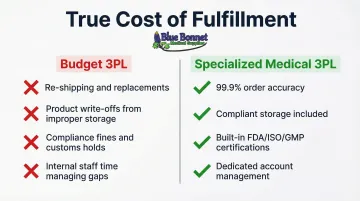
Specialized medical 3PLs charge higher base rates but deliver ROI through 99.9% accuracy, fewer write-offs, and fewer regulatory penalties.
How to Estimate the Right Fulfillment Budget for Your Business
The right fulfillment budget matches service scope to your actual operational and compliance needs. Focusing only on the lowest rate often leads to surprise charges after onboarding.
Factors to Evaluate Before Signing With a 3PL
Before requesting quotes, assess:
- Average monthly order volume — determines which pricing tier applies and whether you'll hit monthly minimums
- Average order size and weight — impacts dimensional weight charges and Additional Handling Surcharges
- SKU count and turnover rate — affects storage fees and long-term inventory penalties
- Storage volume and product sensitivity — determines whether climate-controlled or secure storage is required
- Compliance obligations — regulated products, international shipping, FDA/ISO/GMP requirements
- Desired service scope — just ship, or full-service including returns and kitting
For medical product businesses, working with a 3PL that has FDA, ISO, and GMP compliance already in place — such as Bluebonnet Medical Supplies in Cedar Park, TX — removes the burden of verifying compliance independently. When you account for the cost of compliance failures, that built-in assurance often reduces total cost.
How to Request and Compare 3PL Quotes Accurately
Request quotes based on your actual order profile, not best-case scenarios. When comparing providers, ask for:
- Itemized rate cards rather than bundled quotes
- Clarification on whether compliance-related services are included or billed separately
- A breakdown of any minimums, surcharges, or setup fees
This transparency prevents surprise charges after onboarding.
What Most Businesses Miss When Calculating Outsourced Fulfillment Costs
Most medical product businesses zero in on the per-order rate and stop there. That number rarely tells the full story. Here's what tends to get overlooked:
- The per-order fee is often the smallest line item once storage minimums, receiving fees, and account fees are added up
- Non-specialized 3PLs often can't handle FDA documentation, HIPAA-safe processing, or international customs for medical goods — meaning held shipments, damaged products, or expensive compliance remediation discovered after onboarding
- Returned medical items typically require inspection, testing, and restoration before they can be resold; a 3PL without that capability passes the cost straight back to you
- A 3PL with direct carrier relationships can reduce shipping costs in ways a business negotiating independently simply can't match — that discount needs to factor into any in-house vs. outsourced comparison
Bluebonnet's returns processing and product restoration services are built specifically for this last point: converting returned inventory back into sellable stock rather than writing it off.
Conclusion
Outsourced fulfillment costs in 2025 range widely—from a few dollars per order for basic 3PL services to $15+ for specialized, compliant fulfillment—and the right cost is the one that covers your actual operational and regulatory requirements without surprise charges.
For medical product businesses, the cheapest fulfillment option often becomes the most expensive once compliance failures, re-shipping costs, and operational friction are accounted for. Choosing a fulfillment partner built for your product type—one with FDA, ISO, and GMP compliance already in place—is how medical businesses avoid those hidden costs and keep fulfillment expenses predictable as they scale.
Frequently Asked Questions
Frequently Asked Questions
How much does outsourced fulfillment cost in 2025?
Outsourced fulfillment typically costs $3–$15+ per order depending on order volume, product type, service level, and compliance requirements. Entry-level 3PLs average $3.20 per order, while specialized medical fulfillment is quote-based due to regulatory overhead.
What is the formula for calculating outsourced fulfillment costs in 2025?
Total outsourced fulfillment cost = (per-order fulfillment fee × monthly orders) + monthly storage fees + receiving fees + add-on service fees. Businesses should request itemized quotes to apply this formula accurately and avoid underestimating total costs.
What is typically included in a 3PL fulfillment fee?
Standard fulfillment fees cover pick-and-pack labor, basic packaging materials, and carrier handoff. Receiving, storage, returns, kitting, and compliance services are usually billed separately. Confirm what's included before committing.
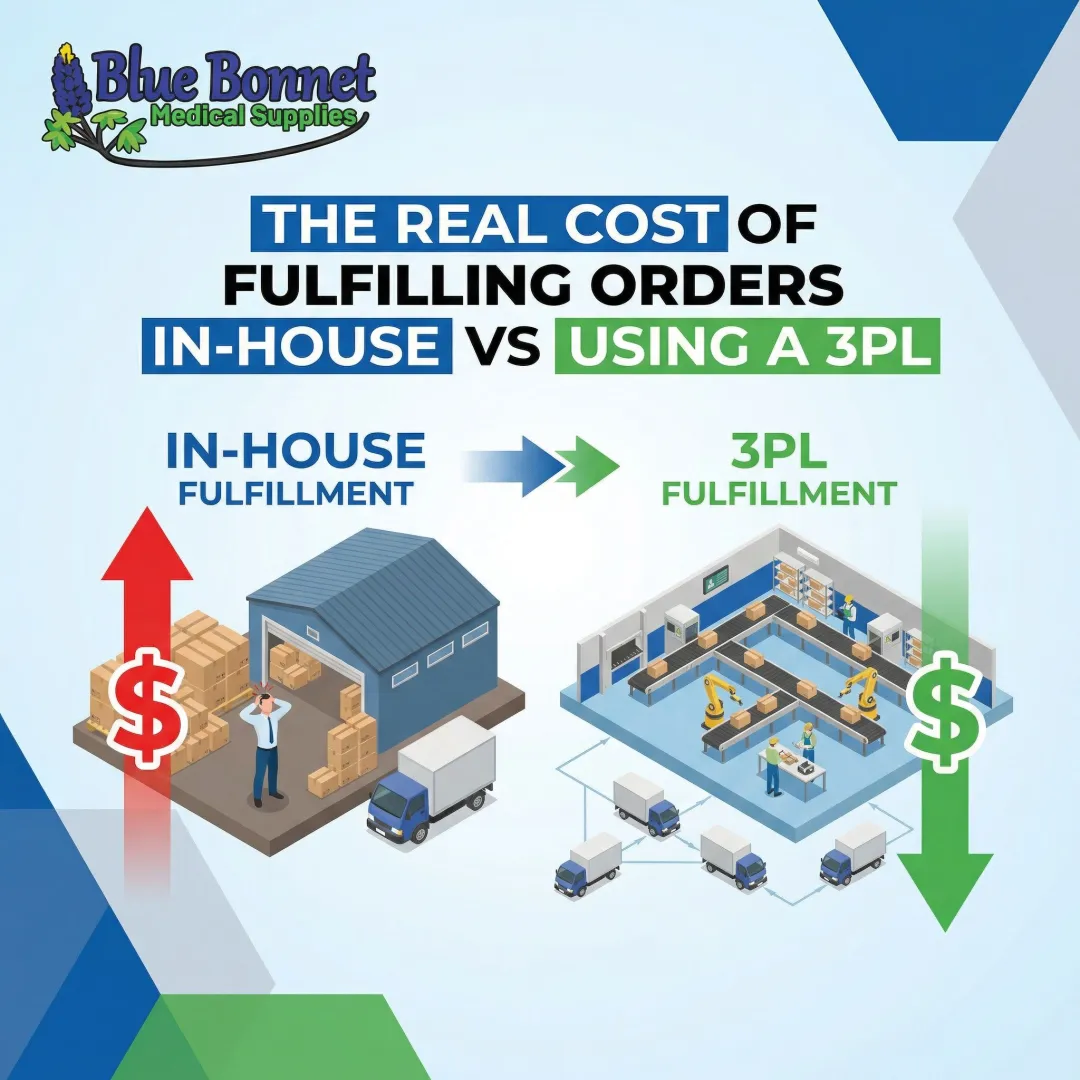
Is outsourced fulfillment cheaper than in-house fulfillment?
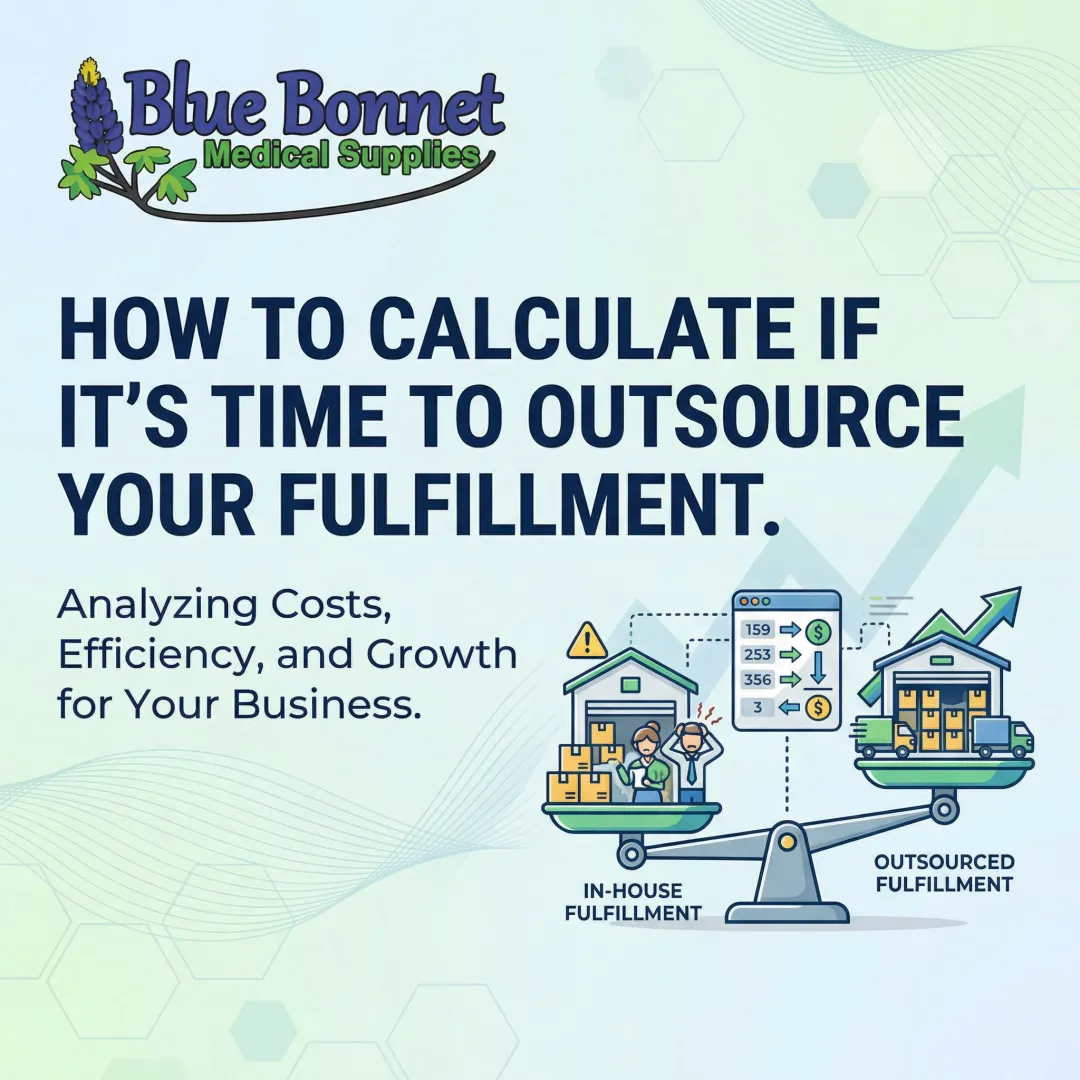
For most growing businesses, outsourced fulfillment becomes cost-competitive once order volume exceeds 100–300 orders per month—the point where warehouse overhead, labor, and software costs outpace 3PL fees. Below that threshold, monthly minimums inflate effective per-order costs.
What extra costs should medical product businesses expect when outsourcing fulfillment?
Medical businesses should expect costs for compliance documentation, regulated storage, specialized handling protocols, and international customs support. These are unavoidable for regulated products—confirm they're included in the quoted price, not billed as line-item extras.
How do I know if I'm ready to outsource my fulfillment?
Watch for these signals:
- Fulfillment is consuming significant time or staff resources
- Your shipping costs exceed a 3PL's negotiated carrier rates
- Order volumes are growing consistently month over month
- Compliance requirements are outpacing your in-house capabilities
Businesses shipping 100–300+ orders per month typically see the clearest ROI.