Introduction
Most medical product businesses calculate fulfillment costs by adding up warehouse rent and labor, then call it done. That approach misses the compliance infrastructure, specialized handling protocols, and error recovery costs that make in-house fulfillment far more expensive than it first appears.
A single customs hold can cost more than months of 3PL fees. A mispicked medical device can delay a procedure by days, costing an average of $4,500 per event according to L.E.K. Consulting research.
This article walks through every cost category—storage, compliance, labor, error recovery, and shipping—so you can make the in-house vs. 3PL decision based on actual numbers, not assumptions.
TL;DR
- In-house fulfillment includes warehouse rent, staff, equipment, software, compliance infrastructure, and error recovery—costs that rarely appear in early estimates
- Medical 3PLs charge structured fees but absorb compliance investment and carrier relationships you'd otherwise build from scratch
- FDA, ISO, GMP, and HIPAA-safe handling requirements significantly raise the cost of in-house fulfillment for medical products
- The right model depends on order volume, growth plans, SKU complexity, and compliance exposure, not just monthly rent
- Neither model is universally cheaper; compare cost per shipped order using your own history and service requirements
In-House vs 3PL for Medical Products: A Quick Cost Snapshot
Most businesses fail to use a complete cost framework when estimating in-house fulfillment expenses. A proper comparison must cover warehouse space, labor, compliance infrastructure, technology and software, shipping rates, and error recovery.
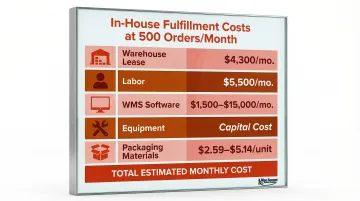
In-House Fulfillment at 500 Orders/Month:
For a modest operation fulfilling a few hundred to 1,000 orders monthly, in-house costs include:
- Warehouse lease at $10.38/sq ft nationally puts a 5,000 sq ft space at roughly $4,300/month
- A single full-time warehouse worker costs ~$5,500/month fully loaded — $18.71/hour mean wage plus the 42.2% benefits burden
- Cloud-based WMS software runs $1,500 to $15,000/month depending on features
- Equipment — label printers, scanners, scales, barcode systems — requires upfront capital before you ship a single order
- Corrugated boxes alone cost $2.59 to $5.14 per unit
3PL Equivalent at 500 Orders/Month:
A specialized medical 3PL converts that fixed overhead into variable costs that move with your volume:
- Pick-and-pack runs $2.00 to $5.00 per order for the first item, plus $0.50–$1.50 per additional item
- Storage costs $20.00 to $45.00 per pallet per month
- Inbound receiving is $25.00 to $45.00 per pallet
- Returns processing is billed per event — no standing overhead
These fees scale directly with volume. Ship 200 orders one month and 800 the next, and your costs adjust accordingly. In-house overhead doesn't work that way — the lease, the staff, and the software cost the same regardless of how much you ship.
The Real Cost of In-House Medical Fulfillment
Fixed Cost Layer
The warehouse itself represents the largest fixed expense. For medical products, the space must meet specific storage conditions that drive up lease and build-out costs compared to general warehousing:
- Proper shelving and segregation for medical product categories
- Loading dock access for freight deliveries
- Climate-controlled zones for temperature-sensitive items
- Utilities, insurance, and administrative overhead
These costs remain constant regardless of order volume fluctuations. Fixed overhead is just the starting point — labor is where in-house fulfillment costs compound quickly.
Labor Costs in Full
Labor is purchased as time coverage, meaning you pay for hours regardless of whether order volume fills them. The BLS reports mean hourly wages for warehouse order fillers at $18.71/hour, but the true employer cost includes a 42.2% benefits burden, bringing the fully loaded rate to approximately $32.00/hour.
Beyond direct pick-and-pack staff, you need:
- Supervisory coverage for quality control and compliance
- Training time for new hires on medical product handling protocols
- Backfill coverage for absences and peak volume spikes
- Management time diverted from business growth to logistics operations
According to nShift research, a third of logistics workers spend more than 50% of their time on manual tasks including exception handling and returns processing.
Technology and Equipment
A warehouse management system is required for medical product fulfillment. First-year WMS costs run $25,000 to $75,000 for small warehouses, with ongoing licensing fees of $1,500 to $15,000/month for cloud-based systems.
Additional equipment includes:
- Label printers and scanners
- Scales for weight verification
- Barcode systems for inventory tracking
- Device redundancy to prevent downtime
Any equipment failure during a peak shipping window can mean missed cutoffs, expedited reshipment costs, and a customer support queue that takes days to clear.
Hidden Operational Costs
Most businesses undercount these expenses:
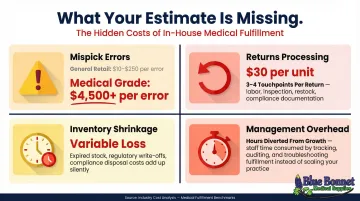
- Mispick errors run $10 to $250 per incident in general ecommerce — but medical logistics errors carry a steeper penalty, with delayed procedures averaging $4,500 per event in downstream costs
- Returns processing adds roughly $30 per unit, with each item passing through 3-4 additional supply chain touchpoints
- Inventory shrinkage from damage, expiration, or misplacement — especially costly for medical items with strict shelf-life requirements
- Management hours absorbed by logistics instead of product development or customer acquisition
The Scalability Problem
During demand spikes or seasonal peaks, in-house operations face a costly dilemma: pay overtime and scramble for temp staff, or miss shipping cutoffs. Both paths carry real costs — expedited upgrades like UPS Next Day Air Early add a $30.00 surcharge per shipment, on top of customer service tickets and refund exposure.
Warehouse labor rates have risen 8% since mid-2020 — making that already-expensive peak season scramble harder to budget for each year.
The Real Cost of Using a Medical 3PL
Structured Fee Model
A well-structured 3PL bill is predictable and tied to specific warehouse events:
- Pick-and-pack fees: Per order or per unit
- Storage fees: Per pallet, bin, or cubic measurement
- Inbound receiving fees: Per pallet or shipment
- Returns processing fees: Per returned item
- Value-added services: Kitting, custom packaging, product testing
This makes cost per shipped order calculable and auditable—you know exactly what you're paying for.
Shipping Rate Advantage
3PLs negotiate volume-based carrier rates that most individual businesses cannot access. High-volume shippers secure 45% to 60% off published Ground rates, whereas independent small-to-mid-size businesses typically achieve only 35% to 50% discounts.
These deeper discounts can partially or fully offset the 3PL's service fees. With FedEx and UPS implementing 5.9% rate increases in 2025 and 2026, carrier relationship advantages matter more than ever.
What a Specialized Medical 3PL Includes
Carrier savings are only part of the picture. For medical product businesses, compliance infrastructure is often the larger hidden cost — and the harder one to build internally.
Bluebonnet Medical Supplies includes these capabilities as part of its standard service:
- Packaging and storage built to FDA protocols, not retrofitted after the fact
- ISO/GMP-aligned documentation, labeling, and inventory tracking
- HIPAA-safe data handling for patient-related products and prescription fulfillment
- Export documentation and customs classification to keep international shipments moving
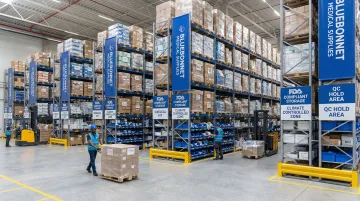
Replicating this in-house — staff training, software, audits, certifications — typically runs $30,000–$80,000 annually for a mid-size operation.
Scalability Benefit
3PL fees scale with volume, so businesses pay for capacity they actually use rather than maintaining fixed overhead for anticipated growth. This is particularly valuable for medical product companies selling through Amazon or their own websites where order volume fluctuates with marketing campaigns or seasonal demand.
That flexibility works in your favor — but only if the contract is structured cleanly. Not all 3PL agreements are created equal.
Cost Risks to Watch
Before signing, watch for:
- Vague definitions of billable units: What counts as a "pick"? Are multi-carton orders billed multiple times?
- Minimum monthly commitments: These behave like a lease during slow periods
- Accessorial fees: Project work and special handling charges
Bluebonnet ties every charge to a specific warehouse event and provides itemized invoices — so you can audit exactly what you paid for and why.
The Medical Compliance Factor: Hidden Costs In-House Fulfillment Doesn't Warn You About
Why Medical Products Have a Higher Compliance Floor
Businesses storing and shipping medical supplies, devices, or equipment must meet:
- FDA regulations: For packaging and labeling under 21 CFR Part 820
- ISO 13485 standards: For quality management systems
- GMP requirements: For handling and storage conditions
- HIPAA-safe practices: For patient-related product data
Achieving and maintaining these certifications independently requires steep fixed costs:
- FDA establishment registration: $11,423 annually
- ISO 13485 audit fees: Typically $2,500 to $4,500+ per day for third-party certification audits, depending on scope and auditor
- eQMS software licensing: $25,000 to $100,000+ annually
The Cost of Compliance Failure
These are not hypothetical risks but real operational consequences:
- Customs holds: Port demurrage fees run $75 to $300+ per container per day once free time expires
- Regulatory fines and recalls: Cardinal Health recorded an $85 million charge in 2020 for a surgical gown recall due to uncontrolled storage environments
- Rejected shipments: FDA has authority to destroy refused devices valued at $2,500 or less, with the owner responsible for storage and disposal costs
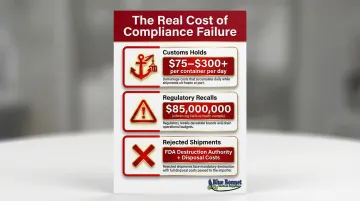
A single customs hold or recall event can cost far more than months of 3PL fees.
Returns and Restoration for Medical Products
Returned medical devices typically require inspection, testing, and restoration before they can be re-sold or re-stocked. In-house operations must hire, train, and equip staff to handle this — often for low return volumes that don't justify the overhead.
A specialized 3PL with built-in product testing and restoration capabilities handles returns as part of its standard service. Bluebonnet Medical Supplies does exactly this, reducing write-off rates and protecting product margins without adding headcount.
International Shipping Compliance
Export documentation, customs classification, and country-specific regulatory requirements add another cost layer. For example:
- FDA Certificate to Foreign Government: $175 for the first certificate, $85 for subsequent certificates
- Health Canada MDEL application: $5,426 to $5,519 CAD (approximately $3,900–$4,000 USD)
- EU EUDAMED registration: Mandatory UDI/device registration starting May 28, 2026
A 3PL with international shipping expertise removes the learning curve and reduces the risk of customs delays that damage buyer relationships.
In-House vs 3PL for Medical Products: Which Model Fits Your Business
Decision Framework
In-house fulfillment may make sense when:
- You're at very early stage with fewer than 100 orders/month
- You have excess warehouse space already paid for
- You maintain an existing logistics team with medical compliance expertise
- You have minimal international or regulatory exposure
However, as order volume grows past a consistent monthly threshold, as SKU count increases, or as compliance requirements become more complex, the fixed cost burden of in-house operations typically exceeds what a 3PL charges per shipped order.
Signals That a 3PL Is the Right Move
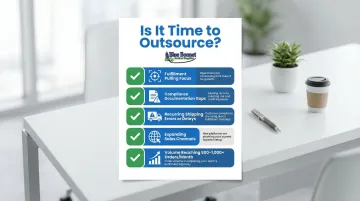
Consider outsourcing when:
- Fulfillment is pulling focus away from product development or customer acquisition
- Compliance documentation has gaps that create audit risk or regulatory exposure
- Shipping errors or customs delays have become a recurring source of customer complaints
- You're expanding sales channels (Amazon, international, healthcare distributors) that require reliable, compliant fulfillment
- Order volume reaches 500-1,000+ per month, where 3PL economics become cost-effective
Take the Next Step
If the signals above sound familiar, it may be time to hand off fulfillment to a specialist. Bluebonnet Medical Supplies provides 3PL fulfillment and warehousing built specifically for medical product businesses — handling storage, packing, compliance documentation, and shipping so you can stay focused on growth. Reach out to explore a logistics solution tailored to your products and sales channels.
Frequently Asked Questions
What is the biggest hidden cost of in-house medical product fulfillment?
The most underestimated costs are compliance infrastructure (FDA/ISO/GMP), error recovery (reships, refunds), and the management time diverted from business growth. These rarely appear in early estimates but consistently drive total in-house cost above 3PL alternatives.
At what order volume does a 3PL become more cost-effective than fulfilling in-house?
There's no universal threshold—it depends on your fixed overhead, order mix, and compliance exposure. For most medical product businesses, the crossover happens around 500–1,000 orders monthly, when fixed costs (rent, staff, compliance systems) exceed what a 3PL charges per shipped order.
How does FDA and GMP compliance affect fulfillment costs for medical products?
In-house FDA, ISO, and GMP compliance requires facility upgrades, documentation systems, staff training, and ongoing audits—often exceeding $50,000 annually. A specialized medical 3PL absorbs these costs as part of its standard service, making outsourcing more cost-efficient for compliance-heavy products.
Can a 3PL handle the specialized storage and shipping requirements for medical devices?
A qualified medical 3PL will have proper storage conditions, compliance credentials, and carrier relationships needed for medical devices. Businesses should verify FDA clearance, ISO/GMP alignment, and HIPAA-safe handling practices before selecting a provider.
What should I look for when choosing a 3PL for medical product fulfillment?
Prioritize providers that offer:
- FDA-compliant packaging and storage
- ISO/GMP-certified processes
- Experience with medical product customs and international shipping
- Transparent per-order pricing
- Returns processing and product restoration capabilities
- Custom solutions tailored to your specific workflow
Is it possible to switch from in-house fulfillment to a 3PL without disrupting operations?
Transitions can be managed smoothly when SKU data, packaging requirements, compliance documentation, and order routing rules are defined upfront. Most reputable 3PLs run a structured onboarding process that minimizes disruption to existing order flow and customer delivery timelines.