Introduction
At some point, in-house fulfillment stops being a cost-saver and starts being a cost center. For medical product businesses, the crossover is harder to spot—and more expensive to miss. Compliance failures, improper handling, and customs documentation errors carry regulatory and financial consequences that a missed shipment in standard ecommerce simply doesn't.
Moving too early can strain margins. Waiting too long risks shipping errors, compliance violations, and stalled growth. The hard part is knowing where you actually stand.
This article covers how to:
- Calculate the real cost of your current fulfillment setup
- Spot the concrete signals that you've crossed the outsourcing threshold
- Recognize when it's genuinely still too early to make the switch
TL;DR
- Fulfillment outsourcing has a financial breakeven point that's closer than most businesses realize once hidden costs are counted
- Key triggers include order volume consistently above 50–100 per day, mounting shipping costs, and compliance complexity you're not equipped to handle
- For medical businesses, FDA, ISO, and GMP handling requirements are a trigger on their own — specialized 3PLs own that complexity
- Timing matters: move too soon and margins suffer; wait too long and shipments slip, compliance breaks, and customers leave
Why the Timing of Your Outsourcing Decision Matters
Outsourcing fulfillment isn't just a cost decision—it's a capacity and risk decision. Transitioning at the right moment means your 3PL partner can be set up properly with your processes, rather than onboarded mid-crisis when orders are failing and customers are waiting.
For medical product businesses specifically, the timing stakes are higher. Delayed outsourcing can mean regulatory exposure, damaged product, or customs failures that standard ecommerce sellers don't face.
A mishandled delivery in healthcare can derail surgical procedures, compromise lab results, and damage supplier reputations. In fact, preventable logistics errors cost U.S. health systems millions annually.
Getting the timing wrong cuts both ways:
- Too early — you're paying for warehouse space and 3PL minimums before the savings offset those fees
- Too late — your in-house setup becomes the ceiling on your growth
How to Calculate If Outsourcing Makes Financial Sense
For medical product businesses, the real cost of in-house fulfillment is almost always higher than it looks on paper. Work through these five steps to see where your numbers actually land.
Step 1: Calculate Your True Labor Cost
Start with the "owner time" calculation. Estimate the number of hours per week spent on packing, labeling, returns, and shipping coordination, then multiply by a realistic hourly value for that time.
Most business owners dramatically undercount this when they only think about direct labor. Include:
- Order picking and packing time
- Label printing and application
- Carrier coordination and pickup scheduling
- Returns processing and restocking
- Inventory audits and organization
- Problem-solving for shipping errors
If you're spending 15 hours per week on fulfillment and your time is worth $50 per hour, that's $750 weekly or $3,000 monthly in opportunity cost—time not spent on sales, product development, or customer acquisition.
Step 2: Add Hard Operational Costs
Total up these categories:
- Packaging materials (boxes, bubble wrap, tape, inserts)
- Shipping software subscriptions
- Printer and equipment maintenance
- Storage space (rent or storage unit costs allocated to fulfillment)
- Utilities tied to your fulfillment area
For a business shipping 200 orders monthly, these costs typically range from $500 to $1,200 per month, depending on product size and packaging complexity.
Step 3: Factor In Error Costs and Compliance Risk
For medical products, this step is critical. Four cost categories add up fast:
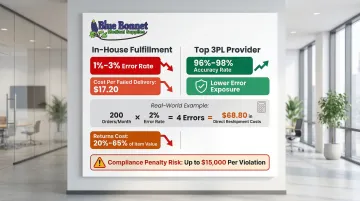
- Failed first-time deliveries average $17.20 per order in reshipment expenses
- Returns processing runs 20%–65% of the item's original value, averaging $15 per returned item
- Civil penalties under 21 U.S.C. § 333 can reach $15,000 per violation for device requirement failures
- Detained international shipments must be resolved within 10 business days — if unresolved, the FDA can refuse entry, and CBP penalties can reach three times the declared value
In-house operations typically run a 1% to 3% error rate, while top-performing 3PLs achieve 96% to 98% accuracy. At 200 orders monthly with a 2% error rate, that's 4 errors costing $17.20 each—$68.80 in direct reshipment costs, not counting customer dissatisfaction.
Step 4: Calculate the Carrier Rate Gap
Small shippers pay retail or lightly discounted carrier rates. 3PLs access volume-negotiated rates—typically 20% to 40% below what a business would pay independently, with some discounts reaching 30% to 50% lower than retail rates.
Simple illustration:
100 orders/month at $10 average retail shipping = $1,000 monthly
3PL negotiated rate at 30% discount = $7 per shipment = $700 monthly
Monthly savings: $300
200 orders/month = $2,000 retail vs. $1,400 with 3PL = $600 savings
500 orders/month = $5,000 retail vs. $3,500 with 3PL = $1,500 savings
Step 5: Compare Against a 3PL Quote
Request a comparable quote from a 3PL that includes:
- Per-order pick and pack fees
- Storage fees (per pallet or cubic foot)
- Receiving fees
- Returns processing fees
Subtract the carrier discount savings from Step 4. When the 3PL total cost (minus shipping savings) is equal to or less than the in-house total from Steps 1–3, you've hit the breakeven point.
Example calculation:
In-house labor: $3,000/month
Hard costs: $800/month
Error costs: $150/month
Current shipping: $2,000/month
Total in-house: $5,950/month
3PL pick/pack: $2.50 × 200 orders = $500
3PL storage: $300/month
3PL receiving: $100/month
3PL shipping (discounted): $1,400/month
Total 3PL: $2,300/month
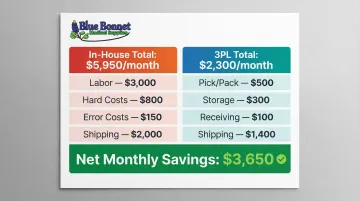
Net savings: $3,650/month
Signs It's Time to Outsource Your Medical Product Fulfillment
These aren't just financial signals—for medical product businesses, operational and compliance signals carry equal weight.
Operational Overload
The pattern: you or your team are spending more hours per week on fulfillment than on sales, marketing, or product development. The average entrepreneur spends 68.1% of their time working "in" their business and only 31.9% working "on" their business.
Many ecommerce business owners find their in-house fulfillment operations become unmanageable around 50 to 100 orders per day. When a spike in orders—a large Amazon order, a seasonal push—creates genuine fulfillment risk (delayed shipments, errors, running out of packaging supplies), the in-house system has no room to flex. It simply cannot scale with demand.
Compliance Complexity Has Outgrown Your Setup
Medical product businesses face a unique trigger that generic ecommerce sellers don't encounter. When FDA documentation requirements, proper storage conditions for sensitive medical items, or international customs compliance become difficult to manage accurately, the risk of a compliance failure outweighs the cost of outsourcing.
Current FDA regulatory requirements include:
- 21 CFR Part 820 covers design, manufacture, packaging, labeling, storage, installation, and servicing of all finished devices
- 21 CFR 820.45 requires documented procedures ensuring integrity, inspection, storage, and operations for labeling and packaging
- 21 CFR 830 requires a Unique Device Identifier (UDI) that adequately identifies a device through distribution and use
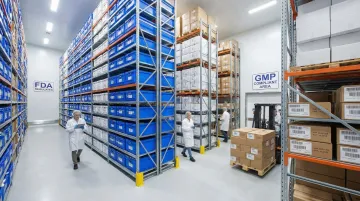
A 3PL specializing in medical products—such as Bluebonnet Medical Supplies, which maintains FDA, ISO, and GMP compliance as part of its standard operations—takes this burden off your plate. Their warehouse is built for proper storage of sensitive medical items, labeling that meets FDA requirements, and careful handling so shipments aren't delayed or flagged.
Shipping Costs Are Eroding Margins
If shipping costs as a percentage of revenue have risen quarter over quarter—or you're absorbing shipping costs to stay competitive while profit per order shrinks—the math is telling you something.
Industry benchmarks:
- For health/wellness products, average shipping spend is $9.29 on an average order value of $83.98, meaning shipping accounts for 11.06% of AOV
- Across most ecommerce categories, shipping costs average 10% to 15% of order value
- Fulfillment costs accounting for 12% to 20% of e-commerce revenues squeeze margins and make profitability difficult
Calculate your shipping cost as a percentage of average order value. If you're consistently above 15%, a 3PL's volume-based carrier discounts can recover that margin—without any changes to your product pricing.
Returns Are Creating a Secondary Problem
For medical products, returns aren't just a logistics headache—they may involve product inspection, testing, and restoration before items can be resold. If returns are piling up, causing inventory inaccuracies, or pulling staff away from core work, that's both an operational and financial problem worth quantifying.
Bluebonnet's returns processing and product restoration service includes inspection, testing, and restoration of returned medical items—so products can safely re-enter sellable inventory rather than be written off. For businesses with high return rates, that recovered value adds up fast.
When Outsourcing May Be Premature — And What to Monitor Instead
Outsourcing too early hurts when:
- Monthly order volume is too low to justify 3PL minimums
- The product line is too new and specifications are still changing frequently
- Margins are too thin to absorb setup and onboarding costs
Volume matters here. Here's where most brands fall:
- Brands shipping under 300 orders per month are generally considered low volume
- Below 100 monthly orders, options narrow significantly due to labor allocation inefficiencies
- Most low-volume 3PLs charge monthly minimums ranging from $1,000 to $2,500
- The average monthly minimum spend requirement reached $517 in 2025
If you're not hitting those thresholds yet, the better move is to build a tracking habit now — so when the numbers shift, the decision is already made. Instead of committing prematurely, start tracking the four cost categories from the calculation section monthly:
- Labor hours spent on fulfillment
- Hard operational costs
- Error and return costs
- Shipping costs as a percentage of revenue
The moment the numbers tip, the decision is grounded in real numbers, not gut feel. The right time to start conversations with a 3PL is before you desperately need one — onboarding during a low-volume period allows for a clean setup rather than a chaotic mid-peak transition.
What Happens When You Wait Too Long to Outsource
Waiting too long to outsource doesn't just slow you down — it actively damages the business you've built. As order volume outpaces manual processes, shipping errors climb, customer satisfaction drops, and negative reviews pile up. For medical product businesses selling on Amazon, those reviews directly affect Buy Box eligibility and your visibility in search results.
Amazon's performance thresholds:
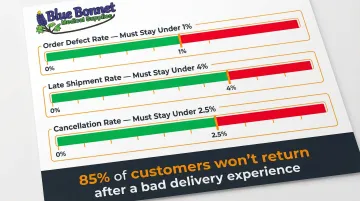
- Amazon requires sellers to maintain an Order Defect Rate (ODR) under 1%
- A Late Shipment Rate (LSR) above 4% or a Cancellation Rate (CR) above 2.5% may result in loss or restriction of selling privileges
- Valid tracking numbers should be provided for 95% of packages shipped to protect Buy Box eligibility
- 23% of consumers never order from a retailer again after a poor delivery experience
- 85% say they wouldn't return after a bad delivery
The compliance stakes are even higher for medical products specifically. Improper handling, storage, or documentation that passes unnoticed at low volume becomes a serious liability at scale — including customs holds on international shipments and FDA compliance failures that a compliant 3PL catches by default. In FY 2022, CBP seized nearly 25 million counterfeit and non-compliant items, including over 5.8 million face masks and 270,135 FDA-prohibited COVID-19 test kits — a reminder of how aggressively regulators scrutinize medical goods at the border.
Frequently Asked Questions
When should a company consider outsourcing fulfillment?
Consider outsourcing when order volume consistently exceeds 50-100 orders per day, fulfillment labor costs are rising, or shipping errors are increasing. For medical products, compliance complexity often triggers the decision earlier than cost alone — the regulatory and documentation infrastructure a specialized 3PL maintains is difficult and expensive to replicate in-house.
What is outsourced fulfillment?
Outsourced fulfillment is the practice of handing storage, pick-and-pack, shipping, and returns management to a third-party logistics (3PL) provider. For medical products, specialized 3PLs also manage regulatory compliance requirements including FDA, ISO, GMP, and HIPAA-safe handling alongside daily operations.
How do I calculate the breakeven point for outsourcing fulfillment?
Total your true in-house labor, materials, storage, error costs, and current shipping rates, then compare to a 3PL quote minus the carrier discount savings (typically 20-40% off retail rates). When costs are equal, you've reached breakeven.
Is outsourced fulfillment right for small medical product businesses?
It depends on volume and complexity. Businesses shipping fewer than 100-300 orders per month may not yet reach breakeven due to 3PL minimums. That said, compliance-heavy products often justify outsourcing earlier — offloading FDA, ISO, and GMP management to a specialized 3PL removes significant operational risk.
What should I look for in a 3PL for medical products?
Look for FDA-compliant handling, ISO and GMP certifications, HIPAA-safe processes, experience with sensitive or temperature-sensitive medical items, returns and restoration capabilities, and direct carrier relationships for discounted rates. The 3PL should integrate compliance into daily operations rather than treating it as a separate function.
Can a 3PL handle FDA and compliance requirements for medical products?
Yes. Specialized medical 3PLs maintain the documentation, storage conditions, and shipping protocols required for FDA-regulated products. Managing these requirements in-house becomes operationally complex at scale, which is why medical product businesses often outsource earlier than general ecommerce sellers.