Introduction
Medical product businesses face a shipping problem that most logistics guides ignore. Items like hospital beds, power wheelchairs, infusion pumps, and diagnostic equipment are heavy, fragile, and subject to strict handling requirements—which means standard carrier rates become margin killers fast. A single durable medical equipment shipment can run $150 or more through standard parcel carriers, and that's before surcharges pile on. For companies operating on tight ecommerce margins, those costs can turn a profitable sale into a break-even transaction.
The challenge isn't just weight. Carriers charge based on dimensional weight, oversized package fees, zone-based pricing, and a growing list of accessorial surcharges that can add hundreds of dollars per shipment.
Without a clear strategy, medical product businesses end up overpaying for shipping, absorbing damage costs from inadequate packaging, and losing customers to competitors who've figured out how to deliver faster and cheaper—while staying compliant.
This guide covers the real cost drivers behind heavy medical equipment shipping, how to reduce them, and when partnering with a specialized 3PL makes more financial sense than managing it in-house.
TLDR
- Dimensional weight and carrier surcharges are the two biggest hidden cost drivers for medical equipment brands shipping heavy items
- Right-sizing packaging and understanding DIM weight formulas can cut shipping bills by 20–40%
- Carrier selection matters—the right option for a 15-pound CPAP unit differs from a 90-pound imaging machine
- Partnering with a 3PL that has pre-negotiated carrier rates reduces shipping costs on heavy medical items without requiring enterprise-level volume
Why Heavy Sports Equipment Is So Expensive to Ship
Dimensional Weight Pricing Charges You for Air
Carriers don't just charge by actual weight—they charge by whichever is greater, actual weight or dimensional weight (DIM weight). DIM weight is calculated by multiplying a package's length, width, and height, then dividing by a carrier-specific divisor. For FedEx and UPS, that divisor is 139 for domestic shipments; USPS uses 166.
Here's where it gets expensive: a foam roller that weighs 3 pounds but ships in a 24" × 12" × 12" box has a DIM weight of 25 pounds (24 × 12 × 12 ÷ 139 = 24.8, rounded up). You're paying for 25 pounds of shipping, not 3. As of August 2025, both UPS and FedEx implemented "ceiling rounding," which rounds every fractional inch up before calculating DIM weight—so a box measuring 12.1" becomes 13", artificially inflating your billable weight.
Carrier Surcharges Pile Up Fast
Beyond base rates, carriers apply multiple surcharges to heavy or oversized sports equipment:
- Additional Handling Surcharge (AHS): Triggered when packages exceed 50 pounds or 10,368 cubic inches
- Large Package Surcharge: Applied to packages exceeding 110 pounds or 17,280 cubic inches—up to $331 per package
- Residential Delivery Surcharge: Added when shipping to home addresses instead of commercial locations
- Fuel Surcharge: A variable percentage added to every shipment based on current fuel prices
Each fee is listed separately on your invoice, and they stack. A single 80-pound weight bench shipped to a residential address can easily accumulate $50+ in surcharges on top of the base rate.
Zone-Based Pricing Hurts Heavy Items Disproportionately
Carriers divide the U.S. into shipping zones based on distance from origin to destination. The farther a package travels, the more zones it crosses, and the higher the cost. For heavy items, this scaling is steep. A 70-pound package shipped via FedEx Ground costs $34.72 in Zone 2 but jumps to $74.61 in Zone 8—a 115% increase. UPS Ground charges $34.87 for the same package in Zone 2, but $103.11 in Zone 8—a 196% increase.
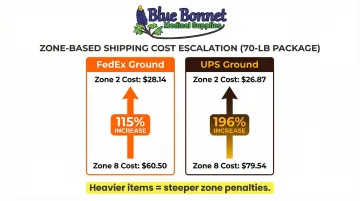
That 196% gap between Zone 2 and Zone 8 barely registers on a 2-pound resistance band. On a 70-pound barbell set, it's the difference between a profitable sale and a loss.
The Hidden Cost of Damage and Returns
Heavy items that are improperly packed are more likely to arrive damaged. Major parcel carriers experience damage rates approaching 10% for heavy and bulky items, compared to just 1.24% for LTL freight shipments. Processing a return for damaged goods costs 20-65% of the item's value, plus $10-$20 in direct replacement expenses per incident. Factor in negative reviews and customer churn, and a single damaged shipment can cost far more than the difference between a budget carrier and a reliable one.
Why Sports Equipment Is Harder to Ship Than Most Ecommerce Categories
Irregular shapes make sports equipment uniquely challenging. Four factors compound the difficulty compared to most ecommerce categories:
- Shape variability: Resistance bands are easy; a rowing machine is not—and your catalog likely includes both
- Mixed SKU weights: No single carrier or packaging strategy works across every product
- Seasonal demand spikes: January home gym surges and spring bicycle season create sudden volume pressure
- Inventory positioning: Brands that don't pre-position stock regionally end up paying for expensive expedited shipping to close the gap
5 Strategies Sports Equipment Brands Use to Cut Shipping Costs
Understand Your DIM Weight Before You Quote
Calculate DIM weight using the formula: Length × Width × Height ÷ DIM divisor. For UPS and FedEx, the divisor is 139; for USPS, it's 166. Run this calculation before selecting packaging—not after. Over-sized boxes are one of the most common and correctable cost mistakes.
Here's how it plays out in practice:
| Box Size | Actual Weight | DIM Weight | Billed Weight |
|---|---|---|---|
| 16" × 14" × 14" | 30 lbs | 31.2 lbs | 31 lbs |
| 15" × 13" × 13" | 30 lbs | 18.2 lbs | 30 lbs |
Switching to a snugger box for the same 30-pound medical device saves you the DIM weight overage on every shipment — those dollars add up fast at volume.
Right-Size Packaging to Reduce Fees
Use the smallest box that safely fits the product. This reduces dimensional weight charges and can eliminate the "large package" surcharge threshold. Test multiple box configurations for your top-selling heavy SKUs to find the optimal size. Companies implementing right-sized packaging see an average 40% reduction in box size and 26% decrease in corrugated material use — cutting dimensional weight charges directly.
Use Strategic Warehouse Positioning or Zone Skipping
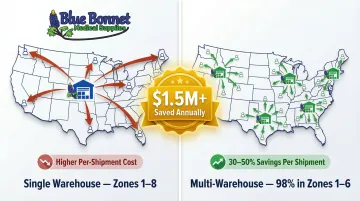
Zone skipping means storing inventory closer to high-density customer populations. By using fulfillment centers in the middle of the country or near major metros, brands reduce the number of shipping zones crossed per order. One medical supply distributor expanded from two to four fulfillment centers, reaching 98% of parcels in Zones 1-6 (just 2% in Zones 7-8) — saving over $1.5 million annually in freight costs.
For medical product businesses, strategic inventory positioning can cut per-shipment costs by 30-50% compared to shipping everything from a single coast-based warehouse.
Know When to Ship Parcel vs. LTL Freight
Parcel carriers like UPS and FedEx cap shipments at 150 pounds and 165 inches in length plus girth. Beyond that threshold, LTL (less-than-truckload) freight becomes the more cost-effective option. The average cost per pound for LTL shipping ranges from $0.15 to $0.75, with most shipments falling between $0.22 and $0.42 per pound.
Items like hospital beds, infusion pumps, imaging equipment, or bulk diagnostic supplies often cross into freight territory. Shipping these via parcel carriers is typically the most expensive option. That said, LTL freight requires accounting for accessorial fees — liftgate services alone can add $80-$350 per delivery.
Negotiate or Access Volume-Based Carrier Discounts
Carriers offer tiered pricing based on shipping volume. Most small-to-mid-sized medical product businesses don't ship enough individually to access meaningful discounts. There are two paths to better rates:
- Build volume internally over time: As your monthly shipment count grows, renegotiate carrier contracts annually
- Access pre-negotiated carrier rates through a 3PL partner immediately: 3PLs pool shipping volume across multiple clients to unlock pricing that individual small businesses cannot achieve on their own
For businesses that need cost relief now — not after years of volume growth — partnering with a 3PL is the faster route.
Choosing the Right Carrier for Your Sports Equipment Type
Choosing the Right Carrier for Your Medical Equipment Type
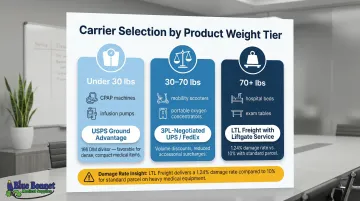
No single carrier is best for every medical product SKU. The smartest brands audit their SKU list and assign different carrier strategies to different product weight tiers rather than using one default carrier for everything.
Carrier Selection Framework by Product Type
Small heavy items (under 30 lbs): Infusion pumps, CPAP devices, diagnostic monitors Best handled by USPS Ground Advantage for dense items under 70 pounds. USPS only applies dimensional weight to packages larger than 1 cubic foot and uses a favorable 166 divisor, making it the most cost-effective option for compact, heavy medical shipments.
Mid-weight items (30–70 lbs): Mobility scooter components, portable oxygen concentrators, surgical lighting units Benefit from 3PL-negotiated heavy parcel programs with UPS or FedEx. These programs reduce per-pound costs and minimize surcharges through volume discounts.
Large/commercial equipment (70+ lbs): Hospital beds, exam tables, rehabilitation equipment Usually require LTL freight with liftgate service. LTL freight damage rates average just 1.24%, compared to 10% for parcel carriers handling heavy items — a critical difference when shipping sensitive medical devices.
Key Questions to Ask Any Carrier Before Committing
- How do you handle oversized packages?
- What additional fees apply to items over X pounds or Y dimensions?
- Do you offer residential liftgate service?
- What is your damage claims rate for heavy parcels?
- Can you provide a detailed breakdown of all surcharges before I ship?
Carriers who can't answer these questions clearly aren't equipped to handle medical shipments without costly errors.
Packaging Strategies That Reduce Both Damage and Costs
Use the Right Materials for Heavy Sports Equipment
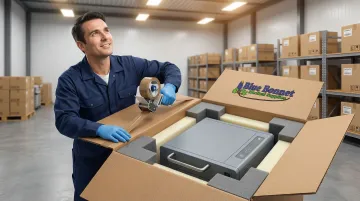
- Double-wall corrugated boxes (not single-wall) for anything over 20 pounds
- Foam corner inserts or molded pulp for items with hard edges
- Reinforced tape on seams to prevent box failure during handling
- Proper dunnage (internal padding/fill) to prevent items from shifting in transit
UPS recommends double-wall corrugated boxes with a minimum Edge Crush Test (ECT) of 61 for items weighing 81-100 pounds. Test packaging to International Safe Transit Association (ISTA) standards — ISTA 3A for parcel delivery systems, or ISTA 6-Amazon for ecommerce fulfillment.
The Cost-Reduction Paradox of Better Packaging
Spending slightly more on box quality and dunnage upfront reduces the far greater cost of damage claims, returns processing, and replacement shipments. With parcel carriers experiencing damage rates approaching 10% for heavy items, the cost of one returned heavy item can easily exceed what better packaging would have cost across dozens of shipments. Proper packaging passes a basic drop test without the product moving inside the box.
Standardize Packaging Specs Across Top-Selling Heavy SKUs
Once you've invested in the right materials, standardizing specs locks in those gains at scale. Document weight and dimension data accurately in your shipping platform. This prevents carrier billing adjustments, where carriers re-measure and charge you more . Standardization also speeds up your packing process and reduces errors that lead to dimensional weight penalties.
When Partnering With a 3PL Makes Financial Sense for Heavy Equipment Brands
Signals That Self-Fulfillment Is No Longer Cost-Effective
- Shipping costs consistently exceed 15-20% of revenue
- Increasing damage claims eating into margins
- Inability to negotiate better carrier rates due to low volume
- Time spent packing heavy items pulling focus away from product development and sales
- Seasonal demand spikes causing fulfillment bottlenecks
Seasonal demand swings hit heavy-item brands harder than most — when you're shipping treadmills or squat racks, a forecasting miss doesn't just mean stockouts. It means expensive last-minute LTL bookings and expedited carrier surcharges that can erase months of margin.
What a Qualified 3PL Brings to Heavy-Item Fulfillment
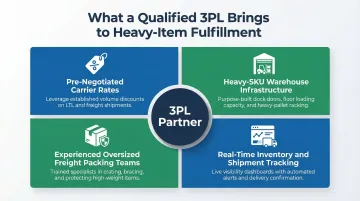
The right 3PL brings four things a growing brand can't easily replicate on its own:
- Pre-negotiated carrier rates that are consistently lower than what a brand can access at its own shipping volume
- Warehouse infrastructure built for large, heavy SKUs — proper racking, material handling equipment, and trained staff
- Packing teams experienced with oversized freight who know how to pass drop tests and keep damage claims low
- Real-time inventory and shipment tracking that integrates with your ecommerce platform and flags stockout risk before it hits
Knowing what a 3PL can offer is the first step — but not all providers are equally equipped for heavy-item fulfillment. Here's what to vet before signing.
Key Things to Look for When Evaluating a 3PL for Heavy Sports Equipment
- Experience with oversized and heavy SKUs: Not all 3PLs are equipped to handle 100-pound treadmills or irregularly shaped kayaks
- Specific carrier relationships for heavy parcel and LTL shipping: Access to discounted rates across multiple carriers, not just one
- Flexible pricing without order minimums: Ability to scale with your business without forcing you into contracts that don't fit your volume
- Personal-service approach: A partner that treats your business as a priority rather than a number in a large client queue
The best 3PLs are built around the idea that no two businesses ship the same way. A customized approach — with direct carrier relationships, careful product handling, and solutions tailored to your SKU mix — is what separates a true logistics partner from a generic fulfillment warehouse.
Calculate the Total Cost Comparison
Brands should calculate the full cost of self-fulfillment:
- Labor (packing, inventory management, customer service)
- Packaging materials (boxes, dunnage, tape)
- Carrier rates (base rates plus surcharges)
- Damage/returns processing costs
- Warehouse rent and utilities
- Shipping software subscriptions
Compare that total against a 3PL's all-in pricing. For most heavy-item brands, the math tips toward outsourcing sooner than expected — particularly once you factor in the hours spent on logistics that could go toward product development or sales.
Frequently Asked Questions
What is dimensional weight and why does it matter for sports equipment shipping?
Dimensional weight is calculated using a box's length, width, and height divided by a carrier's DIM divisor (139 for UPS/FedEx, 166 for USPS). Carriers charge whichever is higher—actual weight or DIM weight—which is why large, lightly dense items like foam rollers or padded equipment can cost more to ship than their actual weight suggests.
When does LTL freight make more sense than parcel shipping for sports equipment?
LTL freight typically becomes cost-competitive when items exceed 70-150 pounds or require special handling like liftgate delivery. Large gym equipment like treadmills or squat racks is almost always cheaper to ship via LTL than standard parcel carriers, and LTL freight has significantly lower damage rates (1.24% vs. 10%).
How can a small sports equipment brand access discounted carrier rates?
Small brands can access negotiated carrier rates by partnering with a 3PL, which pools shipping volume across multiple clients to access rates that individual small businesses cannot achieve on their own.
What packaging materials are best for shipping heavy gym equipment?
Use double-wall corrugated boxes, foam corner inserts or molded pulp, reinforced tape on all seams, and internal dunnage to prevent shifting. Packaging should meet ISTA 3A or ISTA 6-Amazon standards and pass a basic drop test without product movement.
Do carriers charge extra fees for oversized sports equipment beyond the base rate?
Yes, carriers apply additional handling fees, large package surcharges, residential delivery fees, and fuel surcharges on top of the base rate for heavy or oversized items. These add-ons catch brands off guard and can total $331 per package.
How do I calculate whether partnering with a 3PL will actually save money?
Tally the full current cost of self-fulfillment—including labor, packaging materials, software, carrier rates, and damage/return costs—and compare that total against a 3PL's all-in pricing. For heavy-item brands, the break-even point typically arrives sooner than expected once carrier rate differentials are factored in.