Introduction
An Indian seller has products sitting in a US warehouse after customer returns — marked "unsellable" by Amazon or the 3PL. The options seem bleak: write off the inventory, pay to ship it back to India, or liquidate it for pennies.
This problem hits Indian sellers uniquely hard. Unlike domestic US sellers who can quickly intervene, Indian sellers face international shipping costs, customs barriers, and time zone gaps that make every returned unit more expensive to recover.
A US-based seller can pick up a return, inspect it, and relist it within days. An Indian seller's product sits idle — accruing storage fees — while they wait across time zones just to learn what condition it's in.
There's a better path: repackaging returned goods within the US itself. Through on-site inspection, restoration, and proper repacking, those units can be resold as new or like-new — recovering real revenue without the cost of an ocean shipment or the pain of liquidation.
TLDR
- International freight, duties, and re-export costs to ship US returns back to India usually exceed the product's value
- US-based repackaging (through a 3PL or prep center) recovers 30-70% of original value versus 5-10% through liquidation
- Returns flow through inspection, repair, repackaging, and relisting on Amazon FBA/FBM or another sales channel
- Indian sellers handle this remotely through a US-based 3PL that offers returns processing and product restoration
- For medical product sellers, the 3PL must meet FDA, ISO, and GMP standards before handling any medical returns
Why US Returns Hit Indian Sellers Harder Than Local Sellers
The Distance Penalty
When a US-based seller receives a return, they can physically retrieve it, inspect it, and make a decision within days. An Indian seller has no physical presence. The product sits in a warehouse while storage fees accumulate, and the seller waits — often across 10+ time zones — for basic information about the item's condition.
This delay is costly. E-commerce return rates reached 17.6% in 2023 and are projected to hit 19.3% in 2025, meaning roughly one in five units shipped by Indian sellers will come back. For every returned item that sits idle for weeks, the seller loses not just the original sale but also the opportunity to recover value while the product is still marketable.
The "Unsellable" Trap on Amazon FBA
Amazon marks returned items with disposition codes:
- Sellable – unopened, original condition
- Customer Damaged – opened, briefly used, or packaging torn
- Defective – customer claimed it doesn't work
- Warehouse Damaged – damaged by Amazon
- Carrier Damaged – damaged in transit
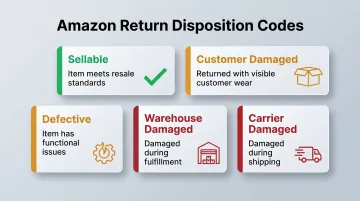
The critical issue: Amazon classifies most returns as "Customer Damaged" even when the product itself is perfectly functional. The packaging may be opened, but the device works fine. Indian sellers often don't know this because they can't physically inspect the item.
The Financial Stakes
Returns cost retailers an average of 30% of an item's value to process, adding up to $211 billion industry-wide. Yet nearly 95.2% of returned inventory stays out of landfills, indicating the vast majority of returns have recoverable value.
A significant share of that recoverable value comes from bracketing: approximately 66% of consumers buy multiple sizes or colors to try at home and return the rest. These items are generally in like-new condition when they come back — yet Amazon marks them "unsellable" because the packaging was opened.
For Indian sellers, that gap between Amazon's label and the item's actual condition is where recoverable revenue disappears.
Time Sensitivity Problem
The longer a returned item sits without action, the more value it loses:
- A Halloween costume returned in November is essentially worthless by December
- Electronics drop in resale value every week as newer models launch
- Medical supplies approaching expiration dates become unsellable regardless of condition
Indian sellers dealing across time zones and without local teams are directly exposed to these delays. By the time they receive return notifications, evaluate options, and coordinate action, weeks have passed.
Category-Specific Severity for Medical Products
Medical supplies, health products, and devices face the steepest value drop if returns aren't processed quickly and compliantly. Amazon requires medical devices to be sold in "New" condition only — returned medical items are automatically marked "Unfulfillable" regardless of actual condition.
This creates a unique challenge: the product may be physically perfect, but Amazon's policy prevents relisting it as new. Without a proper US-based returns workflow, Indian medical product sellers face total losses on every return.
The Real Cost of Your Three Options: Scrap, Ship Back, or Repackage
Option 1: Scrapping or Liquidating
Liquidation means selling inventory to liquidators, donating it, or disposing of it entirely.
Amazon's FBA liquidation program returns approximately 5-10% of the item's average selling price. For a $20 product, that's $1-$2 per unit — before Amazon deducts:
- Per-unit liquidation processing fee
- 15% referral fee on the gross recovery value
Amazon disburses payment 60-90 days after inventory ships to the liquidator.
Beyond the direct financial loss, liquidation removes your product from the US market permanently — you can't recapture customer relationships, reviews, or brand presence.
Option 2: Shipping Back to India
Returning goods to India involves stacking fees at every stage. Here's what that actually looks like:
Freight charges:
- Air freight: Starting at $2.66 per kg (for shipments 45+ kg)
- Ocean FCL (20ft container): Approximately $3,034
- Ocean LCL: Cost-effective only for volumes below 15 cubic meters
Additional fees (adding 25-40% to base freight):
- Port handling
- Customs brokerage
- Insurance
- Fuel surcharges
Re-import duties and GST:
Under Notification No. 45/2017-Customs, re-imported goods qualify for Basic Customs Duty exemption — provided you can prove they're identical to the goods originally exported. Even then:
- IGST (Integrated Goods and Services Tax) is generally still payable
- Goods must be re-imported within 3 years of export
- You must repay all export incentives claimed (Duty Drawback, IGST refund, RoDTEP, MEIS benefits)
- Documentation required: original Shipping Bill, export invoice, packing list, Bill of Entry, correspondence explaining the return
For most product categories, the all-in cost of international return shipping plus re-import duties exceeds the product's residual value. Shipping back to India is rarely worth it.
Option 3: Repackaging and Reselling in the US
A US-based 3PL receives, inspects, repackages, and relists your goods — all without the product ever leaving the US.
Companies with structured reverse logistics recover 30-70% of original product value, compared to 10-20% through liquidation. A well-run 3PL repackaging operation sits at the higher end of that range.
Turnaround runs days to two weeks from return receipt to relist-ready condition, depending on the 3PL and product complexity.
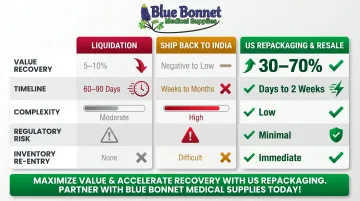
Comparison Table
| Dimension | Liquidation | Ship Back to India | US Repackaging & Resale |
|---|---|---|---|
| Value Recovery | 5-10% of ASP | Negative to low (costs often exceed value) | 30-70% of original value |
| Timeline | 60-90 days | Weeks to months | Days to 2 weeks |
| Complexity | Low (automated) | High (customs, IEC, Notification 45/2017, incentive clawback) | Moderate (requires US 3PL) |
| Regulatory Risk | None | IGST liability; export incentive repayment | FDA/ISO compliance required for medical products |
| Inventory Re-Entry | Lost from US market | Returns to India (may not be needed) | Stays in US market for resale |
Medical Products Context
The table above applies broadly — but for medical product sellers, the stakes are higher. Scrapping or improperly returning goods creates compliance and documentation risks that can affect your account health. Processing returns through an FDA-compliant facility ensures items meet safety standards before resale and keeps your regulatory record clean.
What the Repackaging and Resale Process Looks Like Step by Step
Triggering the Process: Removal Orders and Returns Receipt
For FBA sellers:
Create a removal order in Amazon Seller Central to direct Amazon to send unsellable inventory to a designated US address (your 3PL or prep center).
Key details:
- Select "Ship-to address" when creating the removal order
- Enter your 3PL's name and physical address manually
- The address must be within the 48 contiguous United States (no P.O. boxes or international addresses)
- Processing time: Typically 10-14 business days; up to 30+ days during peak season (October-December)
Critical step: Configure your Automated Unfulfillable Settings in Seller Central. If you don't configure a removal preference, Amazon will automatically dispose of your items — a 100% loss.
For FBM sellers:
Set your 3PL's US warehouse address as your default return address in Seller Central:
- Navigate to Settings > Return Settings > Return Address Settings
- Store your 3PL's address as the default return location
- International sellers must provide a valid US domestic return address or offer returnless refunds
If no valid return address is on file when a return is requested, Amazon may default to a returnless refund.
Inspection and Condition Assessment
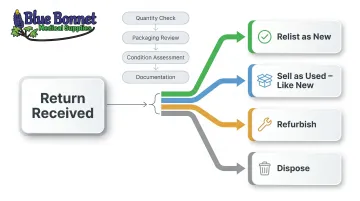
What a proper inspection involves:
- Quantity check – verify units received match removal order or return notification
- Labeling and packaging review – assess outer packaging damage, missing labels, or incorrect FNSKU
- Product condition assessment – functional testing where applicable, cosmetic inspection
- Documentation of findings – written reports with photos showing item condition
This step determines whether a unit can be:
- Relisted as "New"
- Sold as "Used - Like New"
- Refurbished
- Disposed of
Critical distinction: Amazon offers its own FBA Grade and Resell program (which you can disable in Seller Central). Indian sellers should control this process through a trusted 3PL rather than letting Amazon's automated service handle it, so you decide the condition grading and which resale channel to use — not Amazon's algorithm.
Repackaging and Restoration
What repackaging entails:
- Replacing damaged outer packaging
- Removing incorrect or old labels
- Applying new FNSKU labels
- Re-boxing in branded or generic cartons
- Re-taping, adding poly bags, bubble wrap, or inserts
- For medical products: ensuring packaging complies with FDA and GMP standards
What restoration means:
Restoration goes beyond cosmetic repackaging. For medical supplies and devices, it may include:
- Product testing to verify functionality
- Component checks to ensure all parts are present and working
- Documentation updates to confirm the item is safe and compliant for resale
- Labeling replacements including tamper-evident seals
For medical products, the repackaging facility must be FDA-registered and ISO 13485-compliant. Bluebonnet Medical Supplies, for instance, provides FDA-cleared packaging, product testing, and GMP-compliant restoration — handling the full restoration workflow for Indian sellers managing medical product returns in the US.
Relisting and Reselling
Once inspection and restoration are complete, you have five main channels for getting units back into the market.
Option 1: Relist on Amazon FBA as New
If inspection confirms the product is in original condition with undamaged packaging, relist it as new inventory.
Option 2: Amazon Renewed Program
For refurbished products, Amazon Renewed allows sellers to list inspected, tested items that work and look like new.
Eligibility requirements:
- Invoices showing a minimum of $50,000 in qualifying refurbished purchases
- Order Defect Rate (ODR) of 0.8% or less
- Minimum 90-day warranty on all certified refurbished products
- Electronics with batteries must have 80%+ capacity
- No visible cosmetic imperfections when held 12 inches away
Option 3: Amazon FBA Grade and Resell
Amazon inspects and grades items, then creates "Used" listings in four condition tiers:
- Used - Like New
- Used - Very Good
- Used - Good
- Used - Acceptable
This is ideal for items that don't meet Renewed eligibility but are still functional.
Option 4: List on FBM with "Like New" or "Open Box" Condition
Sell through Fulfillment by Merchant (FBM) with clear condition descriptions. This lets you set your own price and write condition descriptions in detail.
Option 5: Alternative Channels
Sell through eBay, Walmart Marketplace, or direct-to-consumer channels if Amazon restricts relisting for your product category, such as certain medical devices.
Managing US Returns Remotely as an Indian Seller
The Core Challenge
Indian sellers have no on-the-ground visibility. You need a 3PL partner that provides:
- Detailed condition reports at each stage
- Photographs showing item condition
- Clear communication via email or portal
- Not just "we received your items" — but "here's what we found and here are your options"
What a Good Remote Management Workflow Looks Like
- The 3PL receives the return (from Amazon removal order or direct FBM return)
- The 3PL sends an inspection report with photos showing outer packaging condition, product condition, labeling status, and functional test results if applicable
- You review the report and approve one of the following:
- Repackage and relist as new
- Restore and sell as refurbished
- Liquidate or dispose
- The 3PL executes your decision and updates inventory status
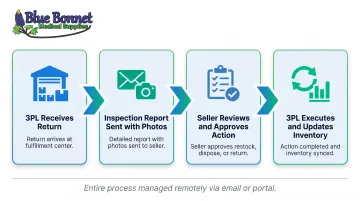
The entire process runs via email or portal — no US presence required.
Importance of Agreed Turnaround Times
Ask prospective 3PL partners about their inspection-to-decision timeline and repackaging turnaround. Delays directly translate to:
- Storage fees
- Lost resale windows (especially for seasonal or trending products)
- Increased risk of product obsolescence
A typical cycle — from return receipt to relist-ready — runs anywhere from a few days to two weeks depending on the 3PL and product complexity. When evaluating partners, get a written commitment on turnaround times before signing on.
What to Look for in a US-Based Repackaging and 3PL Partner
Compliance Credentials Come First
For Indian sellers — especially those in medical supplies, health products, or FDA-regulated categories — the 3PL must hold relevant certifications:
FDA registration: Any US facility that repackages medical devices must register with the FDA, list the devices, and pay the annual establishment registration fee.
ISO 13485:2016 compliance: As of February 2, 2026, the FDA's Quality Management System Regulation (QMSR) formally incorporates ISO 13485:2016. Any facility involved in repackaging medical devices in the US must now comply with this international standard as part of federal regulatory requirements.
GMP-compliant handling: Good Manufacturing Practices ensure proper handling, storage, and documentation throughout the returns process.
Amazon requires medical devices to be sold in "New" condition only — returned medical devices are automatically marked "Unfulfillable." If your 3PL isn't FDA-registered and ISO-compliant, you cannot legally repackage those returns for resale.
Bluebonnet Medical Supplies holds FDA, ISO, and GMP compliance across its packaging and handling operations — covering exactly what Indian sellers need to legally reprocess and relist medical returns in the US.
Returns Processing and Restoration Capabilities
Not all 3PLs offer genuine product restoration — many only do cosmetic repackaging. Ask specifically whether the partner can:
- Test products for functionality
- Replace components
- Update documentation
- Confirm an item is resalable (not just rebag it)
That last point matters most. A 3PL that can only rebag a return isn't saving you money — it's just delaying a write-off. Look for a partner that runs functional assessments and clears items for resale, not just repackages them.
Bluebonnet Medical Supplies provides product testing and restoration alongside FDA-compliant packaging, covering full inspection and functional assessment before items go back into sellable inventory.
Transparent Reporting and Communication
Since Indian sellers manage everything remotely, the 3PL must provide:
- Detailed inspection reports with photos
- Clear condition grading
- Action recommendations (relist, refurbish, liquidate, or dispose)
The difference between a useful update and a useless one looks like this:
Vague: "We received your return." Useful: "Product functional, outer box damaged — needs repackaging and new FNSKU label."
Ask about their condition grading process and what documentation they provide with each return batch.
Frequently Asked Questions
What happens to Amazon returns in India?
Amazon India (amazon.in) handles returns within India through its own system. This article focuses on Indian sellers selling on Amazon US (amazon.com) — where returns stay in the US and must be managed via removal orders or a US-based 3PL.
How to sell products from India to the USA on Amazon?
Indian sellers can sell on Amazon US through Amazon Global Selling, using either FBA (shipping inventory to Amazon's US fulfillment centers) or FBM (shipping directly to customers). You'll also need an IEC (Importer Exporter Code) and standard export documentation.
Is FBA available in India?
Indian sellers can use FBA on Amazon US by shipping inventory to Amazon's US fulfillment centers — programs like Amazon Global Selling SEND offer up to $200 in fulfillment credits for first-time users. FBA is also separately available for sellers on Amazon India (amazon.in), but that's a different program.
Can Indian sellers ship returned US goods back to India to resell?
Shipping returns back to India is possible, but the cost of international freight, re-import duties (including IGST), and potential re-export fees make it economically unviable for most categories. US-based repackaging and resale is the more practical route.
What types of returned products can be repackaged and resold in the US?
Most product categories — including home goods, electronics accessories, sporting goods, and medical supplies — can be repackaged and resold if the product itself is undamaged. The main requirement is that packaging is restored to meet marketplace standards and, for regulated categories like medical devices, compliance requirements are met.
How long does the repackaging and resale process take in the US?
Timelines vary by 3PL partner and product complexity, but a typical process from return receipt to relist-ready condition can take anywhere from a few days to two weeks. Turnaround time should be a key factor when choosing a US-based repackaging partner.