Introduction
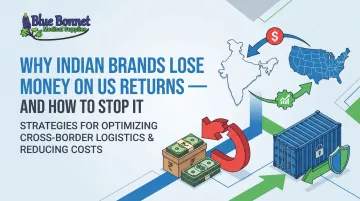
Cross-border e-commerce returns cost sellers 2 to 3 times more than domestic returns, according to recent industry data. For Indian brands selling medical products in the US, this multiplier creates a direct financial trap.
When a US customer returns a product, a seller without US-side infrastructure absorbs costs on both the forward shipment and the return leg — making the transaction a net loss. At low volumes, individual return events feel manageable. But as US sales scale, those losses compound quickly: reverse logistics fees, customs complications, inspection delays, and eventual inventory write-offs stack up faster than most P&Ls can absorb.
This article examines how US return costs accumulate for Indian brands, what structural and operational factors drive those costs up, and three categories of strategies to reduce them — covering logistics infrastructure, return policy design, and inventory recovery.
TL;DR
- Indian brands pay far more per return than US-based sellers — double shipping, customs duties, and write-offs stack up fast
- Without US-side returns processing, goods cross the ocean twice, triggering fresh customs exposure on every return cycle
- Most losses are preventable: smarter pre-return policies, tighter workflows, and the right US infrastructure cut costs at the source
- The fix isn't just operational — it's structural; brands that solve this gain a real pricing and margin advantage over competitors still absorbing the losses
- Medical product sellers carry extra risk: without FDA, GMP, and ISO-compliant US partners, returns create compliance exposure, not just cost
How US Return Costs Build Up for Indian Brands
Return costs for Indian brands don't appear as a single visible charge. They accumulate across several events:
- Reverse shipping from the US customer back to a collection point
- US-side handling, inspection, or storage
- Customs complications on re-import into India
- Write-off or re-processing of the returned goods
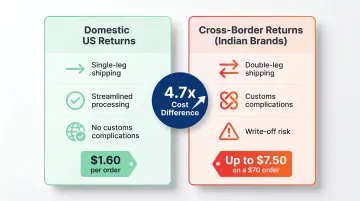
At low volumes this is manageable. At scale, it compounds fast. Brands often don't feel the full impact until US sales hit a meaningful threshold — then the return P&L problem surfaces all at once. According to ATTN Agency's analysis, domestic return costs average $1.60 per order, while international returns can reach $7.50 on a $70 average order value. That's a 4.7x difference.
The Dead Inventory Trap
Returned goods that sit in a US location without an efficient inspection or restoration workflow tie up capital with no clear exit path. Storage costs continue to accumulate while revenue recovery stalls. Branch8's case study of a Hong Kong-based jewelry retailer illustrates the impact: the average return-to-resale cycle was 18 days without optimization. By implementing regional hub processing, the company reduced that to 6 days and recovered approximately $54,000 in previously tied-up inventory value per quarter.
The Double-Shipping Exposure
Dead inventory is one problem. The shipping math creates another. Cross-border returns hit Indian brands with a double-shipping exposure that domestic US sellers never face. You already absorbed the outbound international shipment cost. The return leg then adds either equivalent reverse shipping or a write-off decision — and neither is cheap. According to ATTN Agency, international returns often result in a 100% write-off because reshipping returned inventory back to India rarely makes financial sense.
Key Cost Drivers for US Returns
International Reverse Logistics
International reverse logistics is the primary cost amplifier. Shipping a returned product from a US customer back to India represents a cost that domestic sellers simply do not encounter. Pitney Bowes research shows average cross-border return shipping costs ranging from $15-$30 per parcel, compared to domestic return shipping of $5-$8 per return.
Processing a return costs retailers an average of $33 per item, and returns can cost up to 66% of the initial price of the product when all factors are included.
Customs and Re-Import Complications
Returned goods flowing back into India can trigger customs duties, require extensive documentation, and face processing delays. Under India's Notification No. 45/2017-Customs, goods manufactured in India and re-imported can qualify for exemption from Basic Customs Duty and Integrated Tax — but only under strict conditions:
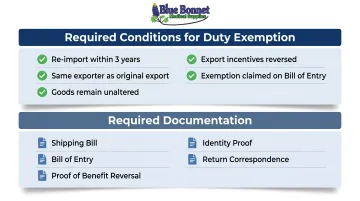
Required conditions for duty exemption:
- Goods must be re-imported within 3 years of export (extendable to 5 years)
- Re-imported by the same exporter
- Goods have not been worked upon or altered abroad
- All export incentives (Duty Drawback, IGST refund, RoDTEP, ROSCTL) are reversed/repaid
- Exemption is explicitly claimed on the Bill of Entry
Meeting those conditions also means assembling a specific documentation package:
- Copy of original Shipping Bill and Export Invoice
- Bill of Entry claiming Notification 45/2017 exemption
- Proof of reversal of all export benefits
- Identity proof linking goods to original export
- Correspondence showing reason for return
If these conditions are not met, returned goods are treated as fresh imports under Section 20 of the Customs Act, 1962. Full BCD + Social Welfare Surcharge + IGST then apply at current tariff rates — a direct cost that compounds the original shipping loss and ties up working capital while customs clears the shipment.
Absence of US-Based Returns Infrastructure
Brands without a US warehouse or 3PL partner have no way to inspect, restore, or re-list returned goods on the ground. Their only options are expensive reverse shipping or writing the product off entirely.
Only about 30% of returned merchandise can be resold at full price; the remainder is discounted or liquidated. For cross-border sellers, this percentage is often even lower.
Product Write-Offs as a Hidden Cost Center
Because Indian brands often lack on-the-ground US inspection capability, returned products — even those that are lightly used or only need re-packaging — are written off at full cost rather than recovered. Branch8 data suggests that if return processing costs exceed 60% of the item's resale value, it becomes more economical to issue a refund without requiring a physical return. Domestic sellers rarely reach that threshold; cross-border sellers hit it routinely.
Policy Mismatch
That write-off pressure is made worse by the return policies Indian brands need to offer to compete. 82% of US consumers say free returns are an important consideration when shopping online, and standard return windows typically run 30 to 90 days.
These expectations are difficult to operationalize efficiently from abroad. Without US-side infrastructure, a "free returns" policy means one of three things:
- Absorbing international reverse shipping costs on every return
- Writing off inventory rather than recovering it
- Restricting returns in ways that hurt conversion and trust
The policy itself becomes a cost driver when it isn't designed around the economics of international fulfillment.
Cost-Reduction Strategies for US Returns
Return costs have three distinct sources: decisions made before a return happens, how returns are handled once initiated, and the operational setup surrounding the entire workflow. Each requires a different fix.
Strategies That Reduce Costs by Changing Decisions
These approaches reduce return costs by altering decisions made before or around the return event—including policy design, product presentation, and packaging choices.
Redesign the US return policy to reflect cross-border logistics realities
A return window and conditions that work for a domestic US seller can be economically destructive for an Indian brand. Consider shorter windows, restocking conditions, or tiered policies that preserve customer confidence without enabling structurally unprofitable returns. Research from UT Dallas found that leniency in return time windows actually reduced return rates due to the endowment effect—longer ownership increases attachment to the product.
Invest in listing accuracy
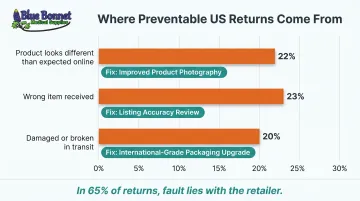
High-resolution product images from multiple angles, precise specifications, compatibility guides, and verified buyer reviews that address common expectation-mismatch concerns can dramatically reduce returns. 22% of returns are due to the product looking different than expected online, and 23% are due to the wrong item being received. In 65% of returns, the fault lies with the retailer, not the consumer.
Improving product photography and size guides reduced returns by 22% in one quarter for an APAC brand selling into Australia.
Upgrade outbound packaging for international transit
Products damaged in transit generate returns that are entirely avoidable. Packaging engineered for domestic US fulfillment often under-protects items during international shipping. Since 20% of returns are due to damaged or broken products, packaging specifically designed for long-haul international transit eliminates a preventable return segment.
Build return shipping costs into pricing or offer tiered policies
This changes the incentive structure without sacrificing customer trust. Differentiate between defective-product returns (covered fully) and preference-based returns (covered partially or with conditions). This approach recognizes that not all returns carry equal responsibility.
Strategies That Reduce Costs by Changing How Returns Are Managed
These approaches improve control, data visibility, and recovery rate once a return has been initiated.
Implement a US-side returns tracking and triage system
Log return reason by SKU, geography, and product condition. This is the foundation for identifying whether losses are coming from a product quality issue, a listing problem, or a logistics handling failure. Brands that skip this step make cost decisions in the dark.
Shift from cash refund defaults to exchange or store credit workflows
Each return that results in an exchange rather than a refund preserves revenue and reduces the net financial loss of the event. 29% of consumers would prefer to receive a refund instantly in the form of store credit for no fee, and 42% of customers will exchange their return at a store if the process is easy and convenient.
A refund on a $40 item results in approximately $50 total loss. An exchange with a $10 bonus credit incentive can convert that into $65 profit if the customer selects a $75 exchange item. Over two years, converting a refund to an exchange can yield $360 in additional revenue.
Establish a US-side inspection and restoration protocol
Not every returned product needs to go back to India. Many can be inspected, re-packaged, and re-listed from a US location, converting a write-off into recoverable inventory. A partner like Bluebonnet Medical Supplies — FDA, GMP, and ISO compliant — can process returned medical products, inspect them for usability and safety standards, and return them to sellable inventory without the product ever leaving US soil.
Use return reason data at the SKU level
A product with a persistently high US return rate due to expectation mismatch is a listing or design problem. It costs more to absorb repeatedly than to fix once. SKU-level data reveals which products need immediate attention.
Strategies That Reduce Costs by Changing the Context Around Returns
These approaches address the structural and environmental factors that amplify return costs. In many cases, the surrounding operational setup is the real cost driver, not the returns themselves.
Position inventory closer to the US customer base
When inventory is already in the US through a US-based fulfillment hub, returns stay in the US for processing. This eliminates the double international shipping exposure entirely. Brands using regional return hubs and local carriers reduce return logistics costs by 40-60% compared to centralized cross-border shipping, and reduce average return processing time by 40%.
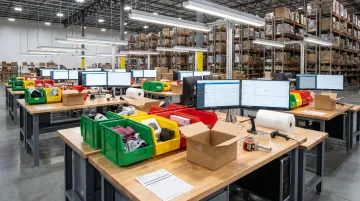
Partner with a US-based 3PL with dedicated returns processing capabilities
A partner with product inspection, testing, and restoration capabilities can convert returned goods from write-offs into re-listable inventory. Bluebonnet Medical Supplies, based in Cedar Park, Texas, offers dedicated Product Testing & Restoration services for returned medical items — assessing usability, restoring to spec, and returning goods to sellable inventory. For Indian brands selling medical products into the US, this capability matters: without it, every return becomes either a costly reverse shipment to India or a full write-off.
Verify regulatory compliance credentials for medical product returns
Non-compliant handling creates regulatory exposure that adds legal and remediation costs on top of the financial return loss. For medical products, the US returns partner must hold FDA clearance, GMP compliance, and ISO standards. These credentials are a regulatory requirement — they protect both the brand and the end customer.
Integrate the US returns workflow with Indian operations in real time
When the US returns workflow operates separately from the Indian team's inventory and order management system, returned goods sit in limbo — storage costs accumulate, and the re-listing window narrows. Real-time integration is what converts a returns operation from a pure loss into partial revenue recovery.
Conclusion
Indian brands lose money on US returns not because returns are inevitable losses, but because the cost structure around those returns—the absence of US-side infrastructure, misaligned policies, and lack of data visibility—turns manageable events into compounding financial damage.
Controlling those costs starts with identifying where they actually originate:
- Pre-return decisions — policy design, product descriptions, size guidance
- In-process gaps — no US-side receiving, inspection, or restocking infrastructure
- Structural blind spots — no data visibility into return reasons or cost per return
Fix the root cause. Brands that do this stop absorbing returns as a permanent line item and start treating them as a solvable operational problem.
Frequently Asked Questions
Why do US returns cost more for Indian brands than for domestic US sellers?
Indian brands absorb outbound international shipping costs upfront and then face a second cost event on the return leg—either reverse international shipping or a write-off. This double-shipping exposure runs 2-3x more than domestic returns, a structural cost that US sellers never encounter.
Should Indian brands ship returned US products back to India?
Rarely. International reverse shipping, re-import duties, and processing delays typically cost more than the product's recovered value. US-side processing and re-listing is almost always cheaper—and avoids the documentation burden that comes with Notification No. 45/2017-Customs.
What happens to returned medical products at a US-based 3PL warehouse?
Compliant US-based 3PLs with FDA and GMP capabilities can inspect, test, re-package, and re-list returned medical products—recovering value that would otherwise be written off. The right regulatory credentials are non-negotiable; non-compliant handling creates legal exposure that compounds the original loss.
How can Indian brands reduce their US return rate before returns happen?
Most preventable returns trace back to three fixable problems:
- Listing gaps — add high-resolution images, precise specifications, and fit guides
- Packaging failures — upgrade international packaging to survive long transit
- Expectation mismatches — mine verified buyer reviews to catch recurring complaints early
None of these require changing the product itself.
How do customs duties affect the cost of US returns for Indian brands?
Returning goods to India triggers re-import duties under Section 20 of the Customs Act unless exemption is claimed under Notification 45/2017—which requires reversing export incentives, extensive documentation, and strict time compliance. In most cases, US-side disposal or restoration is the cheaper path.
What should Indian brands look for in a US returns processing partner?
US warehouse presence, product restoration and re-packaging capabilities, regulatory compliance (FDA/GMP/ISO for medical products), real-time inventory integration, and experience handling the specific product category being sold. A partner missing any of these cannot turn returned inventory into recoverable stock.