Introduction
US e-commerce return rates averaged 19.3% in 2025, totaling $849.9 billion in returned merchandise. For Indian exporters—particularly in medical products—what happens after a customer returns a shipment drains thousands of dollars from every export cycle. Most exporters track the return itself but never calculate the scrapping cost that follows.
The core problem: when returned goods reach a US warehouse with no plan for inspection, restoration, or re-certification, the default outcome is often disposal. By that point, the exporter has already paid import duties, international freight, and compliance fees on that product. These sunk costs compound into a total loss that typically exceeds 2-4x the product's declared value.
That loss is preventable — but only if you know what you're actually paying. This guide breaks down what scrapping costs, what drives those costs, how it compares to a restore-and-resell approach, and what to calculate before your next shipment reaches a US warehouse.
TL;DR
- Scrapping a returned product costs more than its unit value — import duties paid, disposal fees, and lost reorder revenue all add up
- Total cost depends on product category, US regulatory requirements, and whether you have a US-based handler managing the return
- Medical exporters face the steepest losses, with FDA compliance and regulated disposal driving costs significantly higher
- A US-based 3PL with returns processing and restoration services can recover 40–70% of a returned unit's value rather than writing it off
The True Cost of Scrapping Returned Goods in the US
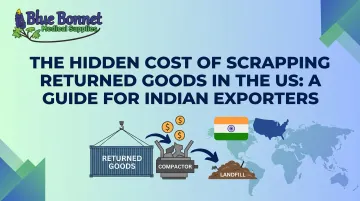
Scrapping a returned product in the US triggers costs that started accumulating long before the return was filed. Once all components are counted, the total loss typically runs 2–4x the product's declared value.
Sunk Costs Already Paid at Point of Return
These costs are gone regardless of what happens next:
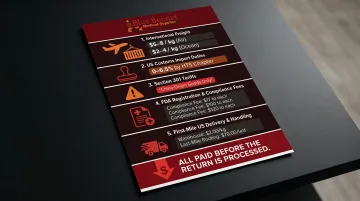
- International freight to the US: Air freight from India averages $5-8 per kg; ocean freight runs $2-4 per kg or $50-80 per CBM
- US customs import duties: Most medical devices under HTS Chapter 90 enter at 0% MFN duty, but components under other chapters may carry 2.5-6.5% rates
- Section 301 tariffs: Currently apply only to China-origin goods, not India
- FDA registration and compliance fees: Paid upfront for regulated medical products
- First-mile US delivery: Warehouse intake and initial handling
While medical device tariffs are currently zero, a Section 232 investigation initiated in September 2025 is examining US reliance on foreign medical device manufacturing. No tariff rates have been proposed yet, but the probe covers surgical instruments, syringes, needles, catheters, bandages, sutures, PPE, pacemakers, insulin pumps, wheelchairs, ventilators, and diagnostic equipment.
Disposal and Scrapping Fees in the US
Physical destruction of medical goods is not free. US disposal facilities charge per unit or per pound, and FDA-regulated products require certified destruction with full documentation.
Regulated medical waste disposal costs:
- $0.30-0.80 per pound for regulated medical waste
- Small practices pay $75-200/month for combined biohazard and sharps disposal
- Cost hierarchy (least to most expensive): general RMW < sharps < pathological < pharmaceutical < chemotherapy < hazardous chemical waste
Medical products require specialized handling, transportation, treatment (autoclave or incineration), and a documented chain of custody. Non-compliance fines range from thousands to hundreds of thousands of dollars per violation.
The Customs Refund Problem
When goods are scrapped in the US rather than re-exported, Indian exporters typically cannot claim duty drawback or IGST refund on the original export. Under Section 75 of the Customs Act, 1962, and Rule 96B of the CGST Rules, 2017, drawback and IGST refunds are conditional on realizing sale proceeds in foreign exchange within the FEMA-prescribed period.
If goods are destroyed abroad and no payment is received, Customs will issue notice to recover drawback already paid, plus interest at approximately 15% (Customs) and 18% (GST).
One exception applies: the RBI may grant a formal "write-off" certifying that non-realization was beyond the exporter's control — but this requires a separate application and is not automatic.
Inventory and Opportunity Cost
The scrapped unit represents lost reorder value: raw material, manufacturing labor, and packaging already spent. It also removes a sellable unit from active stock. When a quarter of your returns go to scrap, that compounds into a measurable drag on quarterly margins.
Returns processing costs:
- Processing accounts for 30% of the retail cost of the unit
- Handling a single return costs approximately $15 on average, or 59% of the original sale price
- Inventory loses 10-15% of its value during the return process
Reputational and Compliance Risk for Medical Exporters
If returned medical goods are not handled through a documented, compliant disposal chain in the US, the Indian exporter may face liability questions from retailers or marketplace platforms. Amazon requires sellers of medical devices to comply with all FDA regulations and typically classifies returned medical devices as "Unsellable" immediately, since Amazon staff are not qualified to certify sterility or functionality.
Amazon strictly prohibits re-sealing and resending returned medical devices as "New." Doing so triggers a "Used Sold as New" violation and can result in permanent account suspension.
What Drives Up Scrapping Costs for Indian Exporters
Not all returned goods reach scrap for the same reasons. Understanding what triggers a scrap decision rather than a restoration decision is the first step to reducing this cost.
Product Category and Regulatory Classification
Medical devices and health products are subject to FDA oversight, meaning returned items cannot simply be re-boxed and resold. If the product's original sterile seal, packaging integrity, or FDA-labeling requirements are compromised, the unit is flagged for disposal rather than resale.
21 CFR Part 820—Quality System Regulation establishes three core obligations for returned medical devices:
- Returned devices must follow written procedures for identification, documentation, evaluation, segregation, and disposition (21 CFR 820.90)
- Disposition options include scrap (destruction), return to supplier, downgrade, use-as-is (with documented justification), or rework with re-testing
- Any post-distribution complaint alleging deficiencies in quality, safety, or performance requires a formal complaint file under 21 CFR 820.198
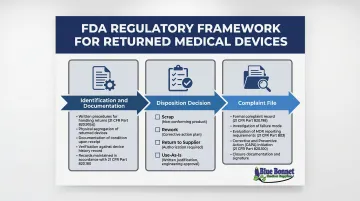
This regulatory framework is the single biggest cost driver for Indian medical exporters.
Absence of a US-Based Returns Handler
Without a US warehouse partner equipped to inspect, test, and restore returned goods, the retailer or marketplace platform makes the disposal decision by default. When Amazon receives a returned medical device via FBA, it typically classifies it as "Unsellable" immediately — choosing the path of least liability rather than least cost.
A 3PL partner like Bluebonnet Medical Supplies can intercept returns before that scrap decision is made, performing inspection, functional testing, repackaging, and re-labeling under FDA, GMP, and ISO standards. That turns a disposal cost into recovered value.
Distance from Origin and Re-Export Economics
Even when restoration is possible, geography makes shipping goods back to India for reprocessing impractical. For low-to-mid value goods, the freight cost alone often exceeds the product's worth.
International return freight benchmarks (US to India):
- Standard air freight: $5–8 per kg
- Ocean freight: $2–4 per kg or $50–80 per CBM
- Small parcels (under 30 kg): approximately $30+ per package via discount brokers
These rates exclude customs clearance, local delivery, insurance, and handling — making in-country (US) restoration the only economically viable alternative to scrapping for most products.
Packaging and Shelf-Condition on Arrival
Returned goods arriving in damaged outer packaging are far more likely to be scrapped, even when the inner product is intact. Common triggers include:
- Torn or crushed outer cartons that signal tampering or transit damage
- Missing or broken tamper-evident seals on the retail unit
- Illegible or detached FDA-required labeling on the secondary package
Many of these failures trace back to original packaging design, not the return journey itself — meaning they're fixable before the product ever ships.
Scrap vs. Restore: A Cost Comparison
For most returned goods, the real decision is whether restoration costs less than writing off the unit entirely.
What "Restoring" a Returned Product Typically Involves in the US
The restore pathway includes:
- Inspecting and functionally testing each unit to confirm it still performs as intended
- Replacing damaged outer packaging to meet original FDA, GMP, and ISO standards
- Updating or replacing FDA-compliant labels where the original labeling is compromised
- Re-certifying the unit so it re-enters sellable inventory rather than a disposal bin
A US 3PL with FDA-cleared packaging, GMP compliance, and product testing capabilities—like Bluebonnet Medical Supplies—can handle each of these steps under one roof, keeping turnaround times short and recovery rates high.
Cost Comparison: Scrap vs. Restore
| Cost Component | Scrap Path | Restore Path |
|---|---|---|
| Sunk import costs | $100-300 (freight + duties) | $100-300 (same sunk cost) |
| Disposal fee | $15-50 (per unit) | $0 |
| Lost inventory value | $50-200 (product cost) | $0 |
| Inspection/testing fee | $0 | $10-25 |
| Repackaging cost | $0 | $15-30 |
| Restored resale value | $0 | $150-400 (60-80% recovery) |
| NET OUTCOME | Total loss: $165-550 | Net recovery: $105-335 |
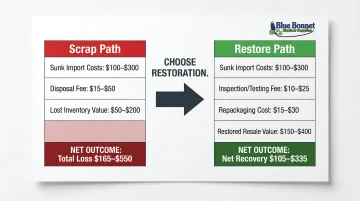
Note: Figures are illustrative and vary by product type, complexity, and restoration requirements.
When Scrapping is Unavoidable
Scrapping is the only option when:
- Products with compromised sterility cannot be re-certified
- Items have expired shelf-life
- Goods have physical damage that renders them non-functional
- Items are subject to a US product recall
Restoration is not always possible, but routing returns to a compliant facility early maximizes recoverable units. For Indian exporters shipping at volume, even a modest improvement in recovery rate can offset a significant portion of annual return losses.
How to Estimate Your Annual Scrapping Exposure
Indian exporters rarely track scrapping losses as a separate line item. They're absorbed into "returns," so the real cost never surfaces.
Simple calculation framework:
- Total US return volume per year × scrapping rate × per-unit scrapping cost = annual scrapping exposure
Key benchmarks:
- 25% of returns are discarded outright by US merchants
- Only 48% of returned goods can be resold at full price
- 5% of all e-commerce returns go straight to liquidation, never restocked
- 9.5 billion pounds of returns ended up in US landfills in 2022
Example calculation:
For an Indian medical device exporter shipping 10,000 units/year to the US with a 4.6% return rate (health product benchmark):
- Returns: 10,000 × 4.6% = 460 units
- Scrapped (25% of returns): 460 × 25% = 115 units
- Average scrapping cost per unit: $300 (sunk costs + disposal + lost inventory)
- Annual scrapping exposure: $34,500
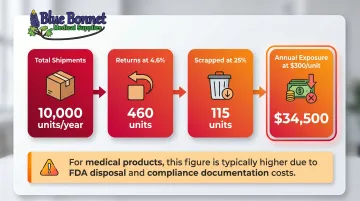
For medical products, this number is almost always higher than exporters expect due to FDA disposal requirements and compliance documentation costs.
That $34,500 figure also understates the true exposure when compliance costs are factored in. Compare what each path actually costs:
What returns management costs look like in practice:
- Returns processed through compliant restoration: $40–55 per unit (inspection + repackaging)
- Returns scrapped without evaluation: $165–550 per unit (total loss)
For 115 scrapped units, that's a difference of up to $57,000 in a single year—enough to fund a US-side returns partner several times over.
What Most Indian Exporters Miss About US Return Costs
Focusing Only on the Refund, Not the Downstream Disposal Cost
Most exporters consider the transaction complete when the return is acknowledged, never calculating what the US side actually does with the product. The refund or chargeback from the US buyer is visible; the disposal cost is not.
Assuming US Return Rates Mirror Indian E-Commerce Return Rates
US consumer return behavior is structurally different. India's overall e-commerce return rate runs 20-30%, with fashion/apparel often crossing 30% due to sizing and expectation issues. US return rates for the same categories can run significantly higher, especially for medical and health products sold online.
Comparative benchmarks:
- India: Fashion/apparel ~30%, Electronics ~8-10%, Overall ~20-30%
- US: Overall e-commerce 19.3%, Health products ~4.6%, Clothing ~26%, Electronics ~8-10%
While health-related products have a lower return rate (4.6% in the US), the per-unit scrapping cost is far higher due to regulated disposal and compliance documentation requirements.
The Compliance Documentation Gap for Medical Products
That regulated disposal isn't just expensive — it requires a documented destruction trail. Under 21 CFR 820.90, manufacturers must establish procedures for controlling nonconforming product, including:
- Identification and documentation of the nature of nonconformance
- Evaluation and determination of cause
- Segregation of nonconforming product
- Documented justification for disposition decision
- Signature of the individual authorizing the disposition
- All activities documented in the Device History Record (DHR)
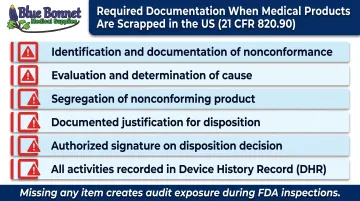
Without a compliant US partner managing this process, the exporter has no audit record — which creates real exposure during FDA inspections or marketplace compliance reviews. Working with a US 3PL that holds FDA, ISO, and GMP compliance means this documentation is handled by default, with no separate audit trail to build from scratch.
Frequently Asked Questions
What is the return rate of e-commerce products in India?
India's e-commerce return rate ranges 20-30% across categories, with fashion/apparel often crossing 30% due to sizing and expectation issues. US return rates for similar categories run higher — a critical benchmark for Indian exporters entering the market.
What happens to returned medical products in the US if they cannot be resold?
FDA-regulated medical products that fail inspection or have compromised packaging must either be recertified through a compliant process or disposed of through certified destruction. The cost of both outcomes falls on the exporter or their US representative, with regulated medical waste disposal running $0.30-0.80 per pound plus documentation requirements.
Can Indian exporters claim a customs duty refund when US-returned goods are scrapped?
No. When goods are scrapped in the US rather than re-exported, duty drawback and IGST refund claims on the original export are not recoverable. Customs can also issue notice to recover drawback already paid, with interest at approximately 15% (Customs) and 18% (GST) — making those import duties a permanent loss.
How does a US-based 3PL help reduce scrapping costs for Indian exporters?
A US 3PL with returns processing capabilities intercepts returned goods before a scrap decision is made, performs inspection and restoration, and re-enters units into inventory. This converts what would be a disposal cost into recovered value, typically recovering 40-70% of a returned unit's value instead of writing it off entirely.
Is scrapping a returned product more expensive than shipping it back to India?
Yes, for most mid-to-low value products. International return freight from the US to India runs $5-8 per kg by air or $2-4 per kg by ocean, often exceeding the product's value when customs clearance, handling, and delivery are included. US-side restoration or liquidation keeps those costs on-shore — and usually recovers more value than a return shipment ever would.
What documentation is required when medical products are scrapped in the US?
FDA-regulated products require a destruction record documenting who disposed of the goods, when, and by what method — with nonconformance evaluation and authorized sign-off per 21 CFR 820.90. Exporters without a compliant US partner may lack this trail during FDA inspections.