Introduction
Pharmaceutical packaging directly determines whether a drug reaches patients safely, maintains full efficacy, and clears regulatory standards. With strict FDA, ISO, and GMP requirements in play, the choice of packaging material carries real legal, safety, and commercial consequences. Wrong choices lead to product degradation, regulatory rejection, or costly recalls.
In 2024, medical device manufacturer Exactech was pushed into bankruptcy after a massive recall and 2,600 lawsuits — all traced to a missing oxygen barrier layer in their packaging that allowed implant oxidation.
This article breaks down the main materials used in pharmaceutical packaging, what makes each suitable or unsuitable for specific drug types, and how to make the right material selection for your product.
TL;DR
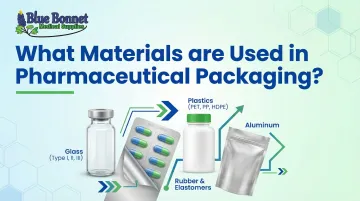
- Pharmaceutical packaging materials fall into five main categories: glass, plastics/polymers, metals (aluminum), rubber/elastomers, and paper/cardboard
- Each material serves a distinct role — glass protects against chemical reactions, aluminum blocks moisture and light, and rubber creates airtight seals
- Choosing the right material comes down to drug form, environmental sensitivities, regulatory classification, and how the product will be shipped
- Poor material selection leads to chemical leaching, drug degradation, contamination, or regulatory non-compliance
What Is Pharmaceutical Packaging?
Pharmaceutical packaging is the complete system of containers, closures, and protective systems used to hold, protect, and deliver a drug product from manufacture through to the end user. It encompasses three distinct levels:
- Primary packaging has direct drug contact (glass vials, blister packs)
- Secondary packaging groups and protects primary packages (cartons, labels)
- Tertiary packaging protects products during bulk transit (corrugated boxes, pallets)
The United States Pharmacopeia (USP) General Chapter <659> defines a "Packaging system" as the sum of packaging components and materials that together contain and protect the article. A "Primary packaging component" is in direct contact with or may come into direct contact with the article, while secondary and tertiary components provide additional protection and transportation safety.
This article focuses on the materials used across these levels—particularly primary packaging—where material selection directly determines drug safety, shelf life, and regulatory compliance.
Why Does the Choice of Packaging Material Matter?
Packaging material directly affects drug stability. Certain materials can react with the drug—leaching chemicals, absorbing active ingredients, or allowing gases to permeate—altering potency, safety, and shelf life. Regulatory bodies like the FDA require extractables and leachables studies for primary packaging precisely because these interactions are unpredictable without systematic testing.
Without careful material selection, serious problems emerge:
- Drug degradation from moisture or light exposure
- Contamination from microbial ingress or chemical migration
- Failed stability tests and costly product recalls
- Customs rejections for internationally shipped products
In July 2023, Cipla voluntarily recalled six batches of Albuterol Sulfate Inhalation Aerosol due to a container defect where leakage through the inhaler valve caused failure to deliver the recommended dose. In a separate case, Hospira recalled lots of Buprenorphine and Labetalol Hydrochloride Injections in May 2024 due to potential incomplete crimp seals—posing an increased risk of systemic infection and loss of therapeutic effect.
Both cases illustrate a broader truth: packaging failures are compliance failures. Non-compliant materials can halt distribution, block export clearance, or trigger FDA, ISO, and GMP enforcement action before a product ever reaches the patient.
Types of Materials Used in Pharmaceutical Packaging
Pharmaceutical packaging materials are not interchangeable. Each has been developed to address specific drug types, delivery formats, and regulatory requirements. Understanding what distinguishes each of the five primary categories helps explain why material selection is one of the most consequential decisions in drug product development.
Glass
Glass is one of the oldest and most trusted pharmaceutical packaging materials, used primarily for injectables, liquid medications, and biologics. It is produced in several grades—most notably Type I borosilicate glass for high-sensitivity drugs and Type II/III for less reactive products—and forms the basis for vials, ampoules, syringes, and bottles.
Key Strengths:
Glass offers superior chemical inertness, excellent barrier properties against gases and moisture, complete UV protection when amber-colored, and non-reactivity with a wide range of drug formulations. This makes it the default material for sterile injectables, vaccines, and parenteral drugs.
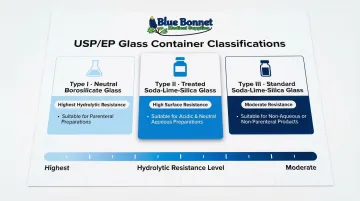
The United States Pharmacopeia (USP) <660> and European Pharmacopoeia (EP) 3.2.1 classify glass containers into three types based on their hydrolytic resistance:
- Type I: Neutral borosilicate glass with high hydrolytic resistance, suitable for most preparations including parenteral administration
- Type II: Soda-lime-silica glass with high resistance from surface treatment, suitable for most acidic and neutral aqueous preparations
- Type III: Soda-lime-silica glass with moderate resistance, generally suitable for non-aqueous parenteral preparations or non-parenteral products
Limitations:
Glass is fragile and heavy, raising real concerns around breakage and shipping costs. It can also leach ions—particularly sodium and silica—into certain drug formulations under specific conditions, requiring careful compatibility testing.
Delamination is a documented risk. In late 2024, American Regent recalled 10 lots of Venofer (iron sucrose) injection due to glass delamination concerns that could cause vascular injury, embolism, or thrombosis if microscopic glass flakes were injected. Glass is also more expensive to manufacture and transport than plastic alternatives.
Plastics and Polymers
Plastics are the most widely used class of pharmaceutical packaging materials, employed in bottles, blister pack forming webs, pouches, vials, syringes, and closures. In 2025, plastics held the highest revenue share (36.62%) of the pharmaceutical packaging market.
Common pharmaceutical-grade polymers include polyethylene (PE), polypropylene (PP), polyvinyl chloride (PVC), polyethylene terephthalate (PET), and cyclic olefin copolymers (COC)—each with distinct barrier and compatibility profiles.
Key Strengths:
Plastics offer unmatched versatility in form, shape, and size. They are lightweight (reducing shipping costs), shatter-resistant, and cost-effective at scale. Certain polymers like COC offer near-glass clarity and low extractables, while multi-layer constructions allow barrier properties to be engineered for specific products.
Cyclic Olefin Copolymer (COC), such as TOPAS, provides excellent clarity, high stiffness, and exceptional water vapor barrier properties. TOPAS COC film grades demonstrate a Water Vapor Transmission Rate (WVTR) of 0.8 to 1.3 g·100 µm/(m²·day) at 38°C and 90% RH, making COC an ideal shatter-resistant alternative to glass for pre-filled syringes and vials storing moisture-sensitive biologics.
Limitations:
Plastics carry inherent risks of chemical migration—including plasticizer leaching (particularly with PVC) and permeation of oxygen or moisture—which can compromise drug stability. The type of plastic must be rigorously matched to the drug formulation through extractables and leachables testing.
The FDA has issued guidance recommending that the pharmaceutical industry avoid DEHP as an excipient due to its known developmental and reproductive toxicity. DEHP is highly mobile and can leach out of PVC into body tissues and fluids. Not all plastics are easily recyclable, raising sustainability concerns.
Metals (Aluminum)
Aluminum is the primary metal used in pharmaceutical packaging, most commonly as foil in blister pack lidding, multi-layer laminations for sachets and pouches, and as tubes for semi-solid preparations like creams and ointments. Its exceptional barrier properties make it essential for protecting light-, moisture-, and oxygen-sensitive drugs.
Key Strengths:
Aluminum foil provides the highest barrier protection of any common packaging material—impermeable to moisture, oxygen, light, and other environmental contaminants. This makes it critical for sensitive oral solid dose forms. Common alloys used in pharmaceutical packaging include 8011 and 8021, which are popular for their formability and strength.
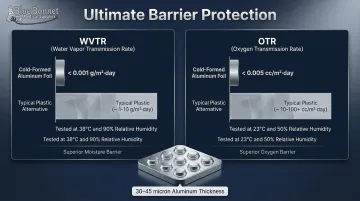
Cold-formed blister foils (typically 30–45 microns thick) provide an ultimate barrier, achieving a Water Vapor Transmission Rate (WVTR) of <0.001 g/m²·day (at 38°C, 90% RH). Their Oxygen Transmission Rate (OTR) reaches <0.005 cc/m²·day (at 23°C, 50% RH). Aluminum also enables tamper-evidence and child-resistant features in blister pack designs.
Trade-offs:
Aluminum has limited standalone structural applications—it's typically used in lamination with plastics or paper rather than as a standalone container. It is more expensive than polymer-only alternatives. Recycling aluminum-plastic composite structures (such as blister packs) is complex due to the difficulty of separating material layers. The European Union's Packaging and Packaging Waste Regulation (PPWR) requires that all packaging be recyclable, though primary packaging in contact with medicinal products is exempt until January 2035.
Rubber and Elastomers
Rubber—predominantly butyl rubber and synthetic elastomers such as bromobutyl or chlorobutyl—is used for closures, stoppers, septa, plunger tips in syringes, and needle shields. It plays a critical sealing role in injectable drug packaging: maintaining hermetic closure while permitting needle penetration for reconstitution or dosing.
Key Strengths:
Rubber provides flexible, resealable, hermetic sealing that maintains sterility and prevents contamination. It holds up across wide temperature ranges—a critical property for cold-chain products like vaccines—and is compatible with a broad range of injectable formulations when properly tested.
Limitations:
Rubber can release additives, antioxidants, or vulcanization agents into drug products—a risk that requires extractables and leachables testing and regulatory approval of the specific rubber formulation. Contamination from rubber particulates is also a documented concern in injectable preparations.
A critical risk associated with rubber stoppers is "coring" or fragmentation upon needle puncture. Repeated puncture of multidose vials can generate particulates larger than 6–8 µm, which, if injected, can lead to phlebitis, pulmonary embolism, granulomas, and mechanical blockade of catheters. This necessitates tight quality control during production.
Paper and Cardboard
Paper and cardboard are primarily used in secondary and tertiary pharmaceutical packaging—as cartons, labels, package inserts, and outer shipping boxes—though paper-based materials are increasingly being incorporated into primary packaging laminates (paper-backed blister packs and sachets) as part of sustainability-driven design.
Key Strengths:
Paper and cardboard are widely recyclable, printable, cost-effective, and biodegradable—making them the standard for outer cartons, labeling, and patient information inserts. They provide structural protection during shipping and an excellent surface for regulatory labeling. In Europe, 82.3% of fibre-based packaging is recycled.
Where It Falls Short:
Paper alone provides minimal barrier protection against moisture, gases, or contamination and cannot be used independently for primary drug contact packaging without coatings or lamination with other materials. Its structural integrity also degrades under humidity, requiring consideration in tropical or high-moisture shipping environments.
How to Choose the Right Pharmaceutical Packaging Material for Your Product
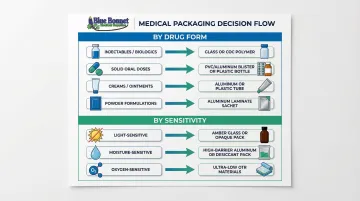
Material selection starts with the drug's physical form and route of administration:
- Injectables and biologics demand glass or COC polymer
- Solid oral doses (tablets, capsules) are well-suited to PVC/aluminum blister packs or plastic bottles
- Creams and ointments require aluminum tubes or plastic tubes
- Powder formulations need high-moisture-barrier materials such as aluminum laminate sachets
From there, drug sensitivity narrows the options:
- Light-sensitive drugs require amber glass or opaque packaging
- Moisture-sensitive drugs need high-barrier aluminum or desiccant-integrated packaging
- Oxygen-sensitive biologics require materials with extremely low oxygen transmission rates
Confirm the drug formulation's stability requirements before finalizing any material choice.
Regulatory and Compliance Requirements
The packaging material must pass extractables/leachables (E&L) testing per FDA and ICH guidelines. The August 2025 ICH Q3E draft introduces strict, standardized limits—including the Analytical Evaluation Threshold (AET) and Safety Concern Threshold (SCT)—for Class 1-3 leachables across the product lifecycle. This shifts the standard from ad-hoc testing to systematic, risk-based E&L lifecycle management for all primary packaging components.
Materials must also comply with pharmacopoeial standards (USP, EP) relevant to the target market. For products distributed internationally, verify that material standards align with import country regulations to avoid customs delays.
Supply Chain and Distribution Conditions
Material choice must account for the full distribution journey, not just shelf storage. Key conditions to evaluate:
- Cold chain products (vaccines, biologics) need materials that hold integrity across temperature fluctuations
- Mail-order and e-commerce shipments face mechanical stress and variable ambient conditions in transit
- International shipments may encounter humidity, heat, and handling variation that domestic supply chains don't
For businesses shipping medical products domestically or internationally, working with a 3PL partner like Bluebonnet Medical Supplies—which provides FDA-cleared, GMP-compliant packing and shipping—ensures that material integrity is maintained from warehouse to final delivery.
Weighing Per-Unit Cost Against Risk
Higher-barrier materials (Type I borosilicate glass, COC polymers, aluminum foil laminates) carry higher per-unit costs that must be weighed against the risk of product loss, recall, or regulatory non-compliance from using a cheaper but insufficient alternative. The recall of extended-release metformin in 2020 hit sales estimates by around $25 million for the 2021 financial year and $15 million for 2022—plus a $10 million one-off cost for the recall itself.
Common Mistakes to Avoid When Selecting Pharmaceutical Packaging Materials
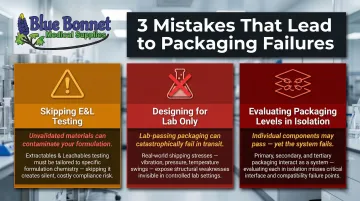
Even experienced teams make costly errors during material selection. These three mistakes show up repeatedly in packaging failures and regulatory rejections.
Skipping compatibility and E&L testing
Assuming a material is "safe" because it's widely used elsewhere — without testing it against your specific drug formulation — is a leading cause of post-market failures. Extractables and leachables profiles vary by formulation, so each drug-material combination requires its own validation.
Designing for the lab, not the supply chain
Packaging that passes stability testing under controlled conditions can still fail in real-world transit. International shipments face temperature extremes, high humidity, and prolonged customs holding. Worst-case distribution scenarios need to be part of the material selection brief from the start.
Evaluating packaging levels in isolation
Outer packaging that absorbs moisture or off-gases chemicals can degrade primary packaging — and the drug inside it. Secondary and tertiary materials should be evaluated as part of a complete packaging system, not as independent components.
Frequently Asked Questions
What is the most commonly used material in pharmaceutical packaging?
Plastics/polymers are the most widely used materials overall due to their versatility, cost-effectiveness, and range of formulations available. However, glass remains the standard for injectable and sterile liquid drug forms due to its chemical inertness.
Why is glass preferred for injectable pharmaceuticals?
Glass—particularly Type I borosilicate glass—is chemically inert, blocks gases and moisture, and does not react with or contaminate the drug formulation. For sterile injectables and biologics, that combination of properties makes it the go-to choice when contamination risk cannot be tolerated.
What are the main risks of using plastic for pharmaceutical packaging?
The main risks are chemical migration (plasticizers or additives leaching into the drug) and moisture or gas permeation that degrades drug stability. Both issues require rigorous compatibility testing to confirm the selected polymer suits the specific formulation.
How does packaging material affect a drug's shelf life?
A material's barrier properties against moisture, oxygen, and light determine how long a drug retains its potency. Poor barrier performance lets degradation reactions take hold, which can render a product unsafe or ineffective well before its labeled expiry date.
Are there eco-friendly alternatives to traditional pharmaceutical packaging materials?
Sustainable options are emerging—including paper-backed blister packs, mono-material recyclable polymer packs, and bioplastics derived from plant sources such as PLA. Adoption remains limited because these materials must clear the same FDA and ICH regulatory hurdles as conventional packaging, and many are still being validated for barrier performance.