
Introduction
Most medical product businesses spend months negotiating supplier rates, optimizing product costs, and protecting margins—while their fulfillment operation erodes all those gains through missed deadlines, damaged goods, and compliance failures.
A strong product margin can't survive a weak fulfillment SLA. For medical product businesses, the cost of getting fulfillment wrong goes far beyond the refund or reship—it can mean regulatory exposure, lost marketplace standing, and customers who never come back.
This article covers what a fulfillment SLA actually is, how SLA failures cost more than most businesses realize, and what to look for in a 3PL partner that protects both your brand and your bottom line.
TLDR
- SLA failures cost 3-5× more than the immediate fix once lost repeat revenue and account health damage are factored in
- Amazon's strict performance thresholds can suppress listings or suspend accounts when SLAs slip
- Compliance and liability risks in medical fulfillment don't apply to general consumer goods
- Hidden SLA costs spread across multiple P&L lines — refunds, reshipments, and regulatory penalties add up fast
- The right 3PL engineers operations to meet SLAs, not just sign them
What Is a Fulfillment SLA?
A fulfillment SLA (service-level agreement) is a binding commitment between a business and its 3PL partner that specifies what services will be performed, at what standard, and within what timeframe. It covers elements like order processing speed, shipping accuracy, inventory receiving windows, and damage rates.
The Difference Between SLAs and Vague Promises
The practical difference between a fulfillment SLA and a vague promise is accountability. An SLA turns "we'll ship quickly" into "orders leave the warehouse within 24 hours with 99.5% accuracy, or a defined remedy applies." Without measurable thresholds and stated consequences for missing them, a commitment is just an intention.
Key SLA components include:
- Order accuracy rate targets (e.g., 99.5%)
- Order processing timeframes (same-day vs. next-day cutoffs)
- Inventory receiving windows (dock-to-stock time)
- On-time shipping commitments
- Damage rate thresholds
- Reporting and visibility standards
These components don't exist in isolation—they run across multiple relationships at once.
SLAs Exist at Multiple Layers
Fulfillment SLAs operate between your business and its 3PL, between the 3PL and carriers, and between your business and end customers (like a delivery promise on a product listing). A failure at any layer lands on the seller's reputation—your customers don't care which party failed; they only know their order was wrong or late.
The Hidden Costs of SLA Failures
Return and Reshipment Cost Spiral
When an order ships wrong or late, the business bears the cost of return shipping, restocking, reshipping, and often a replacement at no charge. According to 2026 ecommerce data, the average cost to process a single return ranges from $10 to $65 per return, including reverse logistics, labor, restocking, and write-offs.
Even a 1-2% error rate becomes expensive at scale. For a business processing 1,000 orders monthly with a 2% error rate, that's 20 returns costing $200-$1,300 per month—$2,400-$15,600 annually—before accounting for lost customer lifetime value.
Customer Lifetime Value Erosion
A buyer who receives a wrong or delayed order rarely complains; they just don't reorder. Research shows that 76% of shoppers say a poor delivery experience influences their decision not to repurchase, and 85% won't return to a retailer after a poor delivery experience.
That math compounds fast. If your average customer lifetime value is $500, a 76% churn risk means each fulfillment failure potentially costs $380 in future purchases — before you've spent a dollar on the return itself.
Marketplace Account Health Damage
For Amazon sellers, late shipment rates, order defect rates, and return dissatisfaction feed directly into seller account health scores. Amazon enforces strict, automated thresholds that trigger immediate consequences:
| Metric | Amazon Threshold | Consequence of Breach |
|---|---|---|
| Order Defect Rate (ODR) | < 1% | Restriction of selling privileges, account suspension |
| Late Shipment Rate (LSR) | < 4% | Buy Box suppression, listing deactivation |
| Pre-Fulfillment Cancellation Rate | < 2.5% | Loss of selling privileges |
| On-Time Delivery Rate | > 90% | Item-level listing deactivation |
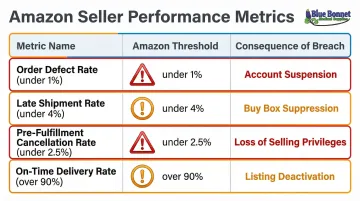
Losing the Amazon Buy Box due to SLA failures can cause revenue on affected products to drop by 50-90%. A sustained fulfillment problem can wipe out access to the channel entirely.
Customer Service Burden
Every SLA failure generates at least one customer service interaction, often several. When errors accumulate across hundreds of orders per month, the cost shows up in staff time, resolution credits, and operational distraction.
A business processing 2,000 orders monthly with a 3% error rate faces 60 service cases per month — consuming 15-30 hours of staff time at minimum.
Review and Reputation Cost
Bad fulfillment experiences generate negative reviews that persist publicly and influence future buyers. Research indicates that 97% of consumers read online reviews before making a purchase decision. Delivery-related complaints directly affect conversion — academic studies confirm that customers give significantly lower ratings to orders delivered late compared to those delivered on time.
The result: lower conversion rates, higher customer acquisition costs, and more ad spend just to offset a reputation problem that started in the warehouse.
Why Margins Don't Cover What SLA Failures Cost You
The Cost Calculation Reality
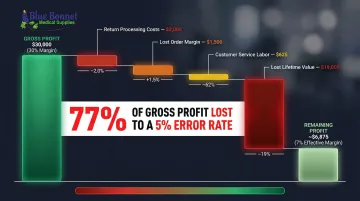
Consider this scenario: a business earns a 30% margin on a product with a $100 average order value (AOV), generating $30 profit per sale. If fulfillment errors force a 5% return/error rate:
- 5% of 1,000 orders = 50 errors
- Average return processing cost: $40 per return
- Total direct cost: $2,000
- Lost margin on those 50 orders: $1,500
- Customer service time (50 cases × 30 min × $25/hour): $625
- Lost lifetime value (50 customers × $500 × 76% churn rate): $19,000
- Total cost of 5% error rate: $23,125
That's 77% of gross profit from 1,000 orders wiped out by a 5% fulfillment error rate. The blended effective margin collapses from 30% to roughly 7%.
The Asymmetry Between Margin Gains and SLA Losses
Shaving an extra 2% off product cost takes months of supplier negotiation and saves $2 per unit. But a fulfillment partner with a weak SLA can erase that gain across hundreds of orders in a single bad week. The scale and speed of SLA-related losses are structurally different from margin optimization.
The math is stark: a 2% product cost reduction on 1,000 units saves $2,000. A 3% fulfillment error rate on those same 1,000 orders costs $13,875 in direct and indirect losses—nearly 7× the margin gain.
The Hidden Nature of SLA Costs
Businesses consistently undercount SLA costs because product margin lives on the P&L as an obvious line item. The true cost of fulfillment failures, by contrast, is spread across returns, reshipments, customer service labor, lost repeat revenue, and ad spend wasted on buyers who won't convert again.
Because these costs sit in multiple budget buckets, they're rarely totaled — which is exactly why margins feel more controllable than they are.
The False Economy of the Cheapest 3PL
A lower fulfillment cost per order looks good on a unit economics spreadsheet, but if that partner can't hold SLA commitments, the savings are consumed rapidly by errors. A 3PL charging $3.50 per order with a 4% error rate costs more than a 3PL charging $4.50 per order with a 0.5% error rate once you factor in the downstream damage.
For medical product businesses especially, that downstream damage compounds fast — returns processing, compliance re-checks, and lost marketplace standing add costs that no carrier discount can offset. The fulfillment partner you choose is a direct input to your margin, not a back-office variable.
The Unique Stakes for Medical Product Businesses
Higher Consequences Than General Consumer Goods
Fulfillment failures carry higher consequences for medical products than general consumer goods. Delayed or inaccurate shipments can affect patient care, create liability exposure, or violate regulatory obligations. The stakes aren't just customer disappointment—they're potentially health-related and legally significant.
The Compliance Dimension
Products must be stored, handled, packed, and shipped in ways that maintain their integrity and regulatory standing. A fulfillment partner that lacks FDA, GMP, or ISO-compliant processes can expose the business to customs holds, product integrity issues, or regulatory citations.
FDA requirements for medical device distribution include:
- Proper handling procedures to prevent mix-ups, damage, and contamination
- Controlled storage environments that prevent deterioration
- Documentation proving only approved devices are released
- Purchase order review prior to dispatch
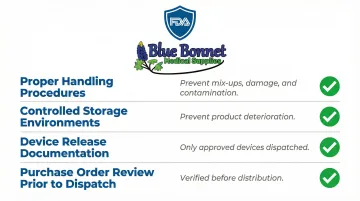
Bluebonnet Medical Supplies' warehouse is built specifically to meet FDA, ISO, GMP, and HIPAA-safe handling standards, so these compliance requirements are built into the SLA from day one.
The FDA has documented Class 2 device recalls due to improper storage by third parties — temperature excursions that compromised product effectiveness.
International Shipping Complexity
Compliance risk doesn't stop at the US border. Medical product businesses shipping overseas face additional SLA dimensions around customs documentation, destination-country regulations, and proper labeling.
The FDA screens all imported medical devices using the PREDICT system. Each shipment requires specific data elements, including:
- Device Foreign Manufacturer (DEV) registration
- Device Listing (LST) number
- Premarket Notification number
Missing or invalid codes are the most common entry errors leading to customs holds or detentions. If a shipment is delayed at port, demurrage and detention charges can reach $2,478 after 14 days in New York and $2,069 in Los Angeles — costs that show up directly on the bottom line.
A fulfillment partner without experience in compliant international medical shipping turns documentation gaps into expensive delays.
Returns and Product Restoration Stakes
That same rigor extends to reverse logistics. A returned medical product isn't like a returned t-shirt — it may need inspection, testing, and documentation before it can be restocked or disposed of properly.
A 3PL without this capability forces businesses to write off returns that could otherwise be salvaged. Bluebonnet's product testing and restoration service inspects, tests, and restores returned medical devices to confirm they meet usability and safety standards before going back into inventory.
What Strong Fulfillment SLA Benchmarks Look Like
Key Performance Metrics
Medical product businesses should hold their 3PL to top-tier performance standards across these metrics:
| SLA Metric | Industry Standard | Best-in-Class Target |
|---|---|---|
| Order Accuracy Rate | 97–99% | 99.5–99.9% |
| On-Time Shipping Rate | 95% | 98%+ |
| Order Processing Time | Within 24 hours | Same-day fulfillment |
| Dock-to-Stock Time | 48 hours | Under 24 hours |
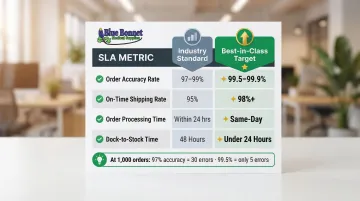
These benchmarks come from 2025–2026 industry data and WERC distribution center metrics. The top of the range matters at volume—the difference between 97% and 99.5% accuracy is 25 errors vs. 5 errors per 1,000 orders.
Those numbers only protect you if they're written into the contract. Negotiate both a target and a floor—not just a vague performance commitment.
Targets vs. Floors
Ask your 3PL for both figures: what they aim for, and what triggers consequences if they fall short.
Example:
- Target: 99.7% order accuracy
- Floor: 99.0% minimum acceptable threshold
- Remedy: Service credits or corrective action plan if floor is breached
Reporting and Visibility Standards
A strong SLA should include:
- Live inventory tracking
- Regular performance reporting (weekly or monthly)
- Clear escalation paths when issues arise
- Proactive communication before problems occur
- Defined response times for inquiries
Ask any prospective 3PL partner: "Show me an example of how you communicated a delay to a client before it became a missed shipment." Their answer tells you more than any SLA document.
Choosing a Fulfillment Partner That Takes SLAs Seriously
Key Vetting Questions
Ask prospective 3PLs these questions before signing:
- How do you define and measure order accuracy?
- What are your SLA commitments in writing?
- What happens when you miss them?
- Can you show me reporting examples?
- Can I talk to your current clients about transparency?
- What compliance certifications do you maintain?
Partners who answer these confidently — and in writing — are the ones who actually intend to be held accountable.
The Value of a Personal Approach
Larger 3PL operations often offer standard SLA tiers that don't account for the specific handling, compliance, or customization needs of a medical product business. A partner who builds a logistics solution around your products will set SLA commitments that reflect how your business actually runs — not a generic template.
That's the approach Bluebonnet Medical Supplies takes — structuring each solution around the client's specific needs rather than fitting businesses into a rigid framework. SLAs can be tailored to product sensitivity, regulatory requirements, and channel-specific demands like Amazon FBA standards.
Beyond the Signature
The right fulfillment partner doesn't just sign an SLA—they engineer their operation to meet it. Look for partners who:
- Build compliance into daily warehouse operations
- Communicate proactively when performance approaches thresholds
- Treat your customers' experience as their responsibility
- Provide transparent reporting without being asked
- Maintain direct carrier relationships that back up on-time delivery commitments
Frequently Asked Questions
What is fulfillment SLA?
A fulfillment SLA is a documented, binding agreement between a business and its 3PL partner that defines specific performance standards—such as order accuracy rates, processing timeframes, and shipping speed commitments—along with consequences if those standards aren't met.
What are three types of SLAs?
The three main types are:
- Customer-specific SLAs: custom agreements tailored to a single client's needs
- Service-based SLAs: standard commitments that apply to all users of a particular service
- Multi-level SLAs: tiered agreements where standards vary based on the service level purchased
What are the 7 steps of order fulfillment?
The core steps are:
- Receiving inventory
- Warehousing and storage
- Order processing
- Picking
- Packing
- Shipping
- Returns handling
A fulfillment SLA sets performance standards across each of these steps to ensure consistency and reliability.
What is SLA in branding?
In a branding context, an SLA is the operational commitment that backs up the promises a brand makes to its customers—covering delivery timeframes, product handling, and return policies. How well your 3PL meets those standards directly shapes how customers perceive and trust your brand.
How does a poor fulfillment SLA affect medical product businesses specifically?
Beyond the standard costs of returns and lost customers, poor fulfillment SLAs for medical products can trigger compliance risks, customs holds on international shipments, and product integrity issues—all of which carry costs and liability risks that standard consumer goods businesses don't face.