Introduction
You've just received a shipment of medical devices, and the package is covered in unfamiliar icons—a factory building, an hourglass, a figure reading a book. What do they mean? These aren't random graphics. They're internationally standardized symbols required by regulatory bodies to communicate critical safety, handling, and traceability information across language barriers.
Medical devices are distributed globally, and a small label cannot accommodate product information in 30–50 languages. Instead, regulators rely on universally recognized pictograms defined under ISO 15223-1. These symbols convey essential details—manufacturer identity, expiration dates, sterility status, and storage conditions—without requiring text translation.
This guide covers the most important medical device and packaging symbols organized by category: identification, dates, sterility, safety, and regulatory marks. Understanding them is essential for compliance, patient safety, and supply chain accuracy.
TLDR:
- Medical device symbols replace multilingual text to communicate critical information globally
- ISO 15223-1 standardizes symbols for manufacturer identity, dates, sterility, and safety
- Missing or wrong symbols trigger customs holds, rejections, and regulatory violations
- Symbols like LOT, REF, UDI, and STERILE are essential for traceability and compliance
- Symbol compliance verification protects against costly delays and enforcement actions
Why Medical Device Packaging Uses Symbols Instead of Text
Medical devices are distributed globally, and a label on a small device cannot accommodate product information in 30–50 languages. The European Union alone has 24 official languages, and markets like Japan, China, and Brazil strictly require local-language labeling. Symbols defined under ISO 15223-1 solve this by providing universally recognized pictograms that communicate across language barriers without requiring text translation.
Regulatory bodies in major markets—including the FDA in the US and the EMA in the EU—require certain symbols to appear on device labels. The EU Medical Device Regulation (MDR) 2017/745 explicitly states in Annex I that information supplied by the manufacturer shall take the form of internationally recognized symbols where appropriate. ISO 15223-1 is the primary international reference that defines what each symbol looks like and means.
Key regulatory difference — EU vs. FDA requirements:
- EU MDR: Harmonized symbols may appear on labels without adjacent text descriptions
- FDA (US): The 2016 Final Rule requires a paper or electronic "symbols glossary" accompanying the device
- Consequence of non-compliance: Missing glossaries can result in misbranding charges under 21 CFR 801.15
This documentation requirement extends to custom symbols as well. When a device uses symbols for specialized information not covered by ISO 15223-1, those symbols must be explained in the Instructions for Use (IFU)—the same document referenced by the "Consult Instructions for Use" symbol on the label itself.
Identification & Traceability Symbols
Traceability symbols identify the manufacturer, batch, catalog number, and unique device identifier — making them essential for post-market surveillance and recall management.
The Factory Symbol: Manufacturer vs. Date of Manufacture
The most common mistake: confusing the two factory icons. Both look similar, but they mean completely different things:
- Filled (solid) factory icon = Manufacturer (ISO 7000-3082)
- Must be followed by the manufacturer's name and address
- Identifies the legal entity responsible for the device
- Outlined (hollow) factory icon = Date of Manufacture (ISO 7000-2497)
- Must be followed by a date in ISO 8601 format (YYYY-MM or YYYY-MM-DD)
- Indicates when the device was produced
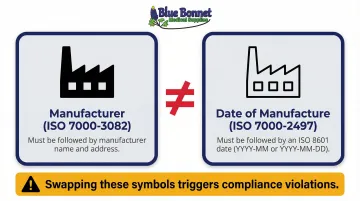
Swapping these symbols is a direct violation of ISO 15223-1 and can trigger traceability failures and customs holds.
MD Symbol: Medical Device Identification
The MD symbol (the letters "MD" in a box) was introduced under the EU Medical Device Regulation (MDR 2017/745) and identifies a product as a medical device for EU market distribution. This is mandatory for European compliance and should not be confused with "MD" as an abbreviation for a physician—on packaging, it always refers to the product classification.
LOT and REF Symbols
- LOT: The batch number assigned by the manufacturer — used to trace products through recalls, quality investigations, and supply chain audits
- REF: The manufacturer's catalog or reorder number identifying the specific device model
UDI: Unique Device Identifier
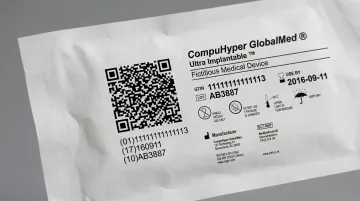
The UDI symbol appears as a barcode or data matrix carrier and contains two parts:
- Device Identifier (DI): Fixed portion identifying the specific version/model and labeler
- Production Identifier (PI): Variable portion identifying lot/batch, serial number, expiration date, and/or manufacturing date
The FDA requires UDI on most medical device labels under 21 CFR Part 830, with phased implementation based on device class. UDIs must be issued by an FDA-accredited agency—currently GS1, HIBCC, and ICCBBA. In the EU, UDI is required under MDR 2017/745.
Manufactured By vs. Manufactured For
Critical distinction: "Manufactured By" identifies the actual production facility, while "Manufactured For" identifies the brand owner or distributor who commissioned production.
Under FDA regulations (21 CFR 801.1), if the device is not manufactured by the person whose name appears on the label, that name must be qualified — for example, "Manufactured for ___" or "Distributed by ___." Getting this wrong shifts regulatory accountability to the wrong party and can stall a recall response.
Date, Lifecycle & Storage Symbols
These symbols communicate when a device was made, when it expires, and how it must be stored to maintain integrity.
Use-by / Expiry Date (Hourglass Icon)
The hourglass icon (ISO 7000-2607) indicates the date after which the device must not be used. It is mandatory for sterile and disposable medical devices and one of the most universally recognized symbols in the field.
Dates must appear in ISO 8601 format (YYYY-MM or YYYY-MM-DD) to eliminate confusion between US (MM/DD/YYYY) and European (DD/MM/YYYY) conventions.
Date of Manufacture
The outlined factory icon with a date beside it indicates when the device was produced. The date typically appears as year then month (e.g., 2024-03). The manufacture date supports shelf-life tracking and compliance with storage validation studies.
Period After Opening (PAO) — The 24M Symbol
Important clarification: The PAO symbol (an open jar icon followed by a number and the letter M, such as 12M or 24M) indicates the number of months the product remains safe to use after the package has been opened. Key context for this symbol:
- Originates from EU Cosmetics Regulation 1223/2009, not ISO 15223-1
- Not an official medical device symbol under ISO 15223-1
- Most common on combination products or devices with chemical components (for example, diagnostic reagents)
- Rarely appears on purely mechanical devices
Temperature Limit Symbol
The thermometer icon with upper and lower temperature values indicates the acceptable storage temperature range for the device. Storage condition violations can compromise device integrity and sterility. ISO 20417 requires that packaging indicate any special handling measures or storage conditions.
Keep Dry Symbol
The package under an umbrella with rain lines indicates the device must be protected from moisture. Moisture exposure can compromise sterile barriers and degrade moisture-sensitive components.
Country of Manufacture
This symbol identifies the country where the device was produced, relevant for import/export documentation and customs compliance.
FDA device labeling regulations don't explicitly mandate a "Made in [Country]" statement. However, US Customs and Border Protection (CBP) strictly enforces 19 U.S.C. 1304, requiring every article of foreign origin entering the US to be legibly marked with the English name of the country of origin.
Sterility & Safety Symbols
These symbols communicate sterilization status, reuse restrictions, and package integrity — and misreading any one of them can create compliance problems or patient safety risks.
STERILE Symbol Variants
The STERILE symbol indicates the device has been sterilized, but the letter following it identifies the method:
- STERILE EO (ISO 7000-2501): Sterilized using ethylene oxide (ISO 11135)
- STERILE R (ISO 7000-2502): Sterilized using irradiation (ISO 11137-1)
- STERILE A (ISO 7000-2500): Sterilized using aseptic processing techniques
- STERILE H (ISO 7000-2503): Sterilized using steam or dry heat (ISO 17665 or ISO 20857)
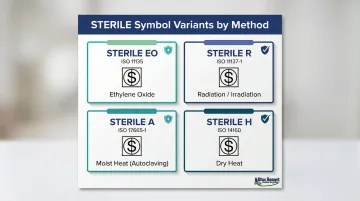
Knowing the sterilization method matters for clinical use and device material compatibility.
Non-Sterile Symbol
The NON-STERILE symbol (the letters "NON" above "STERILE") indicates the device has not undergone a sterilization process. Note that the absence of a sterile symbol does not automatically mean non-sterile. That declaration requires the non-sterile symbol to be present on the label.
Do Not Resterilize
The circle with a stylized re-sterilization reference crossed out means the device is validated for a single sterilization cycle only. Resterilizing can degrade materials, compromise structural integrity, or create toxic residues.
Do Not Reuse / Single Use
The number "2" inside a circle with a line through it (ISO 7000-1051) means the device is intended for a single patient in a single procedure. Key regulatory points to know:
- Reuse creates patient safety risks including cross-contamination
- Prohibited by regulatory standards in most markets
- In the US, the FDA holds third-party reprocessors of single-use devices to the same standards as the original manufacturer
Do Not Use If Package Is Damaged
The package with a broken/open edge and a prohibition mark instructs users to discard the device if the sterile barrier has been compromised. A damaged package means sterility can no longer be guaranteed — even if the device itself appears intact.
Regulatory & Compliance Marks
These symbols indicate conformity with regional health, safety, and environmental standards.
CE Mark
The CE Mark indicates conformity with EU health, safety, and environmental standards under the applicable EU directive or regulation — for medical devices, that's MDR 2017/745. It's not an endorsement by a single body; it's a manufacturer's declaration of conformity.
Key labeling requirements include:
- Minimum 5mm height with proportional lettering
- A four-digit notified body number (when present) confirms an independent body verified the conformity assessment
Caution / Attention Symbol
The exclamation mark inside a triangle (ISO 7000-0434A) signals that the user must read accompanying documentation before use. Manufacturers often pair it with the Consult Instructions for Use symbol (a stylized book with a figure), which directs users to the IFU for critical usage information.
In the US, the Caution symbol with specific text ("Federal law restricts this device to sale by or on the order of a licensed practitioner") functions as the Prescription Only / Rx designation under 21 CFR 801.109.
Authorized Representative Symbols
When a manufacturer is located outside the target market, they must appoint a local representative:
- EU REP: Authorized Representative in the EU (required under MDR Article 11 for non-EU manufacturers)
- UK REP: UK Responsible Person (required by MHRA for UKCA mark compliance)
- CH REP: Swiss Authorized Representative (required by Swissmedic for non-Swiss manufacturers)
Each symbol identifies who is legally accountable for the device in that market — a critical detail for packaging labels and import compliance.
Why Symbol Compliance Matters for Distributors and Shippers
Incorrect, missing, or non-standard symbols on medical device packaging can trigger customs holds, regulatory violations, or product rejections at borders—particularly for international shipments. Regulatory agencies in destination countries require specific symbols to be present, legible, and compliant with local standards.
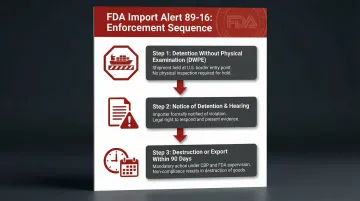
Real enforcement consequences: In a January 2025 Warning Letter to Robbins Instruments, the FDA cited the firm for misbranding under Section 502(t)(2) of the FD&C Act because they failed to submit required UDI information to the Global Unique Device Identification Database (GUDID). Non-compliant devices reaching the US border face immediate action under FDA Import Alert 89-16:
- Detention Without Physical Examination (DWPE) — shipment held without inspection
- Notice of Detention and Hearing — importer formally notified of labeling violation
- Destruction or export within 90 days — required under CBP and FDA supervision if the FDA rejects reconditioning or it fails twice
For businesses shipping medical products domestically or internationally, these aren't edge-case risks — they're operational realities. Working with a logistics partner that understands FDA, ISO, and GMP requirements keeps products moving. Bluebonnet Medical Supplies builds compliance directly into its warehousing and fulfillment operations, so labeling standards, documentation, and handling procedures meet what regulators actually check.
Symbol compliance, in other words, isn't separate from logistics — it's embedded in every step of how a product moves.
Frequently Asked Questions
What does a factory symbol mean?
The factory/building icon represents either the manufacturer (filled/black version, followed by name and address) or the date of manufacture (outlined/white version, followed by an ISO 8601 date). Confusing the two is a common compliance mistake with real regulatory consequences.
What does MD mean on packaging?
"MD" in a box on medical device packaging stands for "Medical Device," as defined under EU MDR 2017/745. It identifies the product's regulatory classification for the European market—not a reference to a physician. This symbol is mandatory for EU compliance.
What does the 24M symbol mean?
The 24M symbol (an open jar with "24M") indicates the Period After Opening—the product is safe to use for 24 months after first opening. The number varies based on validated shelf life. Worth noting: this symbol originates from cosmetics regulations and is not an official ISO 15223-1 medical device symbol.
What is the format for manufacture date?
Manufacture dates on medical device labels follow ISO 8601 format—typically YYYY-MM or YYYY-MM-DD (year, then month, then optionally day). This standardized format ensures global readability regardless of regional date conventions.
Is the UDI symbol required?
Yes—the FDA requires UDI on most US device labels under 21 CFR Part 830 (phased by device class), and the EU mandates it under MDR 2017/745. The UDI symbol (barcode or data matrix) carries the Device Identifier (DI) and Production Identifier (PI).
What does manufactured for mean on a label?
"Manufactured For" identifies the brand owner or distributor who commissioned production, as opposed to "Manufactured By," which names the actual production facility. FDA regulations (21 CFR 801.1) require this distinction for traceability when the labeler and manufacturer are different entities.