Introduction
Medical product businesses often focus on perfecting devices and scaling sales, while overlooking the compliance requirements governing how products are stored, labeled, and shipped. This gap exposes them to customs seizures, platform bans, and regulatory penalties that can shut down operations overnight.
According to the FDA's 2023 establishment data, over 28,000 medical device entities are registered in the U.S. alone — each navigating the same strict web of federal requirements.
Healthcare compliance isn't just for hospitals and clinics. It applies to every business that touches medical products—manufacturers, Amazon sellers, distributors, and 3PLs. One mislabeled shipment or missing certification can trigger customs holds, retailer rejections, or loss of marketplace access.
What follows covers which laws apply, why they matter for your bottom line, and how to stay compliant without drowning in red tape.
TLDR
- Healthcare compliance means following federal, state, and industry regulations governing medical product handling, distribution, and data privacy
- Key laws span FDA quality standards, HIPAA, and anti-fraud statutes like the False Claims Act
- Non-compliance triggers fines, shipment seizures, platform bans, and loss of market access
- Best practices: embed compliance into daily operations, train staff regularly, audit procedures, and partner with a compliant 3PL for storage, handling, and shipping
What Is Healthcare Compliance?
Healthcare compliance is the continuous process of adhering to federal, state, and local laws, regulations, and ethical standards governing the healthcare industry. It covers everything from patient data privacy and billing integrity to product storage, labeling, and distribution. Compliance isn't a one-time checklist—it's an ongoing framework that applies to hospitals, clinics, manufacturers, distributors, and logistics providers alike.
Two Sides of Compliance:
- Clinical compliance: Patient care standards, billing ethics, treatment protocols
- Operational compliance: Product storage conditions, packaging accuracy, shipping documentation, labeling requirements
Medical product businesses primarily deal with operational compliance. The stakes are high: compliance failures result in fines, shipment delays at customs, inability to sell on platforms like Amazon, and reputational damage that can permanently block access to the healthcare market.
The FDA's Quality Management System Regulation (QMSR), effective February 2, 2026, brings packaging, labeling, storage, and initial distribution under formal quality requirements.
Distributors and 3PLs now share direct accountability for compliance. For medical product businesses, that means compliance determines whether you can operate, sell, and ship—not just whether you pass an audit.
Key Healthcare Compliance Laws and Regulations
There is no single "healthcare compliance law." Instead, businesses navigate a web of overlapping federal and industry regulations simultaneously. Here are the critical frameworks for medical product businesses:
FDA Quality Management System Regulation (QMSR)
The FDA regulates how medical devices must be manufactured, labeled, packaged, and distributed. The QMSR (21 CFR Part 820) governs methods, facilities, and controls for design, manufacture, packaging, labeling, storage, installation, and servicing of finished devices.
Coverage extends beyond original manufacturers. Those performing relabeling, remanufacturing, repacking, or specification development fall under QMSR—as do initial distributors of foreign entities performing these functions.
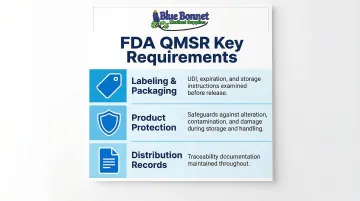
Key requirements:
- Labeling and packaging must be examined for accuracy (UDI, expiration, storage instructions) before release
- Products must be protected from alteration, contamination, or damage during storage and handling
- Distribution records and traceability documentation must be maintained
Good Manufacturing Practice (GMP)
GMP guidelines ensure medical products are consistently produced and controlled according to quality standards. GMP covers facilities, equipment, documentation, and personnel practices. For distributors and 3PLs, GMP principles apply to storage conditions, handling procedures, and environmental controls that prevent product degradation or contamination.
ISO 13485 for Medical Devices
ISO 13485:2016 provides an internationally recognized quality management framework ensuring products are safe and meet regulatory requirements across global markets.
The standard applies to any organization involved in one or more life-cycle stages — including storage and distribution. For distributors, that means specific obligations:
- Monitor outsourced processes (such as 3PLs) proportionate to risk
- Maintain written quality agreements with logistics partners
- Keep supplier evaluation records on file
HIPAA (Health Insurance Portability and Accountability Act)
HIPAA applies to any business that handles individually identifiable health information—even indirectly. This includes 3PLs and distributors handling patient-linked records or returns. HHS guidance clarifies that the "conduit exception" is limited to transmission-only services where access to PHI is strictly transient.
If a 3PL processes returns with patient names or stores photos of defective devices linked to patients, they have persistent access and qualify as a Business Associate. That triggers a Business Associate Agreement (BAA) requirement and full HIPAA Security Rule safeguards.
False Claims Act and Anti-Kickback Statute
These laws apply to any party in the healthcare supply chain receiving federal program payments. The False Claims Act prohibits submitting claims for payment to Medicare or Medicaid that you know or should know are false—with liability including treble damages (3x the program's loss) plus civil penalties.
The Anti-Kickback Statute separately prohibits knowingly paying remuneration to induce or reward patient referrals or business reimbursable by federal health programs.
Recent enforcement actions underscore the risk. In 2025, Semler Scientific and Bard Peripheral Vascular paid nearly $37 million to resolve False Claims Act allegations relating to device tests falsely claimed as reimbursable by Medicare. Distributors need to carefully vet pricing arrangements, marketing services, and reimbursement language. Practices that are routine in other industries can trigger federal prosecution in healthcare.
Why Healthcare Compliance Matters for Medical Product Businesses
Direct Financial Risk
Non-compliant products face immediate consequences: seizure at customs, rejection by retailers, or removal from platforms like Amazon. The FDA maintains an Import Refusals Report, updated daily, publicly listing shipments refused entry due to misbranding, lack of clearance, or registration failures. One missing certification can halt an entire product line at the border.
Market Access Gatekeepers
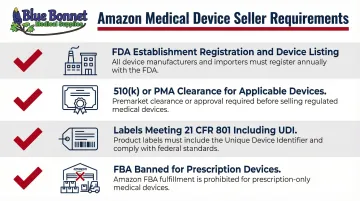
Major distributors, hospitals, and online marketplaces require vendors to demonstrate regulatory compliance before they'll carry or list products. Amazon's medical device policies set a clear bar for sellers:
- FDA establishment registration and device listing required
- 510(k) or PMA clearance mandatory for applicable devices
- Labels must meet 21 CFR 801 requirements, including UDI
- FBA is banned for prescription devices, shifting storage and distribution responsibility to sellers and their 3PL partners
Similarly, Group Purchasing Organizations like Vizient expect suppliers to meet cGMP/QSR (21 CFR 820) and maintain robust quality systems, requiring UDI compliance and evaluating FDA inspection history and recalls.
International Shipping Complexity
Cross-border shipments of medical products face strict customs and import regulations. Proper compliance documentation — labels, certifications, handling protocols — is essential to avoid delays or confiscation. The FDA requires all imported devices to meet the same standards as domestic products. Foreign partners must also designate a U.S. Agent and complete proper device listings before importing.
Supply Chain Responsibility
Compliance doesn't end at manufacturing. How a product is stored, packed, and shipped is also subject to FDA regulation. Businesses outsourcing logistics must ensure their 3PL partners maintain the same regulatory standards through every step of fulfillment. Bluebonnet Medical Supplies holds FDA, ISO, GMP, and HIPAA-safe handling compliance — so medical product businesses have a 3PL partner that protects their regulatory standing from warehouse to final delivery.
Who Is Responsible for Healthcare Compliance?
In clinical settings, compliance responsibility falls on the entire organization—from executives to frontline staff—often led by a designated compliance officer who monitors adherence to regulations.
For medical product businesses, the picture is similar but extends further down the supply chain. Owners, operations managers, and logistics partners all share compliance responsibility. No single role owns it in isolation, which is why compliance must be built into standard operating procedures rather than treated as a separate function.
Key oversight bodies for medical product companies:
- The FDA Office of Regulatory Affairs (ORA) conducts field inspections and import oversight, prioritizing products that pose the highest risk to consumers
- The Office of Inspector General (OIG) enforces fraud and abuse statutes and issues advisory opinions to help businesses assess compliance risk
- State agencies in over 30 states require licensure to distribute medical devices, with varying fee structures and renewal timelines
Healthcare Compliance Best Practices
Conduct Regular Compliance Audits
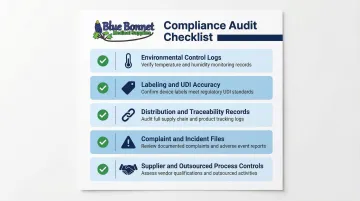
Periodically review operations—from product storage conditions to labeling accuracy to data handling—against current regulatory requirements. Update procedures accordingly. Audits should cover:
- Environmental control logs for storage areas
- Labeling and UDI accuracy on packaging
- Distribution and traceability records
- Complaint and incident files
- Supplier and outsourced process controls
Train All Staff and Partners
Compliance only works if everyone in the chain understands their obligations. Training should:
- Cover regulations specific to each role—warehouse staff need GMP and storage protocols, while shipping teams focus on FDA labeling and documentation
- Be refreshed when laws or internal policies change
- Include practical scenarios and consequences of non-compliance
- Extend to outsourced partners and suppliers
Document Everything
Training tells people what to do. Documentation proves they did it. Regulatory bodies expect verifiable records, so maintain detailed logs of:
- Storage conditions and environmental monitoring
- Handling procedures and deviations
- Shipment documentation and consignee records
- Certifications and quality agreements
- Incidents, complaints, and corrective actions
Thorough records keep audits manageable and give you a clear paper trail if questions come up. FDA regulations also set specific retention minimums: complaint records must be kept for 2 years or the expected life of the device (whichever is greater), and distribution records for 3 years for certain products.
Frequently Asked Questions
What is compliance in simple terms?
Compliance means following the rules, laws, and standards that govern a specific industry. In healthcare, this means meeting requirements designed to protect patients, ensure product safety, and prevent fraud.
What are the 7 elements of compliance?
The OIG identifies seven core elements of an effective compliance program:
- Written policies and procedures
- Designated compliance officer and committee
- Training and education
- Open lines of communication
- Internal monitoring and auditing
- Enforcement and discipline
- Prompt response to detected issues
What is doctor compliance?
Often called patient adherence, doctor compliance refers to how well patients follow their provider's instructions—such as taking prescribed medications as directed. This is separate from the organizational regulatory compliance that governs businesses.
What happens if a medical product company fails to comply with healthcare regulations?
Consequences include fines and legal penalties, shipment seizures or customs holds, removal from retail platforms, loss of FDA clearance or certification, and reputational damage that can permanently affect market access.
How does FDA compliance affect medical product distribution?
FDA compliance dictates how medical products must be packaged, labeled, stored, and shipped. Non-compliant products can be detained at customs, recalled, or barred from sale, making FDA-cleared logistics handling essential for any medical product business.